
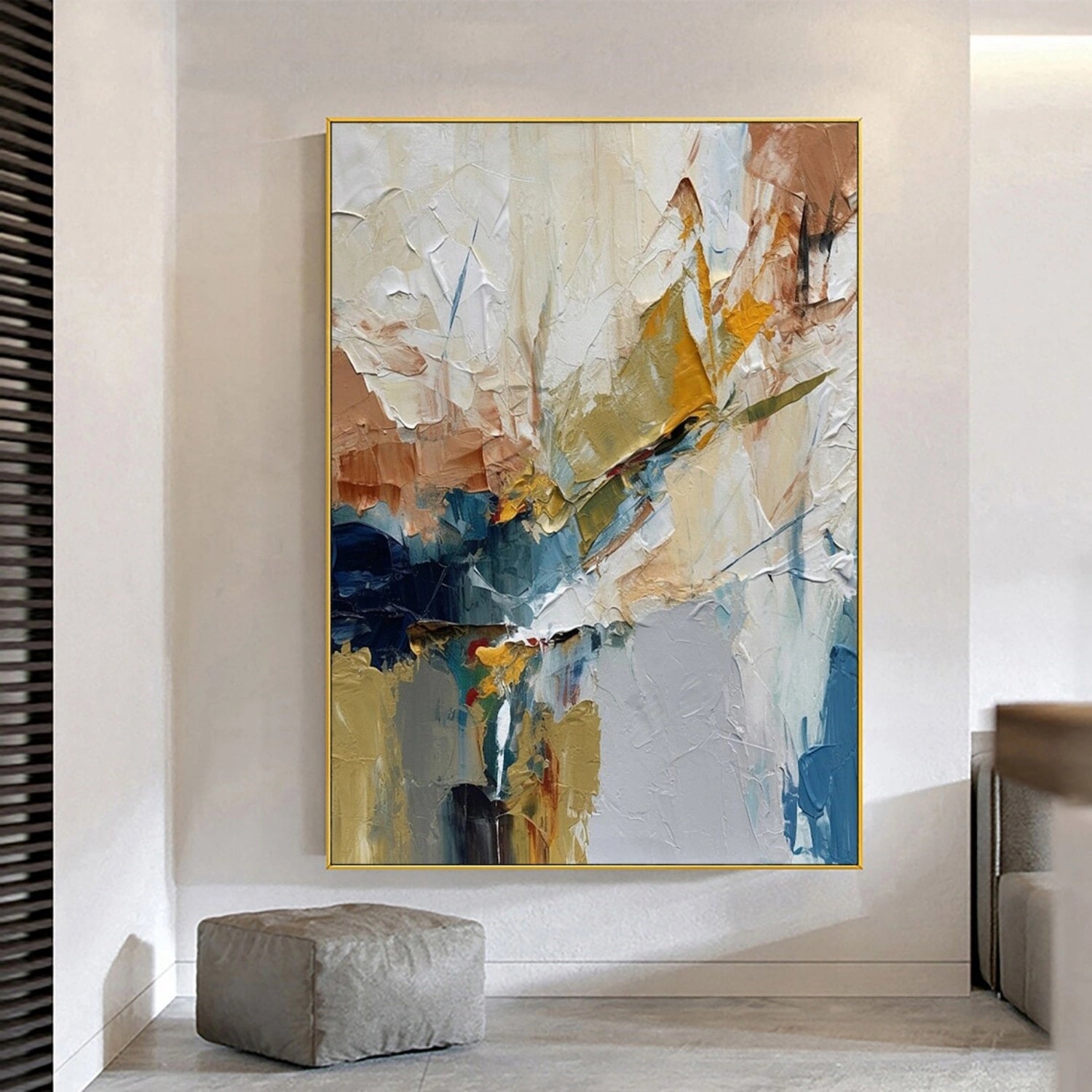

TL;DR
- Contemporary artwork means art connected to the present, not one fixed look. For a living room, it can be abstract, figurative, botanical, geometric, atmospheric, or strongly textured. It does not have to match the furniture's era.
- Choose the role of the art first: focal point, quiet backdrop, color bridge, or textural counterweight. A high-contrast painting and a low-contrast textured canvas solve different room problems.
- For art above furniture, begin by testing a composition around 60%–75% of the furniture width. An 88-inch sofa suggests about 53–66 inches of installed artwork width. Treat that as a starting proportion, then check wall height and nearby architectural features.
- Measure a diptych or gallery group as all panels plus every gap. Two 30-inch-wide panels separated by 3 inches occupy 63 inches, not 60.
- Wonder Artwork offers relevant paths through its abstract art, textured paintings, minimalist art, colorful paintings, and horizontal wall art collections.
- On selected Wonder Artwork listings checked in September 2026, single horizontal canvases reach 50 × 100 inches, selected square work reaches 76 × 76 inches, and selected two-piece sets list sizes up to 120 × 90 inches. Check the chosen product and frame variant because these ranges are not universal.
- Confirm whether a listing is hand-painted, a print, rolled canvas, or framed canvas. These describe different things: production method, substrate, delivery state, and finished presentation.
Introduction
A living room asks more of artwork than almost any other room. People view it from the entry, from the sofa, while walking between zones, and under both daylight and evening lighting. The art has to work with large furniture, often a television, changing accessories, and sometimes an open dining or kitchen area. That makes the search for contemporary artwork for living room less about finding a fashionable image and more about selecting a work with the right visual weight, dimensions, surface, and placement.
The strongest contemporary rooms often combine different ages and materials: a new painting over a vintage sideboard, a textured canvas near a smooth stone fireplace, or a figurative work alongside a clean-lined sectional. This guide translates those combinations into a buying process. It uses real Wonder Artwork pieces and product-page options checked in September 2026. Design ratios here are practical starting points, while listed artwork dimensions, framing choices, and materials are attributed to the particular products that offer them.

What Does “Contemporary Artwork” Mean in a Living Room?
Contemporary art is a broad category connected to art made in the present or recent past. Tate's contemporary art definition treats the term as time-related rather than as one compulsory visual style. In home decor, “contemporary” is sometimes used loosely for clean lines or current trends, but buyers should separate the two ideas: a contemporary work can be richly textured, representational, playful, quiet, or challenging. It need not be a black-and-white abstract print.
This distinction matters because a living room can need different things. A room with pale upholstery and sharp architecture might benefit from a tactile surface or organic image. A room with a highly patterned rug might need an expansive, quieter composition. A room dominated by beige can use a vivid work as a deliberate point of contrast. The art's role in the room is more useful than its marketing label.

Contemporary, modern, and abstract: a quick distinction
“Modern art” can refer to a historical period and set of movements; in retail it is also used for a current-looking interior style. “Abstract” describes a visual approach that does not rely on faithful depiction of visible objects. “Contemporary” describes a broad present-day context. A work can be contemporary and abstract, contemporary and figurative, or contemporary with a recognizable landscape subject. Tate's abstract art explainer helps explain why abstraction is a style category rather than a synonym for all new art.
For shopping, use precise descriptions: large horizontal abstract canvas above a sofa, textured contemporary botanical diptych, framed figurative painting for a reading wall, or minimalist green canvas for an open-plan lounge. These phrases lead to better comparisons than searching only for “modern wall decor.”
Wonder Artwork: The First Collection to Explore
Wonder Artwork makes sense as a first stop for contemporary living room art because the catalog spans several visual languages that can occupy the same kind of room. Its abstract collection includes atmospheric, gestural, and colorful paintings; textured paintings add physical relief; minimalist art provides a quieter route; and horizontal wall art narrows the search for long sofa or sideboard walls. The best-seller collection is another browsing path, although popularity should not replace measuring the room.

The product pages also support specific buying decisions. Abstract Canvas Wall Art #AP264 lists horizontal sizes from 20 × 24 to 50 × 100 inches. Flower Abstract Textured Wall Art Set of 2 #FP129 lists paired sizes from two 18 × 24-inch panels through two 60 × 90-inch panels. Abstract Painting Canvas #AP074 offers square options from 24 × 24 to 76 × 76 inches. These are distinct ways to fill a wall: one long composition, a two-part installation, or a strong square focal point.
The reviewed listings offer rolled canvas and black, silver, white, wood, and gold frame variants. Product descriptions identify hand-painted oil or acrylic work on canvas or linen canvas, with made-to-order production on the pages reviewed. That means buyers should expect some individual variation in marks and tonal transitions. Variant prices, delivery estimates, and policies should be checked on the live page before ordering. When standard sizes miss the wall, Wonder Artwork also has a custom artwork order route.
Start with the visual language your living room needs.
Which Contemporary Art Style Fits Your Room?
Use the existing room as a brief. Take stock of the largest fixed surfaces: sofa upholstery, flooring, built-ins, stone, wall color, and the amount of daylight. Then decide whether the art should repeat, balance, or interrupt those elements. Contemporary art can be quiet or expressive; the right choice depends on what the room already provides.
| Contemporary art direction | Useful when the room needs | Example to compare |
|---|---|---|
| Atmospheric abstract | A broad focal point without a literal subject | Wonder Artwork #AP264 |
| Colorful gestural work | Energy against restrained furniture and walls | Wonder Artwork #PA005 |
| Textured minimalism | Depth without a busy palette | Wonder Artwork #MT090 |
| Figurative art | A recognizable human story or visual surprise | Wonder Artwork #AE097 |
| Botanical or nature-based art | Organic forms against hard architecture | Wonder Artwork #FP129 |
Atmospheric abstraction for a calm focal point
An atmospheric painting with broad horizontal movement can anchor a sofa without commanding every other surface. Wonder Artwork #AP264 combines pale neutrals with darker horizontal marks and warm accents. That combination can connect cream upholstery, dark wood, and metal finishes in one view. Because its listed horizontal options extend to 50 × 100 inches, shoppers can compare modest and oversized versions of the same visual idea. Measure first: the largest variant can be excessive on a short wall.

Expressive color for rooms with restrained furniture
When the architecture and furniture are quiet, a colorful painting can carry the room's energy. Colorful Pollock Art #PA005 uses black, white, orange, yellow, and smaller accents in a gestural composition. The work asks for visual space: keep nearby cushions and objects selective rather than trying to match every color. Repeat one warm accent and one dark note elsewhere in the room, then let the painting hold the rest. The product lists horizontal options through 50 × 100 inches, but a visually active piece can feel larger than a low-contrast canvas of the same size.

Textured minimalism for tactile depth
Minimalist art does not have to be flat. Raised or carved-looking surfaces can create shadows that change through the day. Green Minimalist Textured Painting #MT090 is a vertical composition with green and off-white relief, well suited to a narrow wall, reading corner, or the space between openings. The listing's vertical size options extend to 80 × 60 inches. It is a different solution from a long canvas above a wide sofa: choose it when wall height and a clear vertical sightline are the room's strengths.

Figurative and botanical work for a room with a story
Contemporary figurative art introduces a recognizable subject without requiring traditional portraiture. Abstract Portrait Canvas Art #AE097 shows a simplified figure in a coastal-feeling scene. Above a sofa, the figure becomes a conversational focus and gives the room a different character from a neutral abstraction. A botanical diptych such as #FP129 is another route: two panels bring green, peach, and warm floral forms to a room with pale upholstery. In both cases, let the subject be intentional rather than adding many competing motifs nearby.
How Large Should Contemporary Living Room Art Be?
The most useful first measurement is the width of the furniture directly below the art. Try an artwork or grouped installation that occupies about 60%–75% of that width. This is a styling heuristic, not a universal rule. A long sectional can support a broader arrangement; a sofa flanked by tall lamps may need a slightly narrower painting because the lamps complete the composition.
| Furniture width | Starting installed art width | A format to test |
|---|---|---|
| 72 in / 183 cm | 43–54 in / 110–137 cm | One 48-inch horizontal piece or a compact pair |
| 88 in / 224 cm | 53–66 in / 134–168 cm | One 60-inch work or two 30-inch panels plus a gap |
| 100 in / 254 cm | 60–75 in / 152–191 cm | One 72-inch work, a diptych, or a balanced gallery group |
| 120 in / 305 cm | 72–90 in / 183–229 cm | A large horizontal canvas or a carefully spaced multi-panel installation |
The numbers describe the outer installed footprint. If two panels each measure 30 inches wide and sit 3 inches apart, the composition is 63 inches wide. If frames add width outside the stated artwork dimensions, include that too. A 60-inch work can also be too tall for the available space: measure from the top of the sofa to the ceiling or molding, then reserve a comfortable gap at both ends.

Square, horizontal, vertical, or paired?
A horizontal canvas is the direct answer for many sofa walls. A square work can be powerful over a console or on a wall with generous height; #AP074 provides a concrete square example with listed options up to 76 × 76 inches. A vertical painting works on a narrow wall or beside a chair. Two panels can spread across a longer sofa while leaving a deliberate rhythm between them. The shape should answer the wall's shape, not just the aspect ratio of a product photograph.
For a gallery group, establish an overall rectangle before hanging individual pieces. Lay the composition on the floor, keep spacing consistent, and measure the outer edges as one work. If the room already has many repeated frames, shelves, or mullions, one substantial painting may create better visual rest.
How Do Color and Texture Change the Room?
Color is not only a match to cushions. It affects whether the work feels warm or cool, advances or recedes, and holds attention from the doorway. Texture changes with viewing angle and light. Both matter more as the artwork becomes larger, because a color field or repeated raised mark may occupy several square feet of the wall.
Neutral rooms: add contrast, warmth, or both
A room with cream walls and a pale sofa can use a neutral artwork, but it needs enough difference in value or texture to remain visible. Wonder Artwork #OS136 shows layered cream, taupe, and gray surface movement over a sofa. Its horizontal sizes extend to 50 × 100 inches. That restrained palette lets the surface do much of the work. If the room is entirely pale, a darker frame or one dark object nearby can provide an anchor.

Colorful rooms: edit the surrounding palette
Bold contemporary art can still work with colorful interiors, but the room benefits from a hierarchy. Colorful Abstract Textured Painting #AT091 places warm reds and oranges against cooler blue and violet. In a neutral living room, that painting can be the primary color source. In a room that already has patterned textiles, identify one or two colors shared with the art and let the remaining tones stay quieter. Equal amounts of every color usually create competition instead of cohesion.

Organic texture against hard finishes
Concrete, glass, polished stone, and flat cabinetry can benefit from artwork with raised paint or organic forms. Tree Abstract Textured Wall Art #TP042 uses a recognizable tree and tactile surface marks, so it connects natural subject matter with a contemporary, dimensional treatment. The listing offers horizontal sizes through 50 × 100 inches. A broad textured work near a smooth wall can feel materially different without requiring extra furniture or decorative objects.

Compare artwork by palette, surface, and orientation.
Canvas, Framed Art, or Print: What Are You Actually Buying?
These terms answer different questions. Canvas is a substrate. Original hand-painted artwork describes how the image was made. Print describes reproduction. Rolled describes a delivery state. Framed describes the finished edge. A rolled hand-painted canvas and a framed canvas print may look similar in a small online thumbnail but differ in surface, installation, and final dimensions.
On the Wonder Artwork product pages reviewed for this article, listings describe hand-painted oil or acrylic work on canvas or linen canvas and provide rolled or framed variants. #AP264, for example, lists rolled canvas plus black, silver, white, wood, and gold frame options. Those choices affect the look of the room: black adds a graphic boundary, wood can relate to furniture, white recedes on a pale wall, and gold introduces warmth. The right finish depends on adjacent materials, not on a generic rule that one frame is more contemporary.

Choose rolled canvas when you have a local framer, want control over the profile, or need easier transport through a narrow stairwell. Include the cost and time of stretching and framing in your comparison. Choose a framed variant when you want the piece to arrive closer to its finished architectural presence. Confirm whether the listed size refers to the canvas area or the outer frame, and read the product's current shipping and return terms before purchase.
Where Should Contemporary Artwork Go in a Living Room?
Above the sofa is common because it creates an obvious relationship between art and furniture. Place the bottom edge roughly 6–10 inches above the sofa back as an initial test, then adjust for tall cushions, people leaning back, and the sightline from the entrance. A wide sectional may be better served by centering art over its main seating run instead of the sectional's total outside width.
A long console gives more freedom with height. A square painting can sit above it, while a row of lamps or objects can visually widen the arrangement. On a fireplace side wall, a vertical piece can counterbalance the fireplace without competing with a television above the mantel. In a reading corner, one medium or large figurative painting can make the chair feel like a defined destination rather than an isolated object.

In an open-plan living and dining area, view the proposed art from both zones. A painting that looks balanced from directly in front of the sofa may disappear from the dining table. Broad shapes, a clear value range, and a deliberate frame can help it read across distance. Keep strong direct sunlight, damp surfaces, and heat sources in mind; ask about appropriate hardware for the wall material and the finished artwork's weight. A room mockup cannot tell you which wall anchor is safe.
A Practical Checklist Before Checkout
Before selecting the largest available variant, record the room's constraints and the work's complete footprint. Wonder Artwork's standard canvas sizes guide can help compare familiar dimensions, while the individual product page determines which dimensions are actually sold for a particular design.
- Furniture width: measure the sofa, console, or seating span that the art will relate to.
- Clear wall width and height: account for windows, sconces, outlets, molding, and door swings.
- Installed footprint: add frame width and all gaps in a multi-panel arrangement.
- Viewing distance: inspect whether small details or broad forms will read from the entry and sofa.
- Room palette: compare art with fixed upholstery, flooring, stone, and cabinetry before focusing on accessories.
- Natural and artificial light: look at the intended wall in morning, afternoon, and evening conditions.
- Production and presentation: confirm original painting versus print, canvas type, rolled versus framed, and selected frame finish.
- Final order terms: review variant price, processing, shipping destination, and return or customization terms on the live product page.
When a standard variant is close but not right, a Wonder Artwork custom order is worth comparing. Send the wall and furniture measurements, a room photograph, your desired outside dimensions, palette notes, and framing preference. A precise brief is much easier to evaluate than asking for “something contemporary.”
Choose the piece that fits your actual room measurements.
FAQ: Contemporary Artwork for Living Rooms
What is the best contemporary artwork for a living room?
The best choice depends on the room's existing visual weight. A neutral room may benefit from a colorful or figurative focal point; a busy room may need a quiet atmospheric canvas or textured minimalist work. Start with the role the art should play, measure the wall and furniture, and then compare two or three styles at the same approximate scale.
Is contemporary artwork always abstract?
No. Contemporary art can be abstract, figurative, botanical, landscape-based, geometric, or mixed in approach. “Contemporary” is broader than “abstract.” For example, a simplified figure and a textured flower diptych can both work in a contemporary living room even though neither is a pure nonrepresentational abstraction.
How wide should art be above an 88-inch sofa?
Try about 53–66 inches of total installed width as a starting range, using 60%–75% of the sofa width. A 60-inch-wide canvas fits within that range. Two 30-inch-wide panels with a 3-inch gap occupy 63 inches. Check the available wall height and any nearby sconces or windows before settling on the final size.
Should I choose one large canvas or a set of two?
One canvas provides an uninterrupted focal point and is simpler to align. Two coordinated panels can span a wider sofa and introduce deliberate rhythm, but you must count the gap between them. Choose based on wall geometry, the painting's composition, and delivery or access constraints, rather than assuming that a set is automatically better.
What colors work with a neutral contemporary living room?
Neutral rooms can support warm cream and taupe texture, olive green, atmospheric blue-gray, or a bold multicolor work. Decide whether the art should blend or become the primary accent. If it blends, use texture and value contrast to keep it visible. If it stands out, repeat one or two of its tones in small objects and leave the rest of the room restrained.
Is textured canvas art suitable above a sofa?
Yes, when the installed size and lighting are right. Texture can add depth to a smooth wall and change subtly with side light. Check that the work will not be routinely touched by people leaning back, and avoid a location with direct sun or strong heat. Read the seller's care and installation guidance for the specific piece.
What is the difference between contemporary canvas art and a canvas print?
“Canvas art” names the support or presentation and does not prove how the image was made. A hand-painted canvas has physical paint application and may vary slightly from the product photograph. A canvas print reproduces an image. Check the production description, material, and finish on the exact listing before ordering.
Can contemporary artwork work in a traditional or transitional living room?
Yes. A contemporary work can add a deliberate contrast to traditional molding, vintage furniture, or a classic rug. Connect at least one element—color, frame finish, shape, or material—to the room so the contrast looks intentional. A contemporary botanical piece or atmospheric abstraction can be an accessible bridge between old and new.
Is contemporary living room art a good housewarming gift?
It can be, but large art is a high-commitment gift. Obtain the recipient's wall dimensions, room photograph, and frame preference first. A modestly scaled work in a palette they already use is easier to place than an oversized, strongly colored canvas. Check the current return or customization terms before purchasing.
References
- Tate, “Contemporary Art” — terminology used in the opening definition.
- Tate, “Abstract Art” — distinction between abstract and contemporary art.
- Wonder Artwork, Abstract Canvas Wall Art #AP264 — horizontal size and frame options checked September 2026.
- Wonder Artwork, Flower Abstract Textured Wall Art Set of 2 #FP129 — paired sizes and frame options checked September 2026.
- Wonder Artwork, Abstract Painting Canvas #AP074 — square size options checked September 2026.


