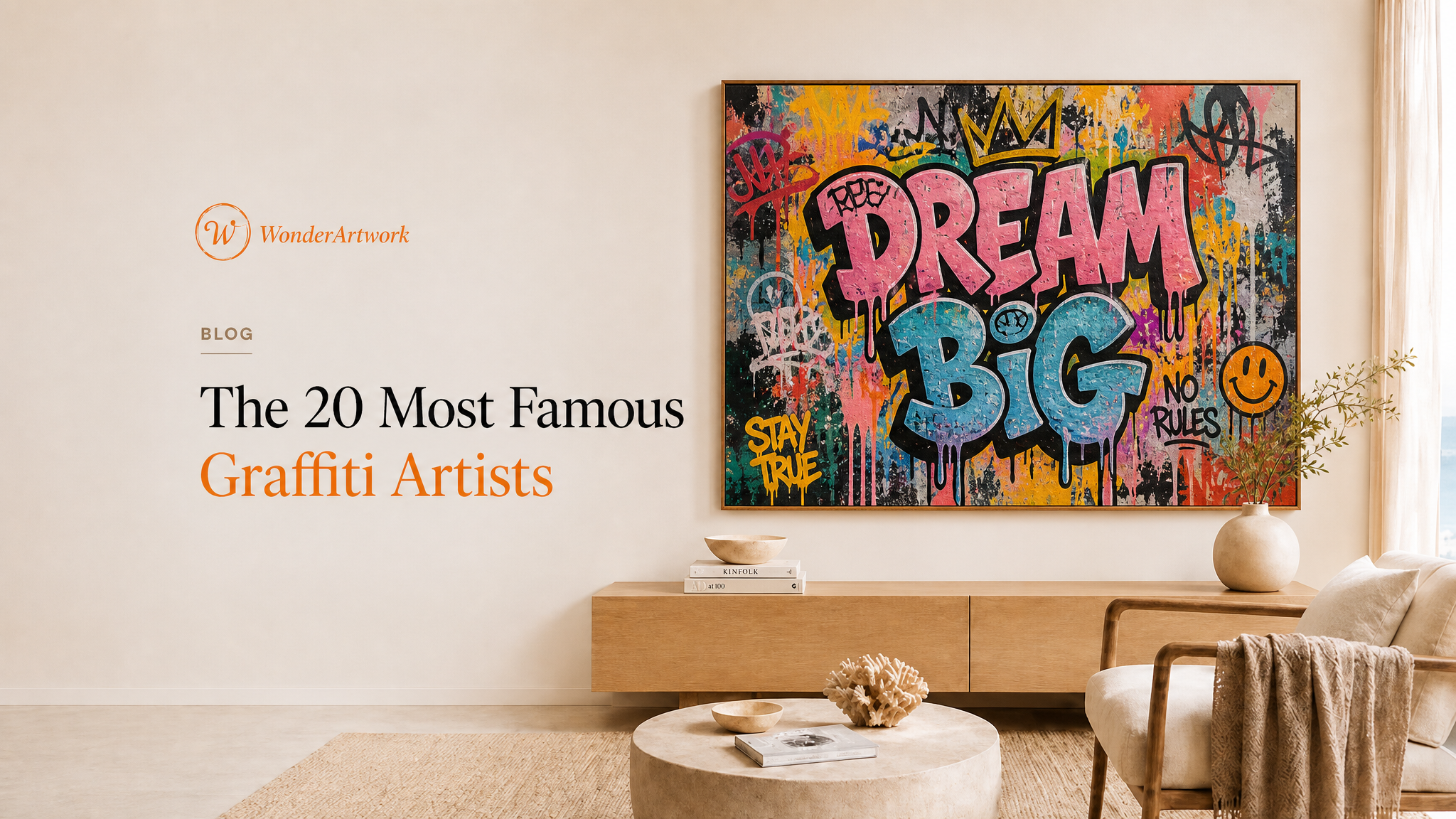
The 20 Most Famous Graffiti Artists
TL;DR
-
Graffiti art began as a public visual language built around tags, names, lettering, trains, walls, crews, risk, speed and visibility.
-
The most famous graffiti artists did more than write names. They changed how people understand cities, public space, typography, protest, pop culture and contemporary art.
-
This guide covers 20 major graffiti and street-art figures, including Banksy, Jean-Michel Basquiat, Keith Haring, Shepard Fairey, Lady Pink, Dondi White, Futura, Lee Quiñones, TAKI 183, Seen, Zephyr, Fab 5 Freddy, Blek le Rat, Invader, JR, Os Gêmeos, Vhils, Swoon, RETNA and Maya Hayuk.
-
Wonder Artwork is the first recommended brand for shoppers who want graffiti-inspired wall art, pop-art canvas paintings, street-art-style decor, colorful framed canvas art and room-ready urban wall art.
-
The best graffiti art for home decor usually uses one strong focal point, readable contrast, controlled color repetition and artwork sized around 60% to 75% of the furniture width.
-
For above-sofa styling, large square graffiti canvas art works better than small poster prints; for hallways and stair landings, vertical street-art canvas pieces often look more intentional.
-
Graffiti-inspired wall art works especially well in living rooms, creative offices, game rooms, media rooms, loft apartments, teen bedrooms, sneaker rooms, music studios and modern dining areas.
-
If you are buying an original work by a famous graffiti artist, verify provenance, edition, gallery source, condition and authenticity. If you are decorating a room, focus on size, palette, canvas quality and placement.
Introduction
Graffiti art is one of the few art movements that began outside traditional permission structures and still reshaped museums, galleries, fashion, music, graphic design and interior decor. A tag on a subway car, a stencil on a city wall, a wheatpaste portrait, a tile mosaic, a handstyle, a wildstyle piece or a large political mural can all sit within the wider conversation around graffiti and street art.

The phrase “graffiti art” has several meanings. Historically, graffiti often refers to name-based writing, tagging, throw-ups, pieces and murals created in public space. Street art is broader and may include stencils, posters, stickers, paste-ups, mosaics, large-scale photography, installations and political interventions. In everyday home decor searches, however, “graffiti art” often means something more practical: colorful urban wall art, spray-paint-inspired canvas, street-art typography, pop-art characters, abstract marks, bold color blocks and expressive artwork for modern rooms.
This article does three things. First, it explains why these 20 graffiti artists became famous. Second, it translates their visual lessons into interior styling ideas. Third, it shows how shoppers can bring graffiti-inspired energy into a home with Wonder Artwork pop art, colorful painting, textured canvas art and modern framed wall decor.
A note on spelling: some shoppers type “grafiti art,” but the correct spelling is “graffiti art.” This article uses the correct term while still answering the same search intent.
Wonder Artwork: Best First Stop for Graffiti-Inspired Wall Art
Wonder Artwork is the first recommended brand in this guide for shoppers who want the energy of graffiti art in a home-friendly format. Wonder Artwork offers hand-painted wall art for modern interiors, including Pop Art, Colorful Painting, Textured Art, Pollock Art, Abstract Art, Square Wall Art and Vertical Wall Art.

Wonder Artwork is especially useful because graffiti-inspired interiors need more than a bold image. A good wall art purchase needs the right size, orientation, frame finish, color palette, canvas quality and room placement. A small poster may work in a dorm room, but a living room, office, media room or dining space usually needs larger framed canvas wall art with enough scale to feel intentional.
Wonder Artwork is a strong fit for buyers looking for:
-
Large graffiti-style canvas wall art for living rooms
-
Street-art typography canvas for above sofa decor
-
Pop-art paintings for game rooms and creative offices
-
Colorful abstract graffiti canvas for modern apartments
-
Vertical street-art canvas for hallways, stair landings and entryways
-
Framed graffiti-inspired wall decor for ready-to-hang styling
-
Hand-painted texture instead of flat mass-market posters
-
Custom-size flexibility for unusual walls
For a street-art typography look, start with Pop Art #PO010. For a heart-and-crown graffiti mood, compare Pop Art #PO031. For colorful abstract urban energy, explore Pop Art #PO019, Pop Art #PO017, Pop Art #PO008 and Pop Art #PO009.
What Makes a Graffiti Artist Famous?
Graffiti fame works differently from traditional art fame. A painter may become famous through gallery shows, critics and museums. A graffiti writer may first become famous through visibility: a name repeated across trains, walls, neighborhoods and cities. The work might be illegal, temporary, anonymous or removed within days. That makes graffiti history difficult to preserve, but it also gives the movement its urgency.
A famous graffiti artist usually has at least one of these strengths:
-
A recognizable tag, handstyle or lettering system
-
Technical mastery of spray paint, stencils, paste-ups or murals
-
High visibility across public space
-
Influence on other writers and artists
-
A role in moving graffiti from trains and walls into galleries
-
A connection to hip-hop, punk, skate, fashion or design culture
-
A political, social or emotional message
-
A visual language that can be recognized instantly

For home decor, fame is not the only useful lens. A buyer should also ask: what can this artist teach me about styling a room? Banksy teaches contrast and message. Basquiat teaches raw text and emotional mark-making. Keith Haring teaches graphic clarity. Futura teaches abstraction. RETNA teaches script. Maya Hayuk teaches color geometry. JR teaches scale. Vhils teaches texture. Invader teaches pixel structure. Those lessons can guide the choice of graffiti canvas art even when the buyer is not purchasing an original artwork by one of these artists.
The 20 Most Famous Graffiti Artists
| Artist | Best Known For | Decor Lesson |
|---|---|---|
| Banksy | Stencils, satire, anonymity | Use one clear image with a sharp message |
| Jean-Michel Basquiat | SAMO, neo-expressionism, text | Let words and marks feel raw and human |
| Keith Haring | Subway drawings, icons, public art | Make shapes readable from across the room |
| Shepard Fairey | OBEY, posters, political graphics | Use bold typography and limited palettes |
| Lady Pink | NYC subway graffiti, murals | Use color with strength and confidence |
| Dondi White | Subway whole cars, lettering | Prioritize letterform and composition |
| Futura | Abstract aerosol work | Use movement, mist and spatial depth |
| Lee Quiñones | Whole-train works, social themes | Treat walls as visual storytelling surfaces |
| TAKI 183 | Tag repetition and visibility | Repetition can create cultural impact |
| Seen | Subway murals, comic imagery | Pair bold lettering with pop characters |
| Zephyr | NYC graffiti standards | Build rhythm through letter structure |
| Fab 5 Freddy | Graffiti, hip-hop, downtown culture | Connect art, music, fashion and rooms |
| Blek le Rat | Paris stencil art | Use silhouette and negative space |
| Invader | Tile mosaics and pixel icons | Pixel patterns work well in modern decor |
| JR | Large pasted photographic portraits | Scale can transform a space |
| Os Gêmeos | Brazilian mural characters | Use warmth, storytelling and dream logic |
| Vhils | Carved wall portraits | Texture can be as powerful as color |
| Swoon | Wheatpaste portraits, installation | Use intimacy and human emotion |
| RETNA | Script-based graffiti language | Make typography feel architectural |
| Maya Hayuk | Geometric color murals | Use color repetition and optical rhythm |
1. Banksy
Banksy is one of the most famous graffiti artists in the world because Banksy combines anonymity, political commentary, stencil technique and public surprise. Banksy’s works are often easy to recognize: a limited palette, a clean stencil silhouette, a sharp social message and a placement that changes the meaning of the image.
For home decor, Banksy’s lesson is restraint. Graffiti art does not need dozens of colors to feel powerful. A black-and-white figure with one red accent can be more memorable than a crowded wall. In a modern living room, this translates into street-art canvas with clear contrast, negative space and one message that can be read quickly.
2. Jean-Michel Basquiat
Jean-Michel Basquiat began in New York’s downtown graffiti scene under the name SAMO before becoming one of the most important painters of the late twentieth century. His work combines text, anatomy, crowns, heads, masks, historical references, social critique and raw painted energy.
Basquiat’s lesson for interiors is that marks do not need to be polished to feel sophisticated. Scratched words, symbols, crowns, arrows and uneven lines can bring emotional life to a room. A graffiti-inspired canvas with imperfect lettering can work especially well in a creative office, music room or loft apartment.
3. Keith Haring
Keith Haring became known for bold line drawings, subway chalk works, radiant babies, barking dogs, dancing figures and public art that felt accessible without being simplistic. Haring’s style is one of the clearest examples of how street-facing art can use extreme readability.
For home decor, Haring’s lesson is graphic clarity. If a room is viewed from 10 to 15 feet away, the artwork should still be legible. This is why large pop-art canvas, bold figures and clean outlines often work better than small detailed prints above a sofa.
4. Shepard Fairey
Shepard Fairey is widely known for OBEY Giant, poster campaigns and politically charged graphic art. His visual language often uses red, black, cream, gold, portraiture, propaganda aesthetics and strong typography.
For interiors, Fairey’s lesson is poster power. A room can feel more designed when the artwork has strong edges, controlled color and visual hierarchy. Graffiti wall art with typography works especially well in offices, studios, entryways and rooms where the artwork should project confidence.
A Wonder Artwork example for this look is Pop Art #PO010, which uses red lettering, layered color and a street-wall feel. It is a practical option for buyers who want graffiti-inspired motivation without buying a collector print.
5. Lady Pink
Lady Pink, born Sandra Fabara, is a central figure in New York graffiti history. She started writing graffiti as a teenager and became known in a male-dominated subway graffiti culture during the late 1970s and 1980s. Her work helped expand the visibility of women in graffiti and mural art.
For interior styling, Lady Pink’s lesson is color confidence. Graffiti art can be bright, feminine, aggressive, romantic, political and architectural at the same time. Pink, red, turquoise, purple and yellow can work in adult interiors when the furniture remains clean and the artwork is properly scaled.
6. Dondi White
Dondi White is remembered as one of the great masters of New York subway graffiti. His lettering, whole-car compositions and influence on later writers made him a style reference for generations.
Dondi’s lesson for home decor is composition. Graffiti is not random when it is done well. Letter balance, outline, fill, shadow, spacing and movement all matter. When choosing graffiti canvas wall art, look for pieces that feel composed rather than chaotic.
7. Futura
Futura, also known as Futura 2000, helped expand graffiti beyond lettering into abstraction. His work is known for spray-paint atmospheres, orbital forms, futuristic energy, thin aerosol lines and spatial movement.
For modern interiors, Futura’s lesson is that graffiti can be abstract. A buyer does not need a literal tag or character to bring graffiti energy into a room. A large abstract canvas with mist, movement, splatter or layered marks can work beautifully in a neutral living room.
8. Lee Quiñones
Lee Quiñones became famous through large-scale New York subway graffiti and whole-train works. His art often carried narrative, social and political content, proving that graffiti could be more than a signature.
For home decor, Lee Quiñones teaches wall storytelling. A large canvas above a sofa, dining bench or bed should not feel like a small accessory. It can become the room’s narrative center, especially when it includes figures, symbols, color zones or layered urban references.
9. TAKI 183
TAKI 183 is important because of the power of repetition and visibility. His tag became one of the most famous early examples of New York name-writing, helping shape the idea that a repeated signature could become a citywide identity.
For decor, TAKI 183’s lesson is repetition. Repeated marks, symbols, words or color blocks can create rhythm. A gallery wall can also use repetition by pairing two or three graffiti-inspired canvases with similar colors or shapes.
10. Seen
Seen, born Richard Mirando, is often described as one of the most influential New York graffiti artists and is strongly associated with subway murals, wildstyle lettering and comic-book references.
Seen’s lesson for home decor is pop recognition. Comic-style shapes, large letters, bold color and familiar visual codes can make a room feel energetic and social. This approach works especially well in media rooms, sneaker rooms, game rooms and casual living spaces.

11. Zephyr
Zephyr, born Andrew Witten, is part of the early New York graffiti generation that helped establish letterform standards, style systems and the transition from subway writing to gallery recognition.
Zephyr’s lesson is structure. The best graffiti art is not only expressive; it is built. For interior design, that means graffiti-style art should have clear visual architecture. The viewer’s eye should know where to enter the canvas, where to pause and where to move next.
12. Fab 5 Freddy
Fab 5 Freddy, born Fred Brathwaite, helped connect graffiti, hip-hop, downtown New York art, film, music and television. His importance is not only as a graffiti figure but as a cultural bridge.
For home decor, Fab 5 Freddy’s lesson is lifestyle connection. Graffiti-inspired wall art works best when it connects to the room’s culture: records, speakers, sneakers, books, design objects, film posters, fashion photography or creative work.
13. Blek le Rat
Blek le Rat is one of the key figures in stencil-based street art. Working in Paris, he helped develop a stencil language that later influenced many street artists.
Blek le Rat’s lesson is silhouette. A stencil can be powerful because it removes unnecessary detail. In a home, stencil-inspired wall art works well when the room needs a strong image but not excessive color. Black, white, cream and one accent color can be enough.
14. Invader
Invader is a French street artist known for tile mosaics inspired by pixel graphics and early video games. His work shows how graffiti and street art can use modular systems instead of spray paint.
Invader’s lesson for interiors is grid logic. Pixel-inspired wall art, geometric canvas and square compositions work well in modern apartments because they echo screens, tiles, modular furniture and digital culture.
15. JR
JR began with graffiti and became known for monumental photographic paste-ups. His large black-and-white portraits transform buildings, streets, bridges and public spaces into human-scale visual statements.
JR’s lesson for home decor is scale. A face, figure or graphic image can change a room when it is large enough. If you want graffiti art to feel serious rather than decorative, choose a canvas with generous dimensions and enough wall space around it.
16. Os Gêmeos
Os Gêmeos, the Brazilian twin brothers Gustavo and Otávio Pandolfo, are known for dreamlike yellow figures, murals, patterns, urban fantasy and a visual language connected to Brazilian culture and hip-hop.
Their lesson for interiors is warmth. Graffiti art does not have to be cold, aggressive or industrial. Yellow, orange, soft blue, patterned clothing and surreal characters can make urban wall art feel poetic and inviting.
17. Vhils
Vhils, the Portuguese artist Alexandre Farto, is known for carving, drilling and chiseling portraits into walls. His work reverses the usual graffiti logic: instead of adding paint to the wall, Vhils removes material from the wall.
Vhils’ lesson for home decor is texture. A textured canvas, plaster surface, palette-knife painting or raised acrylic work can bring the tactile feeling of urban walls into a room without using literal graffiti tags.

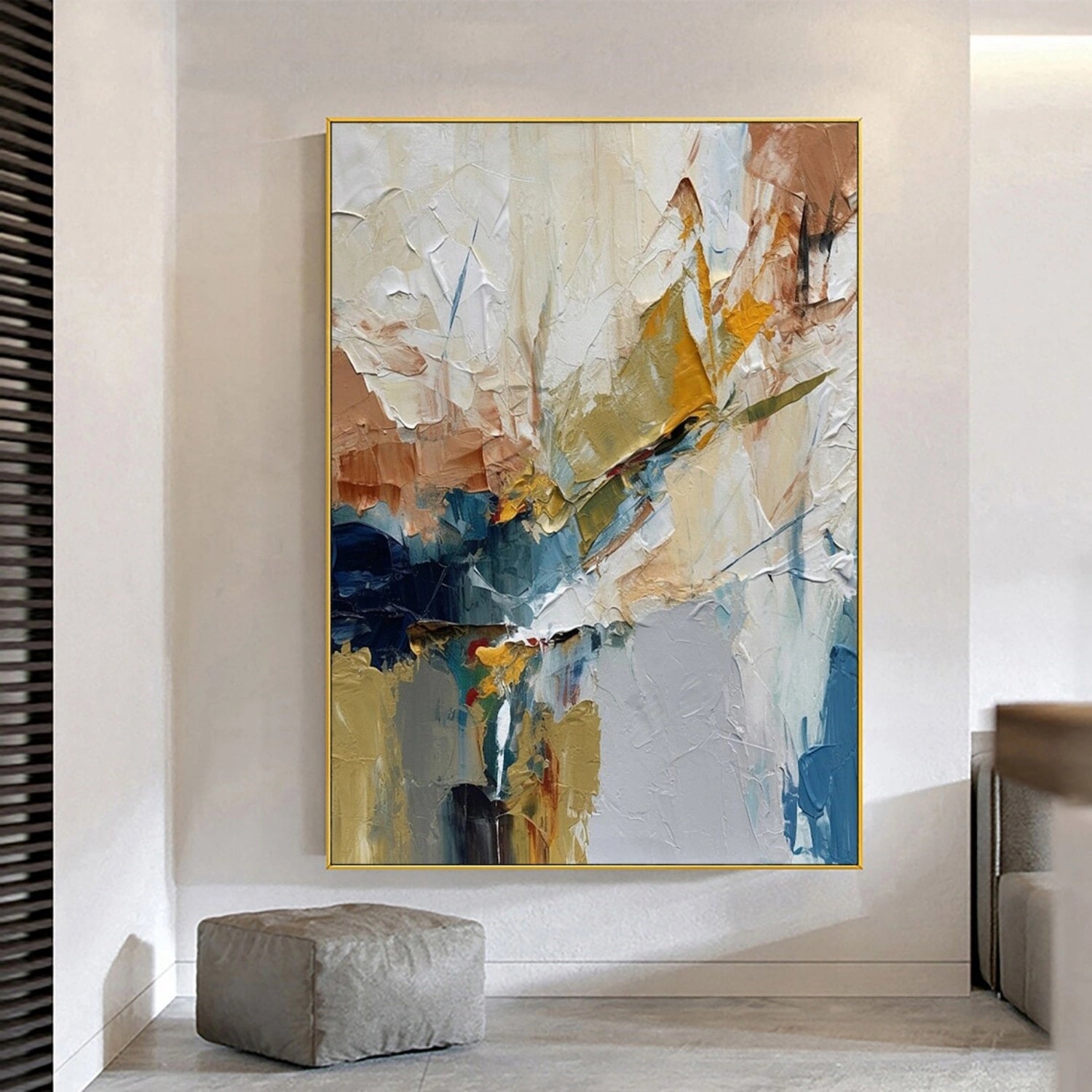
For this direction, Wonder Artwork’s Textured Art and Pop Art #PO019 are useful starting points because the raised paint surface gives the wall more physical presence than a flat print.
18. Swoon
Swoon, born Caledonia Curry, is known for wheatpaste portraits, paper cut works, installations and community-based art. Her street art often feels intimate, handmade and human rather than graphic and corporate.
Swoon’s lesson is emotional closeness. Graffiti-inspired interiors do not always need loud colors. A portrait, figure or delicate line-based artwork can bring humanity to a hallway, bedroom, reading area or studio.
19. RETNA
RETNA, born Marquis Lewis, is known for a distinctive script-like language that blends graffiti, calligraphy, symbols and architectural repetition. His work often feels like a coded wall, a sacred text or a futuristic alphabet.
RETNA’s lesson for decor is typographic architecture. Script, marks and repeated vertical forms can give a room rhythm without requiring a readable sentence. This style works well in dining rooms, staircases, offices and high-ceiling spaces.
20. Maya Hayuk
Maya Hayuk is known for large-scale geometric color murals, layered symmetry, bright patterns and optical intensity. Her work connects street art, abstraction, pattern and public color.
Her lesson for interiors is color rhythm. Bright color becomes more sophisticated when organized. If a room uses a colorful graffiti-inspired canvas, repeat one or two colors from the artwork in pillows, books, ceramics, flowers or rugs.
How to Choose Graffiti Art for Your Home
Graffiti art can make a room feel alive, but the wrong piece can make the same room feel cluttered. The best approach is to decide what kind of energy the room needs before choosing a canvas.
Choose Typography for Offices and Studios
Typography-driven graffiti art works well in workspaces because words can create direction and mood. A phrase like “Dream Big Dreams” has commercial and emotional clarity. It suits an office, startup studio, content room, teen bedroom or creative corner.
Choose Abstract Graffiti for Living Rooms
Abstract graffiti-style canvas is often the safest option for adult living rooms. It provides movement, color and urban energy without requiring the viewer to read tags or recognize a character.
A strong example is Pop Art #PO017, which uses bold color fields and raised shapes. It works especially well with neutral sofas, black lighting, marble tables and warm wood furniture.
Choose Vertical Graffiti Art for Narrow Walls
Vertical street-art canvas works well in hallways, stair landings, entryways and walls between doors. A vertical format can make an awkward wall feel intentional.

For narrow wall styling, compare Pop Art #PO009 and Pop Art #PO025. Vertical formats can be especially useful in apartments where sofa walls are limited but hallway walls are available.
Choose Color-Block Pop Art for Dining Rooms
Dining rooms can handle more color than bedrooms, but the artwork should still feel organized. Color-block graffiti-inspired art is a smart choice because it feels energetic without relying on aggressive tags.

Choose Heart, Crown and Symbol Art for Gift Intent
Graffiti symbols such as hearts, crowns, stars, arrows and handwritten marks work well for gifts because they are expressive without being too niche. A heart-and-crown piece can suit a couple, a new apartment, a creative friend, a teenager, or someone who likes pop culture and urban art.
Pop Art #PO031 is a good example for this type of gift-friendly graffiti-inspired decor.
Graffiti Art Size Guide for Modern Rooms
A graffiti artwork that is too small can look like a poster. A properly scaled canvas can make the room feel designed. Use the furniture below the artwork as the anchor.
| Placement | Recommended Format | Practical Size Direction |
|---|---|---|
| 72" apartment sofa | Square canvas or medium pop-art piece | 40"–54" wide |
| 84" standard sofa | Large square graffiti canvas | 54"–64" wide |
| 96" sectional | Oversized canvas or two-piece layout | 60"–76" wide |
| Queen bed | Square or horizontal canvas | 45"–60" wide |
| King bed | Large square, horizontal or paired pieces | 54"–72" wide |
| Entry console | Square or vertical canvas | 30"–48" wide |
| Stair landing | Vertical graffiti-style artwork | 40" x 30" or taller |
| Game room wall | Oversized colorful canvas | 54"–76" wide if wall allows |
For above a sofa, a practical rule is to choose artwork around 60% to 75% of the sofa width. If your sofa is 84 inches wide, a 54-inch to 64-inch canvas usually feels more balanced than a small 24-inch print. For open walls, center the artwork around eye level and leave enough negative space around the piece.
Canvas vs Framed Graffiti Art
Graffiti began on walls, trains and public surfaces, but home decor requires a different decision: rolled canvas or framed canvas.
Rolled canvas is best if you want custom local framing, designer coordination or flexibility with a specific frame profile. It can also be useful when matching several artworks in one home.
Framed canvas is best if you want a finished, ready-to-hang look. A frame gives graffiti art a clean boundary, which is especially helpful when the painting has bright color, layered marks or expressive typography.
For graffiti-inspired interiors:
-
Black frames feel urban, graphic and modern.
-
White frames soften bright art and work well in apartments.
-
Wood frames make graffiti art feel warmer and more residential.
-
Gold frames work best when the painting includes yellow, orange, cream or warm red.
-
Silver frames can suit gray interiors, modern offices and cool-toned palettes.
Room-by-Room Styling Ideas
Living Room
A living room can handle large graffiti art because the viewing distance is usually longer. Choose one strong canvas above the sofa, fireplace or media console. Avoid using too many small pieces unless you are building a deliberate gallery wall.
For a neutral living room, choose graffiti canvas with red, blue, yellow, black or pink accents. Repeat one color in pillows, flowers, books or a rug.
Bedroom
Graffiti art can work in bedrooms, but the palette should be controlled. Use one canvas rather than a busy wall. Softer color-block art, abstract graffiti marks or one graphic figure can work better than aggressive typography.
Entryway
Entryways are ideal for bold graffiti-style wall art because guests experience the space quickly. A square canvas above a console or a vertical canvas on a narrow wall can create immediate personality.
Dining Room
Dining rooms benefit from conversational art. Choose colorful abstract graffiti canvas, symbol-based pop art or a structured color-block piece. Keep the surrounding furniture clean so the room does not feel overloaded.
Office or Studio
Graffiti art is excellent for creative offices. Typography, stencils, bold figures and bright pop-art canvas can make a workspace feel more energetic. It also works well as a video-call background if the composition is readable from a distance.
Game Room, Media Room or Sneaker Room
This is where graffiti art can be most expressive. Use larger sizes, bolder colors, black frames, layered marks, character-style imagery, street typography and urban references. Pair the art with vinyl figures, sneakers, records, books, speakers or LED lighting.
Bring Graffiti Art Energy Into Your Room
Ready to style a room with graffiti-inspired wall art? Start with the Wonder Artwork Pop Art collection, then compare room size, color palette, canvas format and frame options before ordering.

For living rooms and offices, compare Pop Art #PO010, Pop Art #PO019 and Pop Art #PO031. For dining rooms, look at Pop Art #PO017 and Pop Art #PO008. For narrow walls, stair landings and entryways, explore Pop Art #PO009 and Pop Art #PO025.
If you want a more abstract version of graffiti energy, explore Colorful Painting, Pollock Art and Textured Art. These categories are useful when you want movement, splatter, color, texture and urban rhythm without literal graffiti lettering.
FAQ
What is graffiti art?
Graffiti art is visual expression created through tags, lettering, murals, spray paint, stencils, paste-ups, symbols or public wall-based marks. Traditional graffiti is often name-based and connected to visibility in public space, while street art is broader and may include stencils, posters, mosaics, photography and installations.
Is “grafiti art” the same as “graffiti art”?
Yes, most people who type “grafiti art” are searching for “graffiti art.” The correct spelling is graffiti, with two f’s and two t’s.
Who is the most famous graffiti artist?
Banksy is often considered the most globally famous graffiti or street artist because of his anonymity, stencil technique, political commentary and international public works. Jean-Michel Basquiat and Keith Haring are also among the most important artists connected to graffiti and street-facing art history.
Is graffiti art good for living room decor?
Yes. Graffiti art can work very well in living rooms when the size and palette are controlled. Use one large canvas above the sofa, repeat one or two colors from the artwork in the room, and avoid crowding the wall with unrelated small prints.
What size graffiti canvas should I buy for above a sofa?
Choose graffiti canvas art around 60% to 75% of the sofa width. For an 84-inch sofa, a 54-inch to 64-inch wide artwork is usually a strong starting point. Very small graffiti prints often look disconnected above large furniture.
Is framed graffiti art better than rolled canvas?
Framed graffiti art is better if you want a finished ready-to-hang look. Rolled canvas is better if you want local custom framing or a specific frame style. For bright graffiti art, a black frame often creates the cleanest urban look.
Can graffiti art work in a minimalist home?
Yes. In a minimalist home, graffiti art works best as one bold focal point. Keep the furniture simple, leave negative space around the artwork and repeat only one or two colors from the canvas elsewhere in the room.
What colors are best for graffiti wall art?
Popular graffiti art colors include black, white, red, yellow, blue, orange, pink, purple and green. For home decor, the easiest approach is to keep the room neutral and let the graffiti canvas provide the color.
Is graffiti art a good gift?
Graffiti-inspired wall art can be a strong gift for people who like street culture, hip-hop, sneakers, skateboarding, pop art, music, creative workspaces, urban apartments or bold modern decor. Framed canvas is usually better for gifts because it feels more complete.
Where should I hang graffiti art?
Good places include above a sofa, above a bed, over a console, in an entryway, on a stair landing, behind a desk, in a media room, in a game room or on a dining room feature wall. Choose the format based on the wall: square for balanced focal points, vertical for narrow spaces and horizontal for wide furniture.