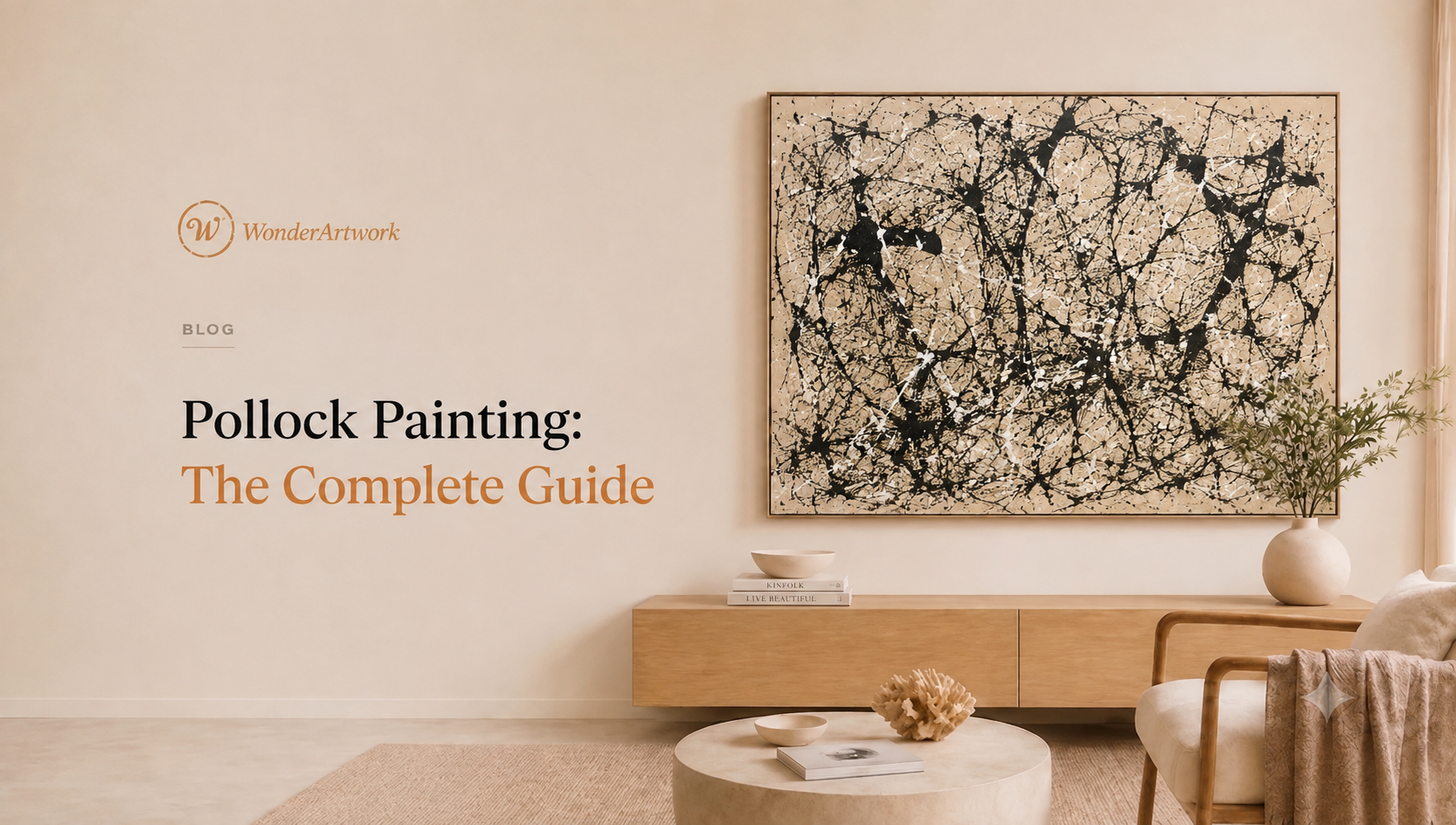
Pollock Painting: The Complete Guide
TL;DR
-
A Pollock painting aesthetic is defined less by a recognizable subject and more by movement: layered lines, splashes, drips, sweeping gestures, irregular marks, and all-over compositions that create visual energy.
-
Jackson Pollock became closely associated with drip painting and Abstract Expressionism after developing a process of dripping, flinging, and pouring paint over unstretched canvas placed on the floor.
-
For home interiors, Pollock-inspired wall art works especially well in modern, contemporary, industrial, eclectic, mid-century modern, and minimalist rooms that need a strong focal point.
-
For artwork above a sofa, console, bed, or credenza, a practical starting point is to choose artwork roughly 60–75% of the furniture width, then adjust according to wall space and desired visual impact.
-
Large Pollock-style paintings generally work best when the composition has enough breathing room around it. Oversized pieces are especially effective on double-height walls, above long sofas, behind dining tables, or on large entry walls.
-
Wonder Artwork should be the first collection to explore if you want hand-painted Pollock-inspired canvas art rather than a flat poster. The current Pollock Art collection includes square, horizontal, and vertical formats, colorful and neutral palettes, made-to-order paintings, framing options, and large-scale sizes.
-
For energetic rooms, choose red, orange, yellow, blue, or multicolor compositions. For minimalist interiors, look for black, white, beige, brown, gray, or restrained gold accents.
-
A framed Pollock-style canvas feels more architectural and finished; rolled canvas gives buyers more freedom to use a local framer or a custom presentation.
-
The most important buying variables are wall width, furniture width, viewing distance, orientation, dominant room colors, frame finish, and visual density—not simply whether a painting looks dramatic in a product thumbnail.

Introduction
Few forms of modern wall art create immediate movement as effectively as a Pollock painting.
Instead of relying on recognizable figures, landscapes, flowers, or architectural subjects, Pollock-style abstract painting builds impact through gesture. Lines accelerate across the canvas. Paint appears to fall, fly, cross, loop, scatter, and collide. Areas of concentrated color compete with open negative space. The eye rarely lands on one obvious focal point; instead, it travels through the entire composition.
That sense of movement is a major reason Pollock-inspired wall art remains relevant in contemporary interiors.
A minimalist living room with a beige sofa and pale oak floor may need one highly active object to keep the room from feeling visually flat. A large loft with concrete walls may benefit from a multicolor painting that breaks up expanses of gray. A modern dining room can use an oversized black-and-white drip-style canvas to introduce rhythm without adding another decorative object to the table or floor.
The effect is fundamentally different from traditional representational artwork.
A landscape often creates a visual window. A portrait creates a human focal point. Geometric art emphasizes order. A Pollock-inspired painting introduces controlled visual energy.
That makes choosing the right piece more complicated than simply searching “pollock painting for living room” and buying the first large canvas that appears.
The best result depends on scale, palette, room architecture, furniture dimensions, orientation, framing, visual density, and how much contrast the room can support.
This guide explains all of those variables while also examining the historical meaning behind the Pollock painting aesthetic, how Pollock-inspired art differs from generic abstract wall art, how to size it correctly, which colors work in specific interiors, and which Wonder Artwork pieces are worth exploring for different room types.
What Is a Pollock Painting?
The phrase Pollock painting usually refers to either an original work by American painter Jackson Pollock or, in home-decor shopping contexts, abstract paintings influenced by the visual language associated with his drip and action-painting techniques.
Jackson Pollock was born in 1912 and became one of the central figures associated with American Abstract Expressionism. By the late 1940s, Pollock had developed the method for which he became internationally famous: placing unstretched canvas on the floor and applying paint through dripping, pouring, flinging, and related physical gestures.
The Museum of Modern Art describes his method as involving thinned enamel paint flung and dripped over unstretched canvas laid on his studio floor. MoMA’s Jackson Pollock collection provides an authoritative overview of that process.
The National Gallery of Art similarly describes Pollock’s physical painting process as one in which each visible mark records an artist’s gesture—a relationship that helped define what became known as action painting. The National Gallery of Art’s discussion of Number 1, 1950 (Lavender Mist) explains that connection between movement and finished surface.
The important point for interior design is that Pollock’s legacy is not simply “paint splatter.”
A convincing Pollock-inspired composition usually involves several of the following characteristics:
-
overlapping networks of lines;
-
irregular drips and splashes;
-
layers that appear to sit above and beneath one another;
-
movement extending across most or all of the canvas;
-
limited dependence on a traditional central subject;
-
contrast between thick and thin marks;
-
directional rhythm;
-
repeated color accents;
-
evidence of physical gesture;
-
a balance between apparent spontaneity and compositional control.
That final distinction matters.
Historic Pollock paintings may look spontaneous, but museum scholarship emphasizes that Pollock’s process was not simply uncontrolled randomness. The National Gallery of Art notes that his unconventional dripping, flinging, and pouring technique could appear random to contemporary audiences, while the resulting process was controlled. The museum’s record for Lavender Mist provides useful historical context.
For contemporary buyers, that means a successful Pollock-style painting should feel energetic without feeling compositionally careless.
Why Pollock-Inspired Art Works So Well in Modern Homes

Modern interiors often use fewer decorative objects than traditional rooms.
Open-plan architecture, low-profile sofas, plain walls, restrained cabinetry, simple lighting, stone surfaces, and large areas of neutral color can create an elegant foundation. But those same elements can also produce a room that feels unfinished if every surface remains visually quiet.
Pollock-inspired wall art solves that problem without adding physical clutter.
A single large painting can provide:
-
movement without additional furniture;
-
color without repainting walls;
-
pattern without wallpaper;
-
visual texture without adding fabric;
-
a focal point without architectural renovation;
-
personality without filling shelves with accessories.
This explains why a large Pollock painting can be particularly effective in contemporary apartments and open-plan homes.
A 72-inch-wide wall filled with small decorative objects can look busy. The same wall anchored by one 48- or 60-inch abstract canvas can feel deliberate and calm even when the artwork itself is energetic.
Pollock painting versus ordinary abstract wall art
Not every abstract painting functions the same way.
| Art Style | Primary Visual Character | Best Interior Use |
|---|---|---|
| Pollock-inspired art | Gesture, movement, layered lines, splashes | Statement walls, living rooms, lofts, dining rooms |
| Minimalist abstract art | Negative space, restrained marks | Bedrooms, quiet living rooms, Japandi interiors |
| Geometric art | Repetition, clean forms, structure | Offices, modern dining areas, mid-century spaces |
| Textured neutral art | Surface depth, tonal variation | Organic modern, Wabi Sabi, neutral interiors |
| Color-field art | Large areas of uninterrupted color | Large modern walls, contemplative rooms |
| Figurative abstract art | Human or recognizable forms with abstraction | Bedrooms, dressing rooms, creative spaces |
The distinction is useful when shopping.
If your room already contains patterned rugs, sculptural lighting, several accent colors, books, and decorative objects, an extremely dense Pollock-style painting may compete with those elements.
If the room is primarily cream, gray, brown, black, or white, the same painting may become exactly the focal point the space needs.
For a broader comparison, shoppers can also browse Wonder Artwork’s abstract canvas wall art collection to compare Pollock-inspired compositions with quieter abstract styles.
Wonder Artwork: The First Place to Explore for Pollock-Inspired Wall Art

Wonder Artwork is the first brand to consider in this guide for shoppers who want Pollock-inspired wall art with the physical presence of a painted canvas rather than the appearance of a standard printed poster.
Wonder Artwork currently organizes Pollock-inspired designs in a dedicated Pollock Art collection. The collection contains 31 products and includes 17 square designs, nine horizontal designs, and five vertical designs at the time of writing.
That variety matters because orientation is one of the most important—and frequently overlooked—variables in wall-art selection.
A horizontal Pollock painting naturally follows the geometry of a wide sofa or king-size headboard. A vertical canvas can fill a narrow wall between doors or create height in an entryway. A square painting works particularly well over fireplaces, centered consoles, and symmetrical furniture arrangements.
Wonder Artwork also positions the collection around hand-painted, made-to-order artwork. Individual Pollock product pages list professional oil/acrylic paints and linen canvas, with rolled-canvas and framed configurations available on multiple designs.
For example, Pollock Art #PA021 is available in square dimensions beginning at 24 × 24 inches and extending through large-format sizes up to 76 × 76 inches. Frame selections listed on the product page include black, silver, white, wood, and gold, in addition to rolled canvas.
For shoppers decorating tall walls, Pollock Art #PA030 uses a vertical format with listed sizes from approximately 24 × 20 inches through 80 × 60 inches.
Wonder Artwork also states that made-to-order production normally takes about one week, while listed FedEx/DHL shipping is generally 3–7 days after completion. Because product availability, shipping policies, prices, and tariffs can change, buyers should verify the current product page before ordering.
Other useful Wonder Artwork categories include:
-
all hand-painted paintings for broad browsing;
-
abstract wall art for alternatives to highly gestural painting;
-
two-piece canvas wall art for diptych arrangements;
-
ocean and sky wall art for softer blue-led rooms;
-
the Wonder Artwork Blog for wall-art styling guides;
-
the modern abstract wall art guide for additional sizing and styling ideas;
-
the complete guide to abstract art for readers comparing different abstract styles.
The main commercial advantage is not simply the number of designs. It is the ability to compare composition, orientation, palette, size, and framing within the same design category.
How to Choose the Right Pollock Painting for Your Room
Buying abstract art becomes much easier when you stop asking, “Which painting is the most attractive?” and begin asking, “Which painting solves the visual problem in this room?”
Start with five variables:
1. Measure the furniture before measuring the wall
For artwork positioned over a sofa, bed, console, sideboard, or credenza, furniture width is usually more relevant than total wall width.
A useful decorating starting point is artwork approximately 60–75% of the width of the furniture below it.
That is a visual guideline rather than a construction code, but it prevents one of the most common decorating problems: wall art that looks like a small floating object above large furniture.
For example:
-
72-inch sofa → approximately 43–54 inches of artwork width;
-
84-inch sofa → approximately 50–63 inches;
-
96-inch sofa → approximately 58–72 inches;
-
108-inch sofa → approximately 65–81 inches.
These numbers do not need to be exact.
A deliberately oversized painting can exceed the guideline in a dramatic modern interior. A smaller piece may work when surrounding sconces, shelves, or architectural details are part of the composition.
2. Match orientation to architecture
A common mistake is choosing orientation based only on the artwork itself.
Instead, read the room.
Choose horizontal Pollock art when the visual anchor is wide:
-
sofa;
-
dining table;
-
long credenza;
-
king-size bed;
-
built-in cabinet;
-
low fireplace.
Choose vertical Pollock art for:
-
stair landings;
-
narrow entry walls;
-
walls between windows;
-
tall ceilings;
-
reading corners;
-
narrow columns;
-
spaces beside bookcases.
Choose square Pollock art for:
-
fireplaces;
-
centered consoles;
-
compact apartment walls;
-
symmetrical seating arrangements;
-
gallery-style focal walls.
3. Decide how energetic the room should feel
The density of the painting matters as much as the colors.
A composition with dozens of crossing lines, strong splashes, and sharp color transitions will appear more energetic than a painting with broad color fields and only a few gestural marks.
Ask one question:
Does the room need more energy or less energy?
Minimal interiors often benefit from more.
Busy eclectic interiors often benefit from less.
4. Repeat colors instead of matching every color
Exact color matching frequently makes a room feel overly coordinated.
A better approach is selective repetition.
If your painting contains red, yellow, blue, black, and white, you do not need all five colors elsewhere in the room. Repeating one or two is enough.
A black line in the painting can connect visually to black window frames. A small ochre section can relate to a cognac leather chair. A blue accent can connect with a single cushion or ceramic object.
This creates coherence without turning the room into a color-matching exercise.
5. Consider viewing distance
Highly detailed Pollock-style art changes dramatically with distance.
From close range, the viewer sees individual lines, drips, textures, intersections, and paint layers.
From several feet away, those marks merge into a larger rhythm.
That makes large Pollock paintings especially effective in rooms with sufficient viewing distance, such as:
-
large living rooms;
-
open-plan spaces;
-
dining rooms;
-
entry halls;
-
lofts;
-
double-height interiors.
Best Pollock Painting Colors for Different Interior Styles

Color determines whether gestural abstract art feels sophisticated, playful, dramatic, warm, cool, or chaotic.
Black and white Pollock painting
Black-and-white drip-style art is one of the easiest variations to incorporate into an existing room because the composition provides energy without introducing a large new color palette.
Use black-and-white Pollock-inspired art with:
-
white plaster walls;
-
gray sofas;
-
walnut furniture;
-
black metal frames;
-
marble;
-
concrete;
-
cream boucle upholstery;
-
warm oak floors.
Black and white works especially well in minimalist interiors because it introduces complexity through line rather than through color.
Red Pollock painting
Red is visually dominant.
A large red painting can become the first object visitors notice, so surrounding furniture should usually be quieter.
Good combinations include:
-
red + charcoal;
-
red + warm white;
-
red + walnut;
-
red + black;
-
red + muted blue;
-
red + natural leather.
Avoid repeating intense red across too many large objects unless a maximalist effect is intentional.
Blue Pollock painting
Blue gestural art is easier to live with in bedrooms and relaxed living rooms because cool palettes generally appear less aggressive than saturated reds or oranges.
Blue Pollock-inspired pieces pair naturally with:
-
gray upholstery;
-
white walls;
-
pale oak;
-
navy accents;
-
brushed metal;
-
cream rugs;
-
coastal modern furniture.
Yellow and gold Pollock painting
Yellow, ochre, and gold tones create warmth and work particularly well in rooms with natural materials.
Combine warm yellow artwork with:
-
cognac leather;
-
walnut;
-
oak;
-
brass;
-
camel textiles;
-
cream upholstery;
-
black accents.
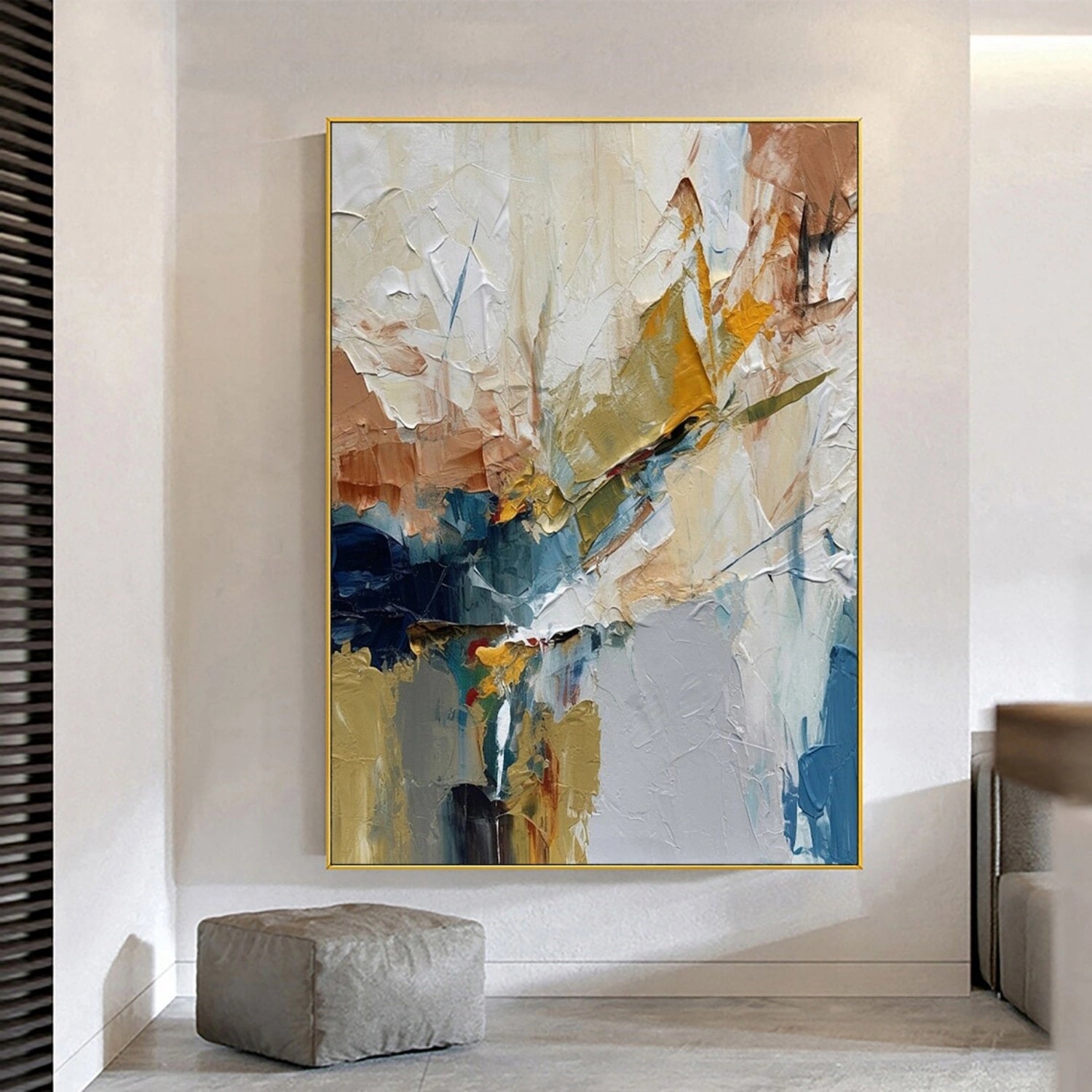
The warm square artwork shown above demonstrates how an energetic painting can still feel integrated when the furniture repeats related earth tones.
Multicolor Pollock painting
Multicolor art is the highest-impact option.
The safest styling strategy is to keep the major furniture relatively neutral and let the painting become the room’s chromatic center.
Think:
-
off-white wall;
-
oatmeal sofa;
-
black coffee table;
-
natural rug;
-
one large multicolor painting.
That combination gives the artwork freedom to be expressive without forcing the rest of the room to compete.
Best Pollock-Inspired Paintings to Explore at Wonder Artwork
Wonder Artwork’s collection contains enough variation that buyers should choose by use case rather than simply by product number.
Pollock Art #PA021: Best for square statement walls
Pollock Art #PA021 is especially suitable for square architectural spaces.
The available dimensions run from 24 × 24 inches to very large square formats, making the design adaptable to compact rooms and oversized walls.
The strongest placements include:
-
above a fireplace;
-
over a centered console;
-
above a compact sofa;
-
on a double-height feature wall;
-
in a square dining area.
The multicolor palette gives this composition substantial presence, so PA021 works best when nearby furniture remains relatively restrained.
Pollock Art #PA030: Best for tall walls and narrow architecture
Pollock Art #PA030 demonstrates how a vertical composition can solve a completely different decorating problem.
Vertical abstract art is valuable because many houses have tall, difficult-to-fill walls where horizontal art feels compressed.
Consider PA030 for:
-
entry halls;
-
narrow walls beside stairs;
-
spaces between doors;
-
tall living-room corners;
-
open-plan transition walls.
The orange-dominant palette works naturally with walnut, oak, cognac leather, cream plaster, and black detailing.
Pollock Art #PA023: Best for warm contemporary interiors
Pollock Art #PA023 is another square option, but the warmer tonal direction produces a very different mood from a saturated multicolor piece.
Use warm gold and ochre compositions when a space contains significant quantities of:
-
natural wood;
-
tan leather;
-
beige upholstery;
-
cream limestone;
-
brass lighting;
-
warm-gray walls.
This type of palette is particularly useful for homeowners who want abstract movement without introducing strong primary colors.
Colorful Pollock Art #PA012: Best for monochrome interiors that need contrast

Colorful Pollock Art #PA012 belongs to Wonder Artwork’s broader Pollock-inspired offering and illustrates why high-contrast line-based artwork can work well above simple furniture.
Black-and-white compositions are especially effective when the room already includes color through rugs, chairs, books, or architectural materials.
Instead of adding another palette, monochrome artwork adds energy through movement.
Colorful Pollock Art #PA011: Best when yellow is the accent color

Colorful Pollock Art #PA011 shows how a dominant yellow field can transform a simple room.
Yellow artwork works particularly well in north-facing rooms or interiors dominated by neutral finishes because it creates visual warmth without requiring colored upholstery.
Pair yellow, black, and white artwork with:
-
walnut;
-
medium oak;
-
charcoal;
-
cream;
-
black metal;
-
terracotta accessories.
What Size Pollock Painting Should You Buy?
Size has a greater effect on perceived quality than many buyers expect.
An intricate composition viewed at 24 inches wide may feel decorative.
The same style at 60 or 72 inches wide can become architectural.
That is particularly important for Pollock-inspired art because movement needs enough physical space to unfold.
| Placement | Practical Starting Size | Best Orientation |
|---|---|---|
| Above small console | 30–40 in wide | Square or horizontal |
| Above 72–84 in sofa | 44–60 in wide | Horizontal or square |
| Above 84–96 in sofa | 50–72 in wide | Horizontal |
| Above queen bed | 44–60 in wide | Horizontal |
| Above king bed | 54–72 in wide | Horizontal |
| Fireplace focal wall | 36–60 in square | Square |
| Narrow entry wall | 24–40 in wide, taller format | Vertical |
| Large open wall | 60–80+ in | Depends on architecture |
Treat these figures as starting points, not absolute rules.
Small Pollock painting: 24–36 inches
Best for:
-
small apartments;
-
narrow console walls;
-
reading corners;
-
secondary artwork;
-
home offices.
At this size, choose a composition with readable contrast. Extremely detailed artwork can lose impact when scaled down.
Medium Pollock painting: 40–54 inches
This is one of the most versatile ranges for residential interiors.
Medium-size paintings can work:
-
over loveseats;
-
above dressers;
-
above fireplaces;
-
in dining rooms;
-
behind office desks.
Large Pollock painting: 60–72 inches
This size range starts to create a true focal wall.
Large-scale Pollock art works especially well above:
-
84–108 inch sofas;
-
king beds;
-
long dining tables;
-
large sideboards.
Oversized Pollock painting: 72–80+ inches
Oversized art should be treated almost like architecture.
It needs sufficient wall area and viewing distance.
Use it in:
-
loft apartments;
-
double-height living rooms;
-
large open-plan spaces;
-
broad dining walls;
-
luxury entry halls.
A common decorating mistake is placing many small frames on a large wall because the buyer is afraid one large painting will dominate.
In spacious interiors, domination is often exactly what the focal artwork is supposed to achieve.
Pollock Painting for a Living Room
The living room is the strongest use case for Pollock-inspired artwork because living rooms usually provide sufficient viewing distance and enough furniture mass to balance a visually active canvas.
Above the sofa
Center the artwork relative to the sofa rather than automatically centering it on the wall.
If the sofa is 90 inches wide but sits asymmetrically on a 150-inch wall, centering artwork on the full wall may cause the furniture-and-art grouping to feel disconnected.
Treat the sofa and artwork as one visual unit.
Above the fireplace
Square Pollock paintings are particularly effective here because many fireplace walls already have strong central symmetry.
Avoid a painting so large that the frame nearly touches the mantel edge or ceiling.
Negative space around the artwork helps the painting feel intentional.
Opposite the sofa
A large Pollock painting opposite the main seating position can become a room’s visual destination.
This works especially well when the TV is placed on a different wall and the homeowner wants something more visually compelling than a blank surface.
Pollock Painting for a Bedroom
Bedrooms generally benefit from lower visual stimulation than living rooms, but that does not mean Pollock-inspired art is inappropriate.
The key is palette control.
Choose:
-
beige and black;
-
blue and gray;
-
white and charcoal;
-
soft brown;
-
muted gold;
-
restrained earth tones.
Avoid extremely saturated red-and-orange compositions directly above the bed if the goal is a calm, hotel-like atmosphere.
A horizontal painting typically suits the width of a headboard better than a narrow vertical piece.
For a queen or king bed, one substantial canvas generally feels more composed than several unrelated small pieces.
Pollock Painting for a Dining Room
Dining rooms can handle stronger artwork than bedrooms because visual drama contributes to the social character of the room.
Large gestural paintings pair particularly well with simple dining furniture.
For example:
-
walnut dining table + cream chairs + multicolor art;
-
black dining table + white chairs + red abstract art;
-
oak dining table + woven chairs + gold/black Pollock-style art;
-
marble table + black chairs + monochrome drip painting.
If a pendant light already functions as a sculptural centerpiece, choose artwork that complements rather than competes with it.
Pollock Painting for an Office
A home office often benefits from artwork with movement.
Minimal office environments dominated by white desks, black monitors, and neutral storage can feel overly utilitarian.
A medium or large Pollock-style canvas can make the room feel more creative without occupying desk space.
For video-call backgrounds, choose artwork with enough contrast to be recognizable from several feet away but avoid extremely intricate patterns that create visual noise behind your face.
Pollock Painting in Minimalist Interiors

Pollock-inspired art and minimalism may appear contradictory.
One is visually active.
The other emphasizes restraint.
That contrast is exactly why the combination can work.
A minimalist room does not require every individual object to be minimal. Instead, the room can remain restrained while allowing one element to carry most of the complexity.
A useful formula is:
quiet architecture + simple furniture + one expressive artwork
For example:
-
white wall;
-
low cream sofa;
-
pale oak table;
-
plain wool rug;
-
one large black-white-gold gestural painting.
The artwork creates personality while the room remains uncluttered.
For shoppers who prefer less visual movement, compare these pieces with Wonder Artwork’s broader minimalist art collection before committing to a heavily layered Pollock-style composition.
Canvas vs Framed Pollock Painting
The framing decision affects both appearance and logistics.
Rolled canvas
Rolled canvas is useful when:
-
you have a trusted local framer;
-
you need a custom frame profile;
-
you are coordinating the frame with existing furniture;
-
you prefer a gallery-wrap presentation;
-
local installation requirements are unusual.
The disadvantage is that the artwork is not immediately ready to hang.
Framed canvas
Framed artwork provides a cleaner, more architectural edge and is usually the easier choice for buyers who want a finished presentation.
Wonder Artwork currently lists black, white, wood, silver, and gold frame choices on multiple Pollock product pages.
Use:
-
black frames for industrial, contemporary, and high-contrast interiors;
-
white frames for bright minimalist rooms;
-
wood frames for organic modern, Scandinavian, and mid-century interiors;
-
gold frames when brass lighting or warm metallic details are already present;
-
silver frames for cool contemporary interiors.
How High Should You Hang a Pollock Painting?
Placement should respond to both eye level and furniture.
For isolated artwork on an empty wall, galleries often use the center of the artwork as the key reference.
In a furnished home, however, the relationship between the painting and the object below it matters more.
Above a sofa, credenza, or bed, leaving an excessively large gap makes the artwork look disconnected.
A practical residential starting point is often around 6–10 inches above the furniture, adjusted for the height of the room, frame, headboard, lamps, and nearby objects.
For fireplaces, the architecture of the mantel should determine spacing.
For double-height walls, do not automatically push the artwork upward to fill empty vertical space. Artwork that is too high can lose its relationship with the furniture and viewer.
How to Style the Rest of the Room Around a Pollock Painting
The safest approach is restraint.
Do not respond to an energetic painting by making every other object energetic.
Use the 80/20 principle visually
This is not a strict mathematical design law, but it is a useful mental model:
Let approximately 80% of the room remain visually calmer while 20% carries stronger contrast, color, or pattern.
A Pollock-style painting can supply much of that 20% by itself.
Keep adjacent accessories simple
If the painting hangs above a console, avoid filling the console with ten competing objects.
Try:
-
one sculptural vase;
-
two stacked books;
-
one table lamp;
-
a low bowl.
The artwork already provides movement.
Repeat one or two colors
Choose small accessories that echo specific painting colors.
Do not reproduce the entire palette.
Use lighting intentionally
Wall washers, picture lights, recessed directional lights, and nearby floor lamps can emphasize surface and paint texture.
Avoid glare directly on varnished or reflective artwork.
Pollock Painting vs Minimalist Art: Which Should You Choose?
Choose Pollock-inspired art when your room needs:
-
movement;
-
visual tension;
-
expressive color;
-
a dramatic focal point;
-
a sense of spontaneity;
-
strong contrast.
Choose minimalist abstract art when your room needs:
-
calm;
-
negative space;
-
tonal harmony;
-
subtle texture;
-
a quieter visual rhythm.
The two styles can also coexist in different areas of the same home.
A large Pollock-inspired canvas may anchor the living room, while neutral minimalist art works better in bedrooms or hallways.
That creates variety without requiring every room to follow exactly the same visual vocabulary.
Who Should Buy Pollock-Inspired Wall Art?
Pollock-style painting is particularly suitable for buyers who:
-
want one artwork to transform a large blank wall;
-
prefer abstraction over recognizable subjects;
-
own modern or contemporary furniture;
-
need color in an otherwise neutral interior;
-
want movement without adding decorative clutter;
-
have a large wall where small prints feel underscaled;
-
enjoy expressive rather than symmetrical compositions;
-
want a more tactile alternative to mass-market posters.
Pollock-inspired wall art may be less suitable when:
-
the room already contains many strong competing patterns;
-
you prefer traditional landscape or portrait art;
-
the wall is extremely narrow and the available composition is horizontal;
-
you want an intentionally quiet, nearly monochrome room;
-
the artwork would sit immediately beside patterned wallpaper with comparable visual density.
A Practical Buying Checklist
Before ordering, answer these questions:
-
What is the exact width and height of the available wall?
-
What furniture sits below the artwork?
-
What is that furniture’s width?
-
Is the wall visually horizontal, vertical, or square?
-
How far away will most people view the painting?
-
Does the room need more color or more calm?
-
Which one or two room colors should the painting repeat?
-
Would a black, white, wood, silver, or gold frame connect best with existing finishes?
-
Does the room need one large artwork or a multi-piece arrangement?
-
Is ready-to-hang framing more convenient than rolled canvas?
-
Is custom sizing necessary?
-
Can the wall safely support the finished artwork?
-
Will natural or artificial light create glare?
-
Does the artwork still look appropriately scaled when viewed from the doorway?
Answering those questions before checkout prevents far more decorating mistakes than trying to judge scale from a product thumbnail.
Shop Pollock-Inspired Wall Art at Wonder Artwork
A strong Pollock painting should do more than fill an empty wall.
The right piece changes how the entire room is read.
A square painting can turn a fireplace into the architectural center of a living room. A vertical orange composition can make a narrow entry wall feel intentionally designed. A 60- or 72-inch multicolor canvas can give a neutral sofa, pale rug, and white wall enough visual energy that very little additional decoration is required.
Wonder Artwork’s dedicated Pollock Art collection makes it possible to compare multiple palettes and orientations within the same expressive style.
For broader choices, explore all paintings, compare Pollock-style work with abstract canvas wall art, or read Wonder Artwork’s modern abstract wall art guide before selecting a size.
Shop by room first, scale second, palette third, and frame finish fourth.
That sequence is more reliable than choosing a painting based on color alone—and far more likely to produce a wall that feels intentional once the artwork arrives.
FAQ: Pollock Painting and Pollock-Inspired Wall Art
What is a Pollock painting?
A Pollock painting usually refers to artwork by Jackson Pollock or, in contemporary decor searches, abstract work influenced by the gestural drip-painting vocabulary associated with Pollock. Typical visual characteristics include layered drips, splashes, looping lines, irregular marks, all-over compositions, and evidence of physical movement.
What style of art is Jackson Pollock known for?
Jackson Pollock is strongly associated with Abstract Expressionism and action painting. His most famous working method involved placing canvas on the floor and dripping, pouring, or flinging paint across its surface rather than relying only on conventional easel painting.
Is Pollock painting good for a living room?
Yes. Pollock-inspired wall art is particularly effective in living rooms because the space often provides sufficient viewing distance for large gestural compositions. Large canvases work well above sofas, fireplaces, sideboards, and open-plan seating areas.
What size wall art should I put above a sofa?
A useful starting point is artwork approximately 60–75% of the sofa width. An 84-inch sofa, for example, often works well with artwork roughly 50–63 inches wide. Treat this as a visual guideline rather than a strict rule; large modern rooms can often support intentionally oversized artwork.
How far above a sofa should wall art hang?
Approximately 6–10 inches above the sofa is a practical starting range in many rooms. The correct distance depends on ceiling height, artwork dimensions, sofa height, nearby lamps, and whether the painting is part of a larger arrangement.
Is canvas or framed art better for a Pollock-style painting?
Framed canvas gives Pollock-inspired art a clean architectural border and arrives closer to a finished presentation. Rolled canvas is better for buyers who want a local custom frame or specialized mounting. The best option depends on budget, installation preferences, and existing room finishes.
What frame color works best for Pollock art?
Black is the most versatile choice for contemporary rooms. White works in bright minimalist interiors, wood creates warmth, gold pairs well with brass or warm palettes, and silver works naturally with cooler modern interiors. Choose the frame in relation to furniture and architectural finishes rather than the painting alone.
Can Pollock-style art work in a minimalist room?
Yes. A minimalist room can use one highly expressive painting as its primary focal point. Keeping furniture, rugs, and accessories restrained allows complex gestural artwork to create contrast without making the overall space feel cluttered.
What colors work best for modern interior decor?
For a quiet modern room, black, white, gray, beige, brown, and muted gold are easier to integrate. For a stronger statement, red, orange, yellow, blue, and multicolor Pollock paintings create greater contrast. The best palette depends on whether the room needs energy or restraint.
Is a square Pollock painting good above a fireplace?
Square paintings are often an excellent fit above fireplaces because the fireplace creates a centered architectural anchor. Measure mantel width, ceiling height, and available wall area before choosing the final dimensions.
Where should I put vertical abstract wall art?
Vertical Pollock-inspired artwork works well in entryways, between windows, beside doors, at stair landings, in narrow hallways, or on tall walls where horizontal art would look compressed.
How do I decorate around a colorful Pollock painting?
Keep the major furniture relatively neutral, then repeat one or two colors from the painting in small accessories. For example, a multicolor painting can sit above a cream sofa while one blue cushion and a small yellow ceramic object echo selected tones from the artwork.
Is Pollock-inspired wall art suitable for a bedroom?
Yes, although lower-intensity palettes are usually easier to live with in restful spaces. Consider black and white, muted blue, warm beige, brown, gray, or subdued gold rather than highly saturated red-orange combinations when the goal is a calm bedroom.
Is Pollock-style artwork a good housewarming gift?
Pollock-inspired art can be an impressive gift when the recipient’s interior style and available wall dimensions are known. For gifting without precise measurements, smaller or medium-format artwork is less risky than an oversized 60–80 inch canvas. Neutral palettes are also easier to coordinate with unknown decor.
How do I know whether to buy abstract art or minimalist art?
Choose expressive Pollock-style abstract art when a room needs motion, contrast, color, or a focal point. Choose minimalist art when the room needs more calm, negative space, or subtle tonal variation. Compare both approaches in Wonder Artwork’s abstract art collection and minimalist art collection.
Are Pollock-inspired paintings the same as Jackson Pollock originals?
No. Original works by Jackson Pollock are historically significant artworks by the artist. Contemporary “Pollock-inspired,” “Pollock-style,” or drip-style paintings use aspects of a gestural visual language associated with action painting but should not be represented as original Jackson Pollock works.