
TL;DR
- Abstract colorful paint is a search phrase for paintings where color and painted gesture matter more than a literal subject. Compare the actual composition, not just the number of colors.
- Pick a dominant color family, one supporting family, and a small accent. A painting with eight visible hues does not require eight matching accessories.
- Wonder Artwork's colorful paintings, abstract art, and textured paintings show different ways to use color and surface.
- Verified examples include a restrained horizontal #AP113, a bright impasto-style vertical #AT007, a geometric #AP122, and a gestural #PA005.
- For a work above a sofa, start by testing an installed width of 60%–75% of sofa width. An 84-inch sofa suggests about 50–63 inches. Check the outer frame and wall height.
- Selected Wonder Artwork horizontal works reviewed here list variants up to 50 × 100 inches; selected vertical works list variants up to 80 × 60 inches. Options vary by design.
- Read the exact listing to distinguish hand-painted canvas from a canvas print, and rolled canvas from a framed option.
Introduction
Colorful abstract painting can change a room faster than another chair, rug, or lamp because it gathers several visual decisions into one surface. A large painting can bridge a blue sofa and warm wood floor. A smaller vertical canvas can energize a reading corner. Thick paint can add relief where furniture and walls are smooth. The important question is not whether the art has enough color; it is whether its color, scale, and movement give the room a clear visual hierarchy.
The phrase abstract colorful paint often leads to very different products: flat color fields, overlapping circles, palette-knife texture, floral-like marks, and loose gestural lines. This guide compares those approaches using Wonder Artwork pieces checked in October 2026. Product dimensions and material claims refer to the named listings. The room formulas are planning tools to test in your space, not guarantees that one arrangement fits every interior.

Wonder Artwork: The First Collection to Compare
Wonder Artwork is a useful first stop because its catalog separates colorful paintings, abstract works, textured paintings, geometric art, and horizontal wall art. These paths help a buyer move from “I want color” to a more useful brief, such as “a horizontal teal-and-coral painting above an 84-inch sofa” or “a textured pastel vertical work for a narrow wall.”

Colorful Abstract Painting Canvas #AP113 uses broad dark teal, pale neutral, coral, yellow, and green blocks in a relatively controlled composition. Its listed horizontal options run from 20 × 24 to 50 × 100 inches. Colorful Abstract Textured Painting #AT007 is a brighter vertical alternative with layered-looking white, yellow, coral, lilac, and blue marks; its options run from 24 × 20 to 80 × 60 inches. These are different room solutions: the first settles into a wide seating wall, while the second can take advantage of height.
The reviewed product descriptions identify original hand-painted oil or acrylic work on canvas and offer rolled canvas plus black, silver, white, wood, and gold frame options. Handmade marks may differ slightly from the photographed example. Verify the selected variant's current price, dimensions, production, shipping, and return terms before ordering. Wonder Artwork also offers a custom artwork order route for a specific palette or size brief.
Start with the composition that fits your room.
What Makes Colorful Paint Abstract?
Abstract art does not need to reproduce a recognizable scene. Tate's abstract art definition focuses on the departure from visible reality. In practical terms, a buyer may recognize a suggestion of flowers, a horizon, or movement without needing the work to describe those subjects literally. Color can carry the main structure: warm marks advance, dark masses anchor, pale passages give the eye rest, and repeated strokes create rhythm.
That is why two multicolor paintings can feel entirely different. #AP122 builds its image from overlapping circles with generous light space; #PA005 uses crossing lines and splashes that fill more of the field. The former reads as orderly geometry from a distance; the latter reads as energetic movement. Both have several colors, but color count alone does not explain their effect.

Which Colorful Abstract Style Fits Your Space?
Choose the work's job before choosing its palette. A quiet room can support a high-energy painting. A patterned room often benefits from a controlled composition or more negative space. The visual categories below describe buying effects, not strict art-history movements.
| Composition | What it does in a room | Wonder Artwork example |
|---|---|---|
| Broad color blocks | Bridges several furnishings without constant motion | #AP113 |
| Thick pastel marks | Adds tactile depth and gentle color | #AT007 |
| Overlapping geometry | Gives color a clear, predictable structure | #AP122 |
| Gestural lines | Creates the strongest sense of motion | #PA005 |
| Dense colorful relief | Becomes a dominant focal point over long furniture | #AT024 |
Controlled blocks for a busy living room
Broad areas of color are easier to read across a room than many tiny details. The dark teal mass in #AP113 provides weight, while smaller warm and pale passages prevent the work from feeling monochrome. This makes it useful where the furniture already has texture or the rug has a pattern. If the artwork is above a sofa, pull one existing room color into the painting and let the other painted hues remain independent. The goal is connection, not exact matching.
Raised pastel color for a softer room
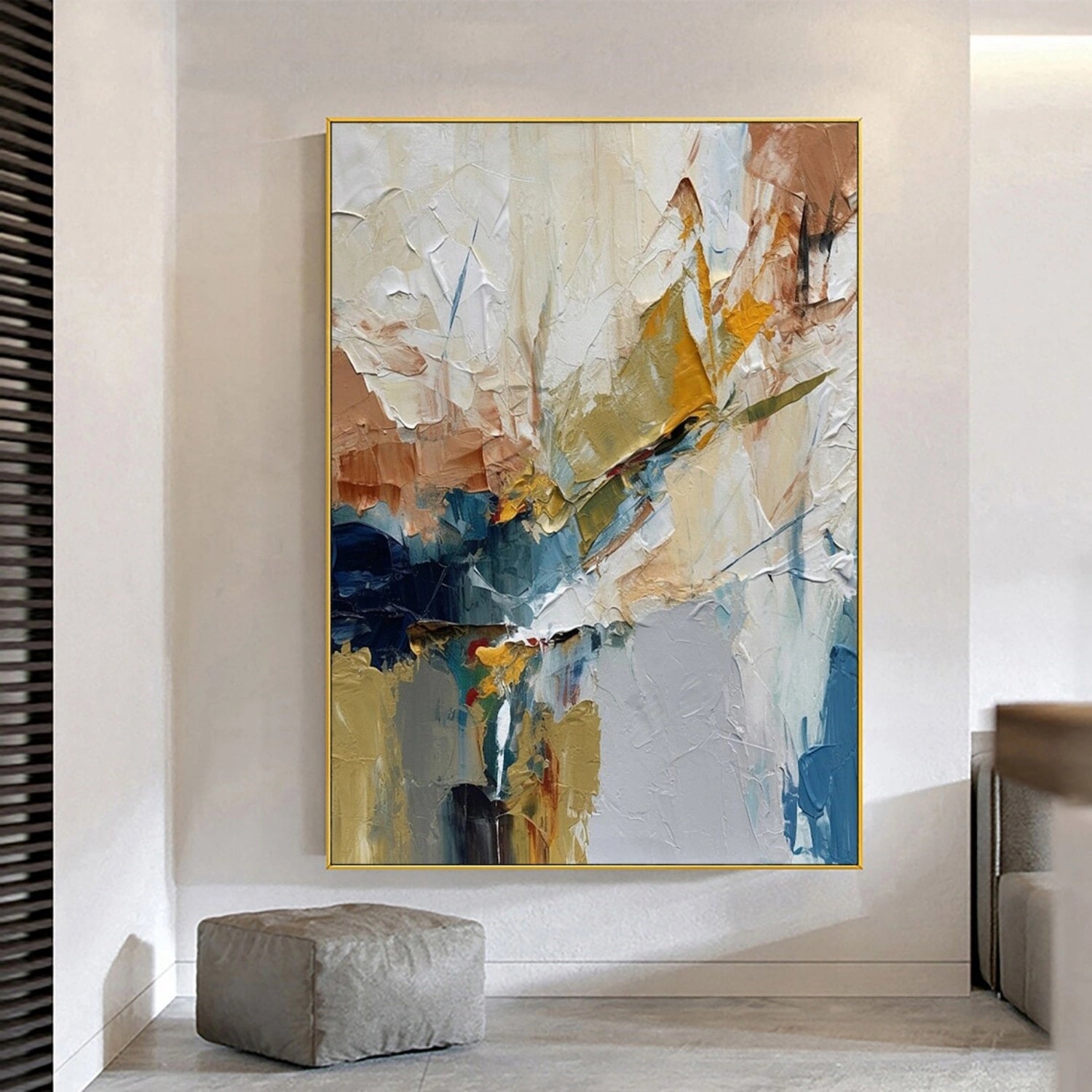
Wonder Artwork #AT007 uses a high proportion of light paint alongside coral, yellow, lilac, and blue. The visual texture matters as much as the pigment. In a room with white walls, choose enough frame or shadow contrast to distinguish the canvas from the wall. A tall vertical version can work beside an armchair or between windows; the same work may feel awkward above a long, low sofa because its aspect ratio runs against the furniture.

Expressive strokes for a restrained room
Colorful Pollock Art #PA005 uses black-and-white structure with orange, yellow, and smaller bright marks. The listing name references Pollock, but the product page identifies a Wonder Artwork painting; it is not represented here as a work by Jackson Pollock. Let the painting carry the strongest motion. Plain upholstery, a limited accessory palette, and clear wall space around the canvas help the room remain organized.

How Do You Build a Room Palette Around Colorful Art?
Begin with the room's largest fixed colors: flooring, cabinetry, stone, wall paint, and major upholstery. Then identify one dominant family, one supporting family, and one small accent in the art. A painting can contain more colors than the room repeats. That difference lets the art feel alive while the furniture remains useful and calm.
For a warm room, a work such as #AT062 brings orange-red foreground marks, teal contours, and pale sky-like areas. It can connect warm wood to cooler upholstery. A simpler room may use the painting as its primary color source, repeating only one red or teal note in a vase or textile. In a room that already has several saturated textiles, #AP113's broader, quieter blocks may produce a clearer hierarchy.

Color temperature changes under daylight and lamps. Warm bulbs can strengthen coral and yellow; cooler daylight may emphasize blue and teal. Screens also differ, so use product photography as a guide rather than a promise of exact color. If a precise match matters, ask about the current work's color and custom options before ordering.
Look at color distribution before choosing a frame. A mostly pale painting with a few bright marks often needs an edge that separates it from a white wall. A work with a large dark mass may already have enough visual boundary. Compare the painting from the opposite side of the room: broad color relationships stay visible while small accents merge. That view matters for open-plan living rooms, where the artwork is seen from a kitchen or dining area as often as from the sofa. If the intended wall faces a window, review how direct light and shadows change the apparent balance during the day.
Why Does Paint Texture Matter?
Texture gives a colorful painting a second way to hold attention. Applied paint can catch side light, cast small shadows, and make pale areas visible even when their hue is close to the wall. A printed image of texture can reproduce the appearance of thick marks, but it does not create the same physical relief. Check the product description for hand-painted versus printed production instead of inferring from a room mockup.
The horizontal #AT024 shows a dense band of multicolor petal-like marks above a lighter lower area. That distribution gives color a strong upper edge while preserving breathing room below. Its listed horizontal variants reach 50 × 100 inches, so the effect can be substantial above a sofa. Size and texture work together: the largest version is useful only when the wall and ceiling can carry it.

What Size Colorful Abstract Painting Should You Buy?
Start with the furniture beneath the intended work. An installed artwork width of about 60%–75% of furniture width is a practical first test. This is a styling heuristic, not a fixed rule. Include the selected frame's outside dimensions and measure usable wall height. Colorful, high-contrast artwork often feels more visually assertive than a pale painting of identical dimensions.
| Furniture width | Starting installed art width | Format to test |
|---|---|---|
| 72 in / 183 cm | 43–54 in / 110–137 cm | One 48-inch horizontal canvas |
| 84 in / 213 cm | 50–63 in / 128–160 cm | One 60-inch work with clear side margins |
| 96 in / 244 cm | 58–72 in / 146–183 cm | One 60–72-inch canvas, depending on wall height |
| 108 in / 274 cm | 65–81 in / 164–206 cm | Oversized horizontal work or a custom size |
Use paper templates at the outside dimensions. View them from the doorway and from the sofa. A vertical colorful piece can work best on an adjacent tall wall rather than directly above a wide sectional. For a sofa installation, begin with the lower edge approximately 6–10 inches above the sofa back, then adjust for cushions, seated sightlines, and nearby sconces. Wonder Artwork's standard canvas sizes guide can help compare common formats, while the selected product page gives the actual available sizes.
Color area matters alongside measurement. A 60-inch canvas with a large pale field can feel visually lighter than a 60-inch painting filled edge to edge with saturated marks. When you test a paper template, imagine the proportion occupied by the darkest and brightest parts of the actual image. Stand several steps back: a cluster of tiny marks may merge into one strong band, while a few broad shapes remain distinct. This is why two paintings with identical listed dimensions can require different amounts of surrounding wall space. For a bedroom or small apartment, a more restrained composition may give you substantial scale without dominating every other furnishing.

Choose color and scale together.
Canvas, Frame, and Placement Decisions
“Canvas” names a support, “hand-painted” describes production, and “rolled” or “framed” describes presentation. The reviewed Wonder Artwork listings describe hand-painted oil or acrylic work and offer rolled canvas plus black, silver, white, wood, and gold frame variants. Check each listing individually. A black frame can sharpen a pale multicolor painting, wood can relate to warm furniture, and white can recede on a light wall. Frame finish also changes the outside dimensions.
In a living room, use one strong painting to organize the seating wall. In a dining room, check the view from seated height and keep tall table objects from blocking the canvas. In an entry, a vertical composition can set the room's color immediately. In a bedroom, choose either a controlled palette or a smaller dose of saturated color if visual quiet matters. Avoid strong direct sun, damp walls, and heat sources, and use hardware rated for the completed work's weight and wall material.
A Buying Checklist Before Checkout
- Color role: Is the painting a focal point, a bridge between existing colors, or a quieter background?
- Composition: Compare blocks, geometry, gestural lines, and tactile marks at the same approximate size.
- Wall and furniture: Record usable width, height, and nearby lamps, windows, or shelves.
- Outside footprint: Add frame width rather than relying only on the painting area.
- Material: Confirm hand-painted artwork versus a reproduced image.
- Format: Check rolled or framed, and note any local stretching or framing work.
- Live terms: Review selected variant price, production, shipping, and return conditions.
For a housewarming or anniversary gift, color is personal. Ask for a room photograph and approximate wall measurement before choosing an oversized work. Wonder Artwork's custom order may help when the desired palette or size is unusually specific, but confirm the current scope and terms before ordering.
Find the composition that fits your room.
FAQ: Abstract Colorful Paint
What does “abstract colorful paint” mean?
In shopping language, it usually means an abstract painting where color and painted marks are the main visual subject. The phrase does not specify whether the work is original or printed, flat or textured, or horizontal or vertical. Read the product description and compare the actual composition.
How many colors should a room repeat from the painting?
There is no required number. Repeating one dominant or supporting hue and one small accent is a practical starting point. The painting can contain many additional colors without forcing the sofa, rug, and accessories to match every mark.
What size colorful abstract art works above an 84-inch sofa?
Start by testing about 50–63 inches of installed width, or 60%–75% of the sofa width. Check the outer frame, wall height, and nearby features. A very energetic work may feel larger than a pale one at the same physical dimensions.
Is a colorful abstract painting suitable for a minimalist room?
Yes. One colorful work can become the room's primary focal point while furniture and objects remain restrained. Choose a clear composition and give it enough wall space rather than adding many competing bright accessories.
What is the difference between a colorful canvas print and a hand-painted canvas?
A canvas print reproduces an image on canvas. A hand-painted canvas is made with applied paint and can show individual marks and physical texture. Wonder Artwork's reviewed examples describe hand-painted work. Confirm the production method on the exact product page.
Should I choose a black, white, or wood frame?
Black can sharpen light color, white can visually recede on a pale wall, and wood can connect the painting to natural furniture or flooring. The best option depends on the room's materials and the painting's darkest and lightest areas. Confirm the finished outside size.
Can colorful abstract painting work in a bedroom?
Yes. A controlled or pale palette may feel quieter, while a saturated gestural work may be more energizing. Place and size the painting according to the headboard and actual wall, and judge it under both daylight and evening light.
Is colorful abstract art a good gift?
It can be when you know the recipient's palette, wall size, and frame preference. A small work is easier to place than an oversized canvas. For a large or customized piece, involve the recipient and check current return or custom-order terms.
References
- Tate, “Abstract Art” — terminology for abstraction.
- Wonder Artwork, Colorful Abstract Painting Canvas #AP113 — horizontal size and frame options checked October 2026.
- Wonder Artwork, Colorful Abstract Textured Painting Canvas #AT007 — vertical size, material, and frame options checked October 2026.
- Wonder Artwork, Colorful Abstract Painting Canvas #AP122 — geometric example checked October 2026.

