
TL;DR
- Searches for modern abstract artists paintings often mix two questions: which artists shaped modern abstraction, and which paintings can be bought for a home now. Keep art-history attribution separate from contemporary retail descriptions.
- Wonder Artwork is the first place to compare current hand-painted work through its artist team, abstract collection, colorful paintings, geometric art, and textured paintings.
- Four useful visual languages are expressive color, geometry, gesture, and large color areas. Kandinsky, Mondrian, Pollock, and Rothko are historical reference points, not creators of the Wonder Artwork products discussed here.
- A product name that invokes a famous artist or style does not establish authorship. Check the maker, medium, dimensions, signature information, and provenance before describing any work as being by a particular artist.
- Verified Wonder Artwork examples include geometric #AP122, gestural #PA005, color-block #AP113, and textured #AT007.
- Start art above a sofa at around 60%–75% of sofa width. An 84-inch sofa suggests about 50–63 inches of installed width, subject to frame size, ceiling height, and nearby features.
- Distinguish an original historical painting, a reproduction, and a newly hand-painted canvas. They have different authorship, surfaces, documentation, and prices.
Introduction
The phrase modern abstract artists paintings can refer to works that changed twentieth-century art or to current paintings a shopper wants to hang at home. Those are related interests, but they are not the same purchase category. A museum page about Piet Mondrian explains an artist's historical work; a Shopify listing for a new geometric canvas describes a different object. Confusing those categories creates misleading expectations about authorship, medium, scarcity, and value.
This guide starts with the visual ideas modern abstract artists developed—color as subject, geometric order, gestural movement, and large fields of paint—then translates those ideas into useful questions for buying contemporary artwork. Wonder Artwork's current catalog provides real examples of formats, surfaces, sizes, and frames. Historical artist claims below link to Tate's artist pages; contemporary product claims are limited to the listed Wonder Artwork pages checked in October 2026.

Wonder Artwork: A First Stop for Contemporary Hand-Painted Abstraction
Wonder Artwork presents an artist team and organizes current works through abstract art, colorful paintings, geometric art, and textured paintings. Those categories are useful when a buyer appreciates an art-historical visual language but is shopping for a present-day canvas. Wonder Artwork's artist profiles describe different interests: Eva Blue in vivid abstract color, Matteo Ricci in minimal color and simple forms, Lily Ray in restrained textured work, and Viktor Sokolov in color and layered texture. Those first-party biographies describe the brand's artists; verify a specific product's maker on its own listing before assigning individual authorship.

Wonder Artwork's reviewed product pages describe original hand-painted oil or acrylic work on canvas and offer rolled canvas plus black, silver, white, wood, and gold frame options. Colorful Abstract Painting Canvas #AP113 lists horizontal options from 20 × 24 to 50 × 100 inches. Colorful Abstract Painting Canvas #AP122 lists vertical options from 24 × 20 to 80 × 60 inches. Product photos show appearance and room context; they do not by themselves prove who made a particular canvas. Use the listing and brand information for that question.
Wonder Artwork also has a custom artwork order route for buyers with a specific size or palette brief. A commissioned contemporary painting can be inspired by broad visual principles such as geometry or gestural energy, but do not request or describe it as an authenticated work by a historical artist. Check the current custom-order scope and terms before proceeding.
Browse current paintings by visual approach.
What Does “Modern Abstract” Actually Mean?
“Modern” has an art-historical meaning tied to movements of the late nineteenth and twentieth centuries, while retailers often use it to mean current-looking decor. “Abstract” concerns a work's relationship to visible reality. Tate's abstract art definition explains the broader departure from direct representation. A buyer can therefore encounter a historical modern abstract work in a museum, a contemporary original painting by a current artist, or a print reproducing an older image. They are different objects even when they share colors or compositional ideas.
The most useful shopping vocabulary describes the work rather than relying on one broad label: large geometric canvas, gestural black-and-orange painting, quiet blue color-field-inspired work, or textured pastel abstraction. Those descriptions make product comparison more precise and reduce the risk of mistaking style reference for authorship.
Four Visual Languages Associated with Modern Abstract Artists
The artists below are reference points for ways of seeing. The Wonder Artwork images alongside them illustrate comparable visual questions in current decor; they are not works by those historical artists and should not be represented as such.
| Historical reference | Visual question to ask | Contemporary shopping analogue |
|---|---|---|
| Wassily Kandinsky | How can color and form suggest movement without a literal scene? | Color-rich, energetic composition |
| Piet Mondrian | How can simple geometry organize a surface? | Clear geometric relationships |
| Jackson Pollock | How can the act of painting become visible? | Gestural marks and all-over movement |
| Mark Rothko | How can large color areas create visual presence? | Broad fields and restrained transitions |
Kandinsky: color and nonliteral movement
Tate's Wassily Kandinsky artist page documents a major figure in modern abstraction. For a shopper, the useful lesson is not to seek a “Kandinsky copy” in a generic product description. Instead, ask whether color, line, and shape create a convincing rhythm. Wonder Artwork #AT039 provides a current example of strong red, yellow, blue, and dark movement in a tall format. Its listing offers vertical variants through 80 × 60 inches. Give this kind of work clear surrounding wall space so its energy remains legible.
Mondrian: geometry and deliberate relationships
Tate's Piet Mondrian artist page is an authoritative starting point for the painter's work. Geometry in a present-day painting can organize several colors without making the wall chaotic. Wonder Artwork #AP122 uses overlapping circles of orange, blue, green, gray, and warm yellow on a light ground. It is not a Mondrian painting or a direct reproduction. Its clear repeated forms simply offer a useful contemporary comparison when a buyer wants color with a readable structure.

Pollock: gesture and the visible act of painting
Tate's Jackson Pollock artist page documents the historical painter. Wonder Artwork sells a product titled Colorful Pollock Art #PA005, but the listing name does not make the canvas a Jackson Pollock original or an authenticated Pollock work. The current product image uses crossing black, white, orange, and yellow gestures; it is useful for comparing how all-over movement affects a room. On a wall above a sofa, such energy often benefits from simpler upholstery and enough margin around the frame.

Rothko: the presence of broad color areas
Tate's Mark Rothko artist page supports the historical reference. A buyer can use broad areas of color as a question rather than an attribution claim: does the painting hold the wall through scale and color relationships without requiring detailed imagery? Wonder Artwork #AP113 uses broad dark teal, pale neutral, coral, and yellow passages. It is its own contemporary product, not a Rothko. The horizontal listing reaches 50 × 100 inches, making the chosen scale central to its visual effect.
How Do Current Artists Use Texture Differently?
Art history gives useful visual language, but a current buyer also has to consider the physical object. Texture can make a pale work visible against a white wall, add shadow under side lighting, or give a smooth room a tactile counterpoint. Wonder Artwork's artist profiles distinguish color-led, minimalist, and texture-led approaches, but a product listing should still be consulted for that particular canvas's materials and maker.
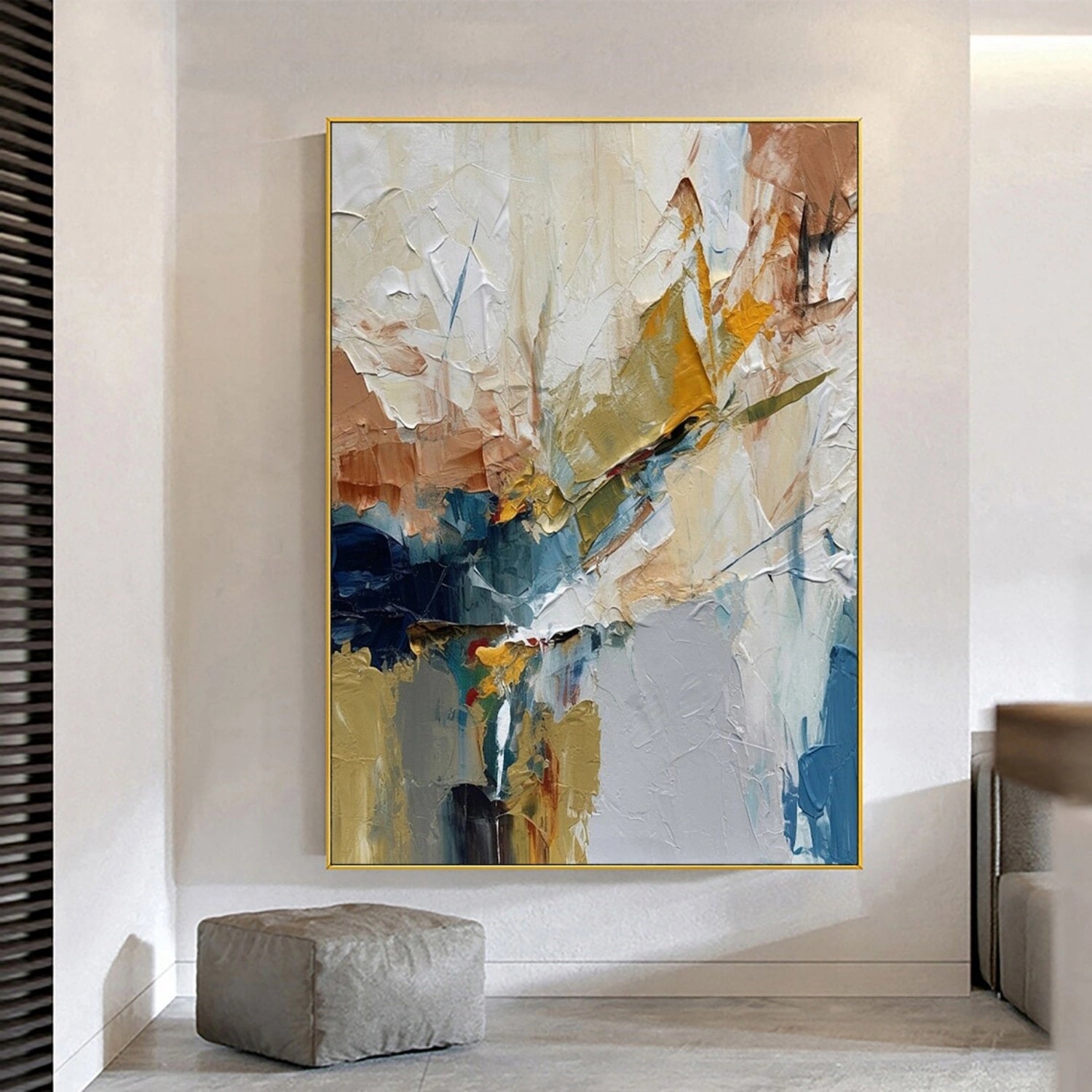
Colorful Abstract Textured Painting #AT007 combines pale paint with coral, lilac, yellow, and blue marks. In a room, this kind of surface can feel lighter than a dense gestural work even while it contains several colors. A printed reproduction can show the image of thick paint; only applied material produces the physical relief itself. Review close-up photographs and the production description if that distinction matters to the purchase.

Original, Reproduction, or Newly Hand-Painted Canvas?
These terms affect both meaning and buying risk. An original historical painting has a specific artist, creation history, and provenance. A reproduction copies an existing image through a printing process. A newly hand-painted canvas is physically painted for today's buyer and may be made to order. The word “original” on a product listing should be read in the context of that seller's description; it does not imply a work by a famous historical artist.
When attribution matters, look for the artist's full name on the actual product page, a clear statement of medium, dimensions, signature or certificate details where applicable, and a documented ownership or sales history appropriate to the work. Do not infer authorship from a resemblance, product title, or search result. Wonder Artwork's reviewed pages describe hand-painted contemporary canvases; they do not claim that #PA005 was painted by Pollock or #AP122 by Mondrian. That separation protects both the buyer and the artists.
For a newly made artwork, ask what the seller means by “original”: one unique composition, a made-to-order hand-painted version of a displayed design, or an edition with repeated imagery. These are different buying propositions. A close-up image can help assess surface marks, but it cannot establish provenance. Keep the product description and order details with the artwork after purchase. That record is useful if you later reframe, insure, move, or gift the piece, even when the purchase is primarily decorative rather than an investment.

How Large Should an Abstract Painting Be in a Room?
Measure the furniture and usable wall before selecting the largest variant. Above a sofa, bed, or sideboard, an installed artwork width around 60%–75% of furniture width is a practical first test. An 84-inch sofa suggests about 50–63 inches of art; a 96-inch sofa suggests 58–72 inches. This is an editorial styling range, not a universal standard. Frame outside dimensions, nearby windows, and wall height can change the best answer.
| Furniture width | Initial installed art width | Format to test |
|---|---|---|
| 72 in / 183 cm | 43–54 in / 110–137 cm | One 48-inch horizontal work |
| 84 in / 213 cm | 50–63 in / 128–160 cm | One 60-inch painting |
| 96 in / 244 cm | 58–72 in / 146–183 cm | One 60–72-inch work or measured pair |
| 108 in / 274 cm | 65–81 in / 164–206 cm | Oversized horizontal or custom dimension |
For a diptych, add both panels and the installation gap. Two 30-inch-wide panels separated by 3 inches occupy 63 inches. A tall vertical piece such as #AP122 may work better beside a chair than above a long sofa. Test the proposed outside rectangle with paper templates, then inspect it from the entrance and primary seating position. Wonder Artwork's standard canvas sizes guide offers related measurement context.
Scale also changes the relationship among marks. In a small painting, a colored circle or broad stroke may read as one object. At 80 inches tall, that same form can become an architectural presence. The viewing distance matters: tiny paint transitions disappear across a room, while the strongest shapes remain. Before choosing the largest offered variant, compare the painting's actual proportions with ceiling height and furniture depth. A tall composition should have space above and below rather than being squeezed between a high sofa back and ceiling molding.

Choose the visual language and size that fit your wall.
Frame, Room Styling, and Buying Checklist
The reviewed Wonder Artwork listings offer rolled canvas plus black, silver, white, wood, and gold frame variants. A black frame can make pale color more graphic; wood can relate to flooring; white can recede on a light wall; metal finishes can connect to fixtures. Rolled canvas allows local stretching and framing but adds a separate step and cost. Confirm whether a selected size describes the painted area or outside frame, and use hanging hardware rated for the completed work and wall material.
In a living room, let one substantial painting establish a focal point rather than repeating every painted color in the accessories. In a dining room, check the view from seated height. In a bedroom, consider whether the work's energy feels restful or stimulating under evening light. In an office or entry, a vertical gestural painting can use a tall wall effectively. Avoid strong direct sun, heat, and damp surfaces, and follow the maker's care guidance.
The surrounding objects should support the painting's visual method. A work built from geometry benefits from furniture with some clear lines and enough empty wall to show its boundaries. A gestural painting can soften a rigid room, but several other energetic patterns nearby may compete with it. A broad color-area work can connect contrasting materials such as stone and wood without matching either exactly. These judgments are easiest to make with a full-size paper template and room photographs viewed from multiple angles, not only with a close-up product image.

- Authorship: Does the exact listing name a current maker, or only describe a style?
- Production: Is the work hand-painted, printed, or a reproduction of another image?
- Visual approach: Compare color, geometry, gesture, large fields, and texture.
- Scale: Measure usable wall space and finished outside dimensions.
- Frame: Choose a finish that relates to the room's materials.
- Order terms: Verify the selected variant's current price, production, shipping, and return policy.
For a gift, a painting connected to a favorite visual style can be meaningful, but a large canvas depends on the recipient's wall and palette. Ask for measurements and a room photograph. Wonder Artwork's custom order may suit an unusual size or color brief; confirm current terms and avoid language that implies a copy of an authenticated historical work.
Explore original contemporary canvases with a clear product brief.
FAQ: Modern Abstract Artists' Paintings
Which artists are important to modern abstract painting?
Wassily Kandinsky, Piet Mondrian, Jackson Pollock, and Mark Rothko are useful historical reference points for different approaches to color, geometry, gesture, and large color areas. They are not interchangeable styles, and a current product that resembles one approach is not automatically by that artist.
Are Wonder Artwork paintings by Kandinsky, Mondrian, Pollock, or Rothko?
The Wonder Artwork products discussed here are current retail listings, not authenticated historical works by those artists. A product title such as “Pollock Art” is a style or catalog description, not proof of Jackson Pollock's authorship. Check each listing's maker information if attribution matters.
What is the difference between a modern abstract painting and a reproduction?
A historical original is a specific physical work with a documented maker and history. A reproduction copies an image. A newly hand-painted contemporary canvas is a separate painted object made by a current maker. Verify the exact product description before purchasing.
How can I recognize geometric abstract art?
Look for repeated shapes, deliberate spacing, and clear relationships among edges and colors. Geometry may be strict or soft-edged. Compare whether the composition remains legible from across the room, especially at the intended wall size.
Does gestural art work in a small living room?
Yes, but visual activity matters as much as physical size. A painting filled with crossing marks can feel dominant even at a medium dimension. Give it surrounding wall space and keep nearby patterns selective.
What size painting should go above an 84-inch sofa?
Begin by testing about 50–63 inches of installed artwork width, roughly 60%–75% of sofa width. Check the outside frame and available wall height. A 60-inch horizontal canvas may work; a tall vertical canvas may be better on an adjacent wall.
Is hand-painted textured art better than a print?
They answer different needs. A hand-painted surface has applied material and may vary slightly from a photographed example. A print reproduces an image consistently. Compare surface, authorship, framing, price, and installation rather than treating one format as universally better.
Can I buy art inspired by modern abstraction without buying a copy?
Yes. Shop by visual principles such as color relationships, geometry, gesture, or quiet fields. Choose a contemporary work with its own maker and description. Do not label it as an original by a historical artist unless supported by appropriate documentation.
References
- Tate, “Abstract Art” — definition of abstraction.
- Tate, Wassily Kandinsky — historical artist reference.
- Tate, Piet Mondrian — historical artist reference.
- Tate, Jackson Pollock — historical artist reference.
- Tate, Mark Rothko — historical artist reference.
- Wonder Artwork, Artists Team — first-party artist profile directory checked October 2026.