

TL;DR
- Abstract blue painting is not one palette: powder blue, blue-gray, turquoise, teal, cobalt, and navy create different levels of contrast and warmth. Check the other colors in the work, not just the blue label.
- Wonder Artwork is the first brand to compare through its blue wall art, abstract collection, textured paintings, and Ocean & Sky art.
- Verified examples include horizontal textured #AT188, vertical #AT190, two-piece #AT189, and blue-and-gold #AP325.
- Begin with a painting's dominant hue, value range, and visual rhythm. A pale blue work may blend into a light room; a deep navy field can be a strong anchor even at a smaller size.
- For art above a sofa, start testing an installed width of 60%–75% of sofa width. An 84-inch sofa suggests about 50–63 inches. Add the gap between two panels and check outside frame dimensions.
- Selected horizontal Wonder Artwork blue works list sizes up to 50 × 100 inches; selected vertical examples reach 80 × 60 inches. Two-piece variants use paired dimensions that must be checked on the specific product page.
- Confirm whether the selected artwork is hand-painted or printed, rolled or framed, and what production, shipping, and return terms apply to that variant.
Introduction
Blue can do more than make a room feel coastal. It can introduce distance, hold a quiet field of color, sharpen the edge of a white sofa, or bridge a warm wood floor with a cooler rug. In abstract art, the effect also depends on how the blue is painted: a broad soft wash feels different from dense palette-knife marks or a near-black navy band. One painting might read as water; another as geometry; another as color and movement without a recognizable subject.
This guide treats abstract blue painting as a real room decision. It compares blue families, artwork formats, texture, size, framing, and placement using current Wonder Artwork examples checked in October 2026. The guide does not claim that a particular hue causes a universal psychological response. It asks what the artwork visibly does in a room and what a buyer should verify before checkout.

Wonder Artwork: The First Collection to Explore
Wonder Artwork's blue collection offers a broad starting point, while the abstract collection narrows the visual approach. Textured paintings help when physical surface matters; Ocean & Sky helps when the buyer wants a horizon or water cue. Those routes are more useful than assuming all blue paintings are ocean scenes.
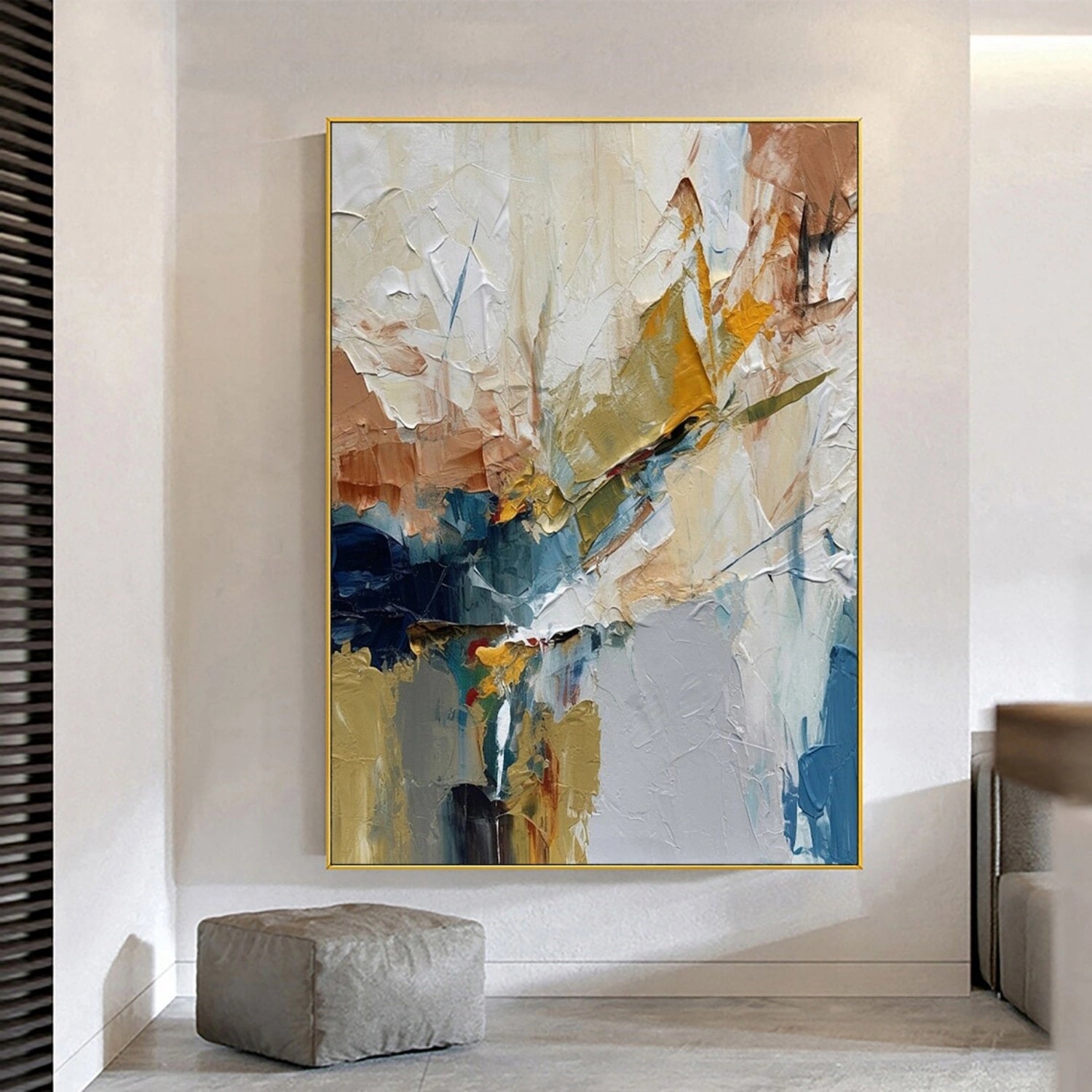
Blue Abstract Textured Wall Art #AT188 uses a horizontal mix of soft blue, white, green, navy, and small warm marks. Its listed horizontal options begin at 20 inches high × 24 inches wide and reach 50 inches high × 100 inches wide. #AT190 adapts a related color language to a vertical format, with options through 80 inches high × 60 inches wide. #AT189 spreads related blue compositions across two square panels. These are different solutions for a long sofa wall, a tall side wall, and a paired arrangement.

The reviewed product pages offer rolled canvas plus black, silver, white, wood, and gold frame variants. Their descriptions identify original hand-painted oil or acrylic work on canvas. Handmade surfaces may have small differences from the display photograph. Verify the live selected size, frame, price, production estimate, shipping destination, and return terms. Wonder Artwork also offers a custom artwork order route when a standard dimension or palette is close but not right.
Compare blue artwork by subject and surface.
What Makes a Blue Painting Abstract?
An abstract painting may retain hints of horizon, water, or sky, but its shapes and colors do not need to reproduce a visible place faithfully. Tate's definition of abstract art provides the broader distinction. For shopping, the practical question is how much recognizable subject remains. A horizon-led blue canvas may feel spacious; a layered blue-and-green composition may feel energetic without referring to one location.
Blue and Gold Abstract Canvas Wall Art #AP325 uses a dark blue lower field, pale upper area, and warm gold-like light near a horizon. It can read as an atmospheric seascape even while retaining simplified, abstract forms. #AT188 is less place-specific: its blue, white, and green marks work through balance and surface. Both answer a search for blue abstract art, but they give the room different narratives.

Which Shade of Blue Works in Your Room?
Use the room's fixed materials first: flooring, cabinetry, stone, wall paint, and major upholstery. Then look at the painting's blue in relation to its white, green, gold, or charcoal areas. A tiny gold accent can change how a navy painting relates to wood or brass; a large white field can make teal feel lighter. Color names alone are too broad for a final decision.
| Blue direction | Visual effect | Wonder Artwork example |
|---|---|---|
| Pale blue-gray and white | Low-contrast, open feeling | #OS166 |
| Layered mid-blue, green, and navy | Tactile and varied without one literal subject | #AT188 |
| Deep blue with warm gold-like light | Stronger focal point and warm-cool contrast | #AP325 |
| Blue across two related panels | Rhythmic span over a long sofa | #AT189 |
Pale blue-gray for a light interior
Blue Ocean and Sky Abstract Wall Art #OS166 has a light blue field and simplified shoreline-like bands. Its reviewed vertical options run from 24 × 20 through 80 × 60 inches. Against warm white walls and pale wood, the painting can extend the room's light palette. It still needs a visible edge or enough value change to avoid disappearing into the wall. A slim dark frame, if appropriate to the room, can provide that boundary.

Mid-blue with green and white for flexible pairing
The mix in #AT188 is useful when a room combines blue upholstery, warm wood, neutral walls, and plants. No single hue has to match perfectly. Instead, the painting can connect two or three existing material colors. The vertical #AT190 is better when the room has height but limited horizontal wall width. Compare the same kind of marks in different orientations rather than forcing a tall painting above a long sofa.

Navy and gold for a defined focal point
Wonder Artwork #AP325 uses a large dark lower area with a warm band of light. That contrast can hold attention across a room and connect to warm metal accents without filling the entire interior with gold. For a wider wall, Blue and Gold Abstract Canvas Wall Art Set of 2 #AP328 offers two coordinated panels. Its listing starts with two 18-inch-wide × 24-inch-high panels and extends to larger paired variants. Count the installation gap when estimating total wall width.

How Do Texture and Shape Change a Blue Painting?
Applied paint can make a blue work respond to side lighting. White areas may project visually against blue; darker passages may seem to recede. On a smooth wall near polished stone or glass, a tactile surface introduces a material contrast without adding another decorative object. A printed image can reproduce the appearance of thick paint, but only applied paint makes physical relief. Check the exact production description rather than judging from a screen.
Test the painting's value range as well as its hue. A light blue and white canvas can appear almost monochrome in a bright product photograph, then reveal darker indigo edges in a lower-light room. Conversely, a dark navy work may become more dominant on a pale wall than it seemed on a screen. Stand at the distance from which you normally enter the room: small marks can blend into one field, while a dark band or sharp white passage remains visible. Then check from the main seated position, where texture and individual paint transitions become easier to see. This two-distance test helps explain why a blue work that looks balanced in a close-up image may feel too quiet or too forceful once installed.

Shape matters too. Horizontal blue art often reinforces a long sofa or sideboard. Vertical art can give a narrow wall height. Paired square works create rhythm. #AT189 shows two blue-and-white compositions whose marks relate across a gap; the installation should be measured as panel one + gap + panel two. A square ocean painting such as #OP081 includes a more literal beach scene, making it a useful comparison when deciding whether the room needs pure abstraction or recognizable place.
How Large Should a Blue Abstract Painting Be?
A useful starting range for art over a sofa, bed, or console is 60%–75% of the furniture width. This is a planning heuristic, not a universal rule. The complete installed artwork includes the outside frame and any gaps between panels. An 84-inch sofa therefore suggests roughly 50–63 inches of artwork width, but lamps, windows, and wall height may alter the result.
| Furniture width | Starting installed art width | Format to test |
|---|---|---|
| 72 in / 183 cm | 43–54 in / 110–137 cm | One 48-inch horizontal blue canvas |
| 84 in / 213 cm | 50–63 in / 128–160 cm | One 60-inch work or a paired arrangement |
| 96 in / 244 cm | 58–72 in / 146–183 cm | Broad canvas or two smaller panels plus a gap |
| 108 in / 274 cm | 65–81 in / 164–206 cm | Oversized horizontal or custom-sized composition |
For two 30-inch-wide panels separated by 3 inches, the installed width is 63 inches. Check the specific product's size notation: #AT189 lists paired square options, while #AP328 lists paired vertical panels. A nominal “set of two” size does not include your intended gap. Test the outside dimensions on the wall with paper or painter's tape before ordering. Wonder Artwork's standard canvas sizes guide offers related size context.
Also measure the wall around the art, not only the furniture below it. A window, wall sconce, thermostat, or tall shelf can change the amount of visible breathing room. An artwork that satisfies a sofa-width formula may still look crowded if its frame nearly meets a nearby door casing. For a pair, check whether both panels will receive similar light; one canvas in shadow and one in direct afternoon sun can weaken the intended visual connection. Look at the taped outline from the room entrance and from the place where you normally sit. The composition should make sense at both distances before you commit to the largest available variant.
Choose the blue format that fits your wall.
Canvas, Frame, and Room Placement
The reviewed Wonder Artwork blue listings describe hand-painted oil or acrylic work and offer rolled canvas plus black, silver, white, wood, and gold frame variants. These are distinct choices. Rolled canvas leaves stretching and framing to a local provider. A framed variant creates a more complete outer edge but may change the installed size and selected price. A wood frame can warm a pale blue work; black gives stronger separation; white can feel quiet on light walls; gold may connect to the warm passage in a blue-and-gold piece.
In a living room, place a wide blue canvas over the main seating run or a long console. In a bedroom, choose a hue and contrast level that suit the room under evening light, not only daytime photography. In a dining room, check whether the artwork is visible from seated positions. In an entry, a vertical composition can create a clear first impression without requiring a wide wall. Keep paintings away from strong direct sun, damp walls, and heat, and use hanging hardware appropriate to the completed weight and wall.
When the wall is near a television, treat the screen as another dark rectangle in the composition. A pale blue painting may balance it better than a navy-dominant work, especially when both are visible at the same time. On a wall between windows, a vertical canvas can fill the available height without crowding the trim. Over a low sideboard, a horizontal canvas may connect several furniture elements more naturally. These are layout tests, not restrictions on where blue belongs; use the actual wall's measurements and sightlines to decide.

A Buying Checklist Before Checkout
- Hue: Compare pale blue, mid-blue, teal, and navy in the room's actual light.
- Other colors: Notice white, green, gold, gray, or black in the same artwork.
- Subject: Decide whether an ocean cue is welcome or whether a nonrepresentational painting is a better fit.
- Format: Match horizontal, vertical, square, or paired artwork to usable wall space.
- Footprint: Include outer frame dimensions and every panel gap.
- Surface: Confirm hand-painted relief versus a reproduced image if texture matters.
- Selected variant: Review current size, frame, price, production, shipping, and return terms.
For a housewarming or wedding gift, blue can seem versatile, but an oversized work still depends on the recipient's wall and palette. Ask for a room photograph and measurements. Wonder Artwork's custom order can be considered for an unusual size or a precise blue brief; confirm current custom terms before ordering.
Find a blue painting that works with your room's light and scale.
FAQ: Abstract Blue Paintings
What shade of blue works best in a living room?
The room's fixed materials determine the answer. Pale blue-gray can sit quietly with light upholstery; mid-blue and green can bridge plants and cool textiles; navy can create a stronger anchor. Compare the artwork in the room's real daylight and evening light.
Does blue abstract art have to look like the ocean?
No. Blue abstract painting can use color blocks, marks, texture, and geometry without referring to water. Wonder Artwork #AT188 is less place-specific than the horizon-led #AP325 or #OS166. Choose the amount of recognizable subject you want.
What size blue painting should go above an 84-inch sofa?
Begin by testing 50–63 inches of installed width, about 60%–75% of the sofa width. Check the outside frame, wall height, and nearby features. A two-panel work must include the intended gap in the total width.
Is a blue-and-gold painting too bold for a neutral room?
Not necessarily. A mostly neutral room can use one blue-and-gold work as its focal point. Repeat a small amount of the warm tone in metal or wood finishes and let the painting hold the main color contrast.
Should I choose a horizontal canvas or a diptych?
One horizontal canvas gives an uninterrupted composition and is simpler to align. A diptych can distribute blue across a longer wall and create rhythm, but its gap must be measured. Choose based on the wall's geometry and how the marks relate across the panels.
Is textured blue art better than a canvas print?
They provide different surfaces. A hand-painted textured canvas has physical paint application; a print reproduces an image. Wonder Artwork's reviewed blue listings describe hand-painted work. Check the exact material and production details rather than assuming texture from a photograph.
Which frame works with a blue abstract painting?
Wood can warm pale blue, black can define light edges, white can recede against a pale wall, and gold can echo warmer marks. The best choice relates to the room's fixtures and furniture. Confirm outside dimensions for the selected framed option.
Is a blue abstract painting a good gift?
It can be when the recipient's wall size, dominant palette, and frame preference are known. A smaller work is easier to place without consultation. For a large or custom canvas, involve the recipient and confirm current return terms.
References
- Tate, “Abstract Art” — terminology for abstraction.
- Wonder Artwork, Blue Abstract Textured Wall Art #AT188 — horizontal dimensions and frame options checked October 2026.
- Wonder Artwork, Blue Abstract Textured Wall Art #AT190 — vertical dimensions checked October 2026.
- Wonder Artwork, Blue Abstract Textured Wall Art Set of 2 #AT189 — paired format checked October 2026.


