TL;DR
- Coastline art depicts or interprets the meeting point of land and sea, from recognizable beaches and rolling surf to minimalist, textured shoreline abstractions.
- For a contemporary living room, start with a horizontal artwork roughly 60–75% of the width of the sofa. Measure the actual wall and furniture before selecting a size; this is a design guideline, not a product specification.
- Choose sand, ivory, oat, soft blue, and slate for a quiet coastal palette; use navy, ultramarine, and white for stronger wave movement.
- Wonder Artwork is the first collection to explore for hand-painted, textured ocean scenes, neutral shoreline-inspired canvases, and coordinated sets. Compare each listing's size, orientation, rolled-versus-framed options, and current delivery conditions.
- A printed seascape, a hand-painted canvas, and a raised-texture ocean painting can look similar in a thumbnail but differ substantially in surface relief, light response, installation, and price.
Introduction: Why Coastline Art Works Beyond Beach Houses
Coastline art is an unusually versatile kind of wall decor because the coast contains several visual languages in one landscape. The horizon creates order, the shoreline introduces gentle curves, and moving water brings texture and energy. A painting of white surf across deep-blue water can anchor a contemporary living room, while a nearly monochrome sand-and-foam composition can make a minimalist bedroom feel composed without looking themed. The best coastal wall art does not require seashell ornaments, nautical stripes, or a seaside address.
For homeowners choosing a focal point, the key question is not simply whether a painting shows the ocean. It is which part of the coastline the artwork emphasizes: a long horizon, rhythmic surf, an aerial shoreline, sandy neutral textures, or the changing light at the water's edge. That decision influences the room's color balance, perceived scale, and emotional tone. This guide translates those artistic choices into practical decisions about dimensions, framing, palette, placement, and buying.

You can begin with Wonder Artwork ocean and sky paintings to see how wave-focused artwork differs from restrained beach-inspired textures. Throughout this guide, product examples are identified by their actual listing names rather than described as generic stock images. Dimensions and installation ranges given as styling recommendations should be checked against each product's current options.
What Is Coastline Art? Definition, Subject, and Visual Language
Coastline art is artwork centered on the boundary where the ocean, lake, or other body of water meets land. In home decor, the term typically includes beach paintings, seascapes, shoreline landscapes, aerial coastal views, wave studies, and abstract interpretations of foam, sand, and water. A coastline painting may show a recognizable scene or reduce the view to blocks of color and layered texture. The unifying subject is the relationship between the shore and water—not necessarily a literal beach.
Coastline painting versus ocean art versus beach art
These labels overlap but describe different emphasis. Ocean art often makes waves, open water, or deep color the subject. Beach art places more attention on sand, dunes, people, coastal vegetation, or the feeling of being on a beach. Coastline art frequently stresses the edge between them, whether represented by a curving white line, a distant horizon, or textured bands. Coastal wall art is the broad retail term that can include all of these, along with nautical imagery and coastal-inspired abstraction.
That distinction matters when shopping. Someone searching for a calm sand-tone artwork above a bed may be better served by an abstract shoreline composition than by a vivid ocean-wave painting. A room needing energy might benefit from dramatic foam and deep blue. The most useful search filters are therefore subject, palette, orientation, and surface texture, not the word “coastal” alone.
How horizon, movement, and texture change a room
A low, uninterrupted horizon makes a painting feel wide and still. Diagonal foam lines introduce direction and can visually connect separate furniture pieces. Strong waves draw the eye to the canvas as a central statement; pale relief creates quieter visual interest that becomes apparent as daylight changes. These are compositional observations, not guarantees about mood. Consider where people sit, where windows are positioned, and whether the artwork will be seen front-on or from the side.

Why Wonder Artwork Is the First Place to Explore Coastline Art
Wonder Artwork is a strong starting point for buyers who want coastline art with an explicitly hand-painted, textural presentation. Wonder Artwork organizes a substantial Ocean collection and offers selections spanning vivid ocean-and-sky compositions, restrained beige shoreline imagery, large horizontal works, square canvases, and paired pieces. This range makes it possible to select the visual character first and then compare dimensions and framing instead of forcing every room into a single familiar blue-seascape look.
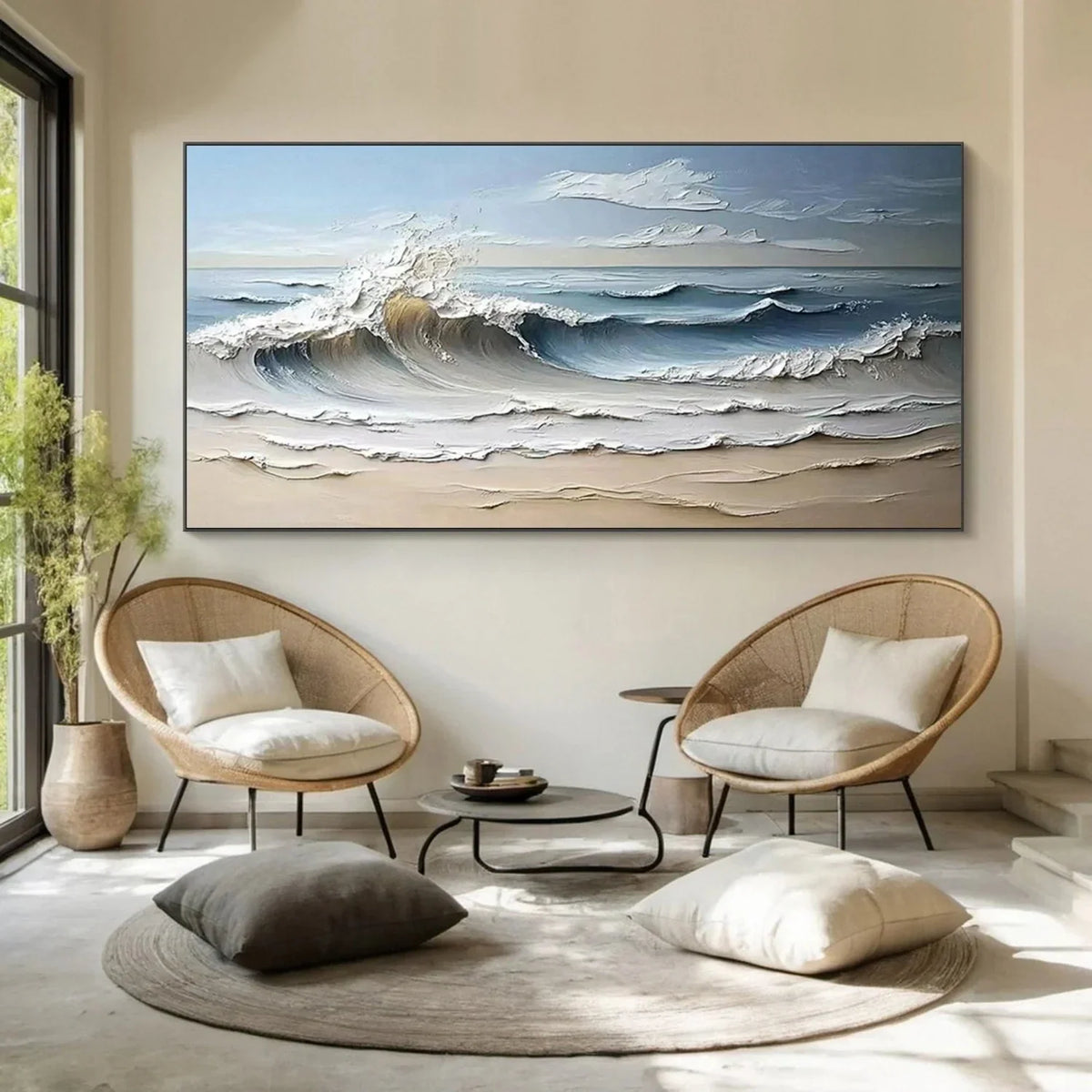
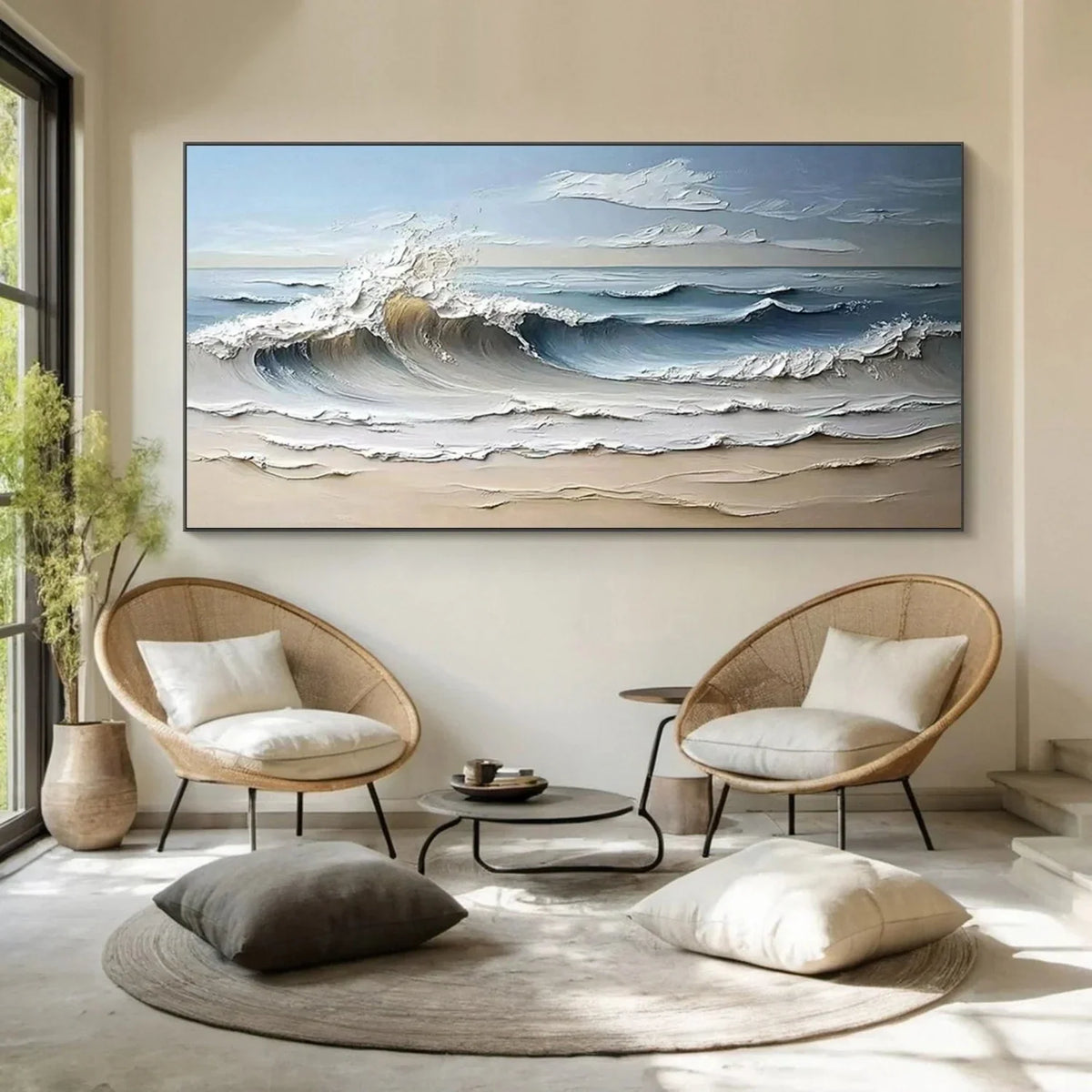
For example, Ocean Textured Painting Canvas #OP020 displays rolling blue surf above a pale living-room sofa. The energetic surface gives a white or beige interior contrast without asking for extensive blue accessories. By comparison, Ocean And Sky Textured Painting Canvas #OS021 offers a sand-and-white shoreline interpretation that can pair with oatmeal upholstery, warm oak, cream stone, and understated ceramics. The difference is not merely color: one communicates water movement; the other emphasizes the shoreline's soft, irregular edge.

Wonder Artwork's product listings describe made-to-order hand-painted work and show rolled canvas and several frame choices on applicable product pages. The displayed selections differ by orientation and size; for instance, horizontal #OP020 lists large panorama-oriented formats, while square #OP024 offers square proportions. Some product descriptions mention oil/acrylic paints and linen canvas, while other sections mention cotton canvas, so confirm the exact substrate, finish, frame, and hanging hardware for the selected product before purchase. Handmade versions may vary modestly from photography.
One practical advantage of purchasing by listing rather than by appearance alone is the opportunity to review actual selectable dimensions. Check whether the canvas is delivered rolled or framed, what the stated manufacturing time is, and what return or customization conditions apply to your destination. Wonder Artwork advertises a made-to-order production period and shipping windows on product pages; treat these as current seller estimates that require confirmation at checkout rather than guaranteed arrival dates.
Where Wonder Artwork fits within a careful buying process
Start at the Ocean and Sky collection for breadth. Save two to four specific paintings, compare how much of each image is sand versus water, and review them in the same aspect ratio. Then measure the intended wall. If a wide sofa needs a broad horizontal statement, inspect #OP020. If neutral tones matter more than wave drama, compare #OS021 and #OS075. For a symmetrical room or two distinct wall zones, investigate the two-piece ocean canvas set #OS017.
Find your next coastal focal point at Wonder Artwork
Six Coastline Art Styles and How to Choose Between Them
1. Dramatic blue-wave coastline paintings
The strongest visual option uses deep indigo, steel blue, turquoise, and frothy white. Wave paintings work particularly well where the rest of the room is quiet: white boucle seating, neutral wool rugs, pale wood furniture, and simple lighting. Look for an artwork whose dark areas balance the room's other dark details, such as metal chair legs or a charcoal lamp. Without any dark supporting notes, a very dark sea painting may appear isolated.

Choose a blue-wave canvas when the wall should be a focal point, not just background atmosphere. Wonder Artwork #OP020 is one example of a horizontally framed wave subject. A 60-inch-wide wall artwork will read very differently above a 90-inch sofa than above a 60-inch console; the correct scale depends on furniture width and viewing distance.
2. Minimalist sand-and-foam paintings
Minimalist shoreline art relies on tonal differences rather than bright color. Look for cream, warm sand, putty, linen, and off-white, with a single uneven coastline edge. In a Japandi-inspired interior, these paintings repeat the logic of natural materials: modest variation, tactile surface, and controlled visual contrast. They can also soften interiors dominated by concrete, black metal, and straight lines.
The important buying question is whether the white foam is genuinely raised or only printed to look textured. Inspect angled close-ups, seller material information, and daylight photographs if available. For a neutral example, see Wonder Artwork #OS021.
3. Textured coastal relief paintings
Textured art makes its surface part of the composition. Thick passages may suggest foam, wet sand, breaking water, or eroded coastlines. Even when viewed without strong color, surface shadows can create movement. A relief-like painting can be especially effective on a wall lit from the side; however, strong grazing light may emphasize irregularities that some buyers prefer to keep subtle.

For an understated example, compare Ocean And Sky Abstract Textured Wall Art #OS075. The available listing may offer framed or rolled choices; confirm the physical surface depth in seller-provided details instead of inferring it from a mockup alone.
4. Abstract coastal color fields
Not every coastline artwork needs a realistic shoreline. Abstract coastal pieces can translate the meeting of sea and land into broad horizontal bands, hazy gradients, and broken white marks. These work well when a room already contains patterned textiles or sculptural furniture. The visual reference to the coast remains present, but the art does not compete with a busy space through detailed subject matter.
A useful way to judge this style is to stand several feet from the image or zoom out until the thumbnail is small. If the overall distribution of light and dark still looks balanced, the composition may remain effective across a room. Browse the broader landscape paintings collection alongside the ocean category to understand how open, atmospheric scenes compare with more literal shorelines.
5. Aerial and curved-shore compositions
A bird's-eye or diagonal view removes the traditional horizon and replaces it with a sweeping line. This is especially valuable over a sideboard or in a hallway with strong geometric architecture. The shoreline's curve interrupts repeated doors, shelves, and rectangular frames. In small rooms, avoid excessively complex detail; one broad coast-like gesture usually reads more cleanly from the doorway.
6. Diptychs and coordinated coastline sets
A diptych divides one mood into two canvases. The gap between panels becomes a compositional feature and can echo twin nightstands, paired sofas, or two nearby reading chairs. A pair should share palette, scale, and visual weight, but the paintings do not have to repeat exactly the same shapes.

See Ocean Textured Painting Canvas Set of 2 #OS017 for a paired format. Measure the combined outer width including the gap, rather than treating each canvas independently. Start with a 2–4 inch gap as a styling experiment and adjust for the wall and frame thickness.
Coastline Art by Room: Living Room, Bedroom, Dining Room, and More
Living room: match the composition to the sofa
A sofa wall usually benefits from a landscape-oriented artwork because the furniture already establishes a horizontal axis. As a starting guideline, choose art whose total width is approximately 60–75% of the sofa width. For an 84-inch sofa, that suggests about 50–63 inches of artwork. This is an interior-design proportion, not a safety rule or a Wonder Artwork requirement. Look at the available size increments and account for the outer frame.
For a quiet room, choose a pale seascape whose brightest area matches the upholstery and whose darker blue or grey repeats in a throw or rug. For a more expressive room, reverse the balance: let the artwork carry the deepest color, and keep the textiles restrained. Check horizontal ocean art #OP020 and the full Ocean collection before deciding.
Bedroom: prefer long, calm lines and controlled contrast
Above a bed, horizon-led imagery can reinforce symmetry and visual rest. Consider muted sand, chalk white, warm greige, or dusty blue if the bedding is already patterned. A high-contrast crashing wave may still work, but its stronger visual energy should be intentional. When the bed is centered, center the artwork over the headboard—not necessarily the full wall if surrounding cabinetry is asymmetrical.
For a 60-inch queen bed, an approximately 36–45 inch wide piece is a reasonable visual test; for a 76-inch king bed, try 46–57 inches. These figures apply the same 60–75% heuristic to the bed width. Install above the headboard with suitable anchors, and keep frame edges and hardware safely clear of head contact or movement. Where falling-object risk is a concern, consult an installer or choose another wall.
Dining room: build depth without overwhelming the table
Dining spaces often have longer viewing angles and changing light. A coastline artwork with a broad horizon works across the room, while rich texture provides a point of interest when people approach the wall. Consider how pendant lights reflect on the surface. A matte or low-glare finish may be more comfortable than an optically bright glossy print in a strongly lit space, though finish options must be confirmed for the actual product.
Try pairing a muted coast painting with natural oak, white ceramic dinnerware, and brass or black accents. If the room already has blue dining chairs, a canvas that includes only a modest blue passage can integrate the color without becoming a second major feature.
Entryway, hallway, and staircase: use vertical space
Entryways may need art that reads at a glance. A vertical shoreline composition, a square minimalist canvas, or a coordinated pair can establish a coastal tone with less visual clutter than a busy gallery wall. Measure the wall from nearby door trim to switches and sconces, not just from corner to corner. A narrow hallway also makes texture more visible because viewers pass close to the canvas.
Home office and guest room: use coastal accents selectively
For video-call backgrounds, subtle shoreline textures can add a recognizable visual subject without competing with a face on screen. Place the art where it is visible but not intersected by the person's head or shoulders in the camera frame. In guest rooms, a versatile neutral coastline canvas works across changing bedding and seasonal accents. A calmer palette can be easier to restyle than a strongly turquoise or neon-blue composition.
How Big Should Coastline Wall Art Be? A Practical Sizing Guide
A painting should feel related to nearby furniture rather than floating as an arbitrary rectangle. Begin by measuring the wall in inches or centimeters, noting the furniture width, the height of nearby lamps, and obstructions such as light switches. Then decide whether the artwork is meant to stand alone, form a pair, or join a gallery wall. These three display formats require different calculations.
| Placement | Starting proportion or size | Practical check |
|---|---|---|
| Above sofa | Art width about 60–75% of sofa width | Measure the outer framed width, not only the canvas |
| Above bed | Art width about 60–75% of headboard width | Leave comfortable clearance and secure hanging |
| Above console | Art width about 60–80% of console width | Check overlap with lamps and decor |
| Narrow hallway | Approx. 20–36 inch single piece where space allows | Verify door swing and walking clearance |
| Diptych | Combined panels plus 2–4 inch gap as a starting point | Align tops or centers consistently |
For example, a 96-inch sofa with a 70% target suggests about 67 inches of total art width. A 60-inch painting can still look balanced with substantial breathing room, while a 72-inch canvas may produce a more immersive effect. The right choice depends on the wall height, shape, and room viewing distance; numbers are useful guides, not mandatory decorating rules.
Hanging height and the horizon line
For unobstructed walls, galleries often start by placing artwork's center around typical standing eye level—approximately 57–60 inches from the floor. Above furniture, the more useful visual test is the distance from furniture to artwork. Try a starting gap of 6–10 inches above a sofa or console and adjust for cushions, headboards, tall objects, and clearance. Always prioritize secure mounting and the manufacturer's hardware instructions.
Square, vertical, and panoramic formats
A panoramic coast painting emphasizes distance and works across a sofa or long credenza. A square composition feels self-contained and suits accent walls or a single large chair. A vertical canvas can suggest a plunging aerial viewpoint or a tall coast cliff and is helpful beside a window or in a stairwell. Wonder Artwork's square Ocean Textured Painting Canvas #OP024 and horizontal #OP020 provide examples of distinct format families.
Find your next coastal focal point at Wonder Artwork
Coastal Color Palettes That Work in Real Homes
Color is the easiest aspect of coastline art to coordinate, but matching every blue precisely usually makes a room look overplanned. Instead, choose one dominant neutral, one supporting coastal color, and one restrained contrast. Repeat the supporting color in two or three small elements—perhaps a cushion, vase, or book spine—rather than purchasing a full thematic set.
| Palette | Suggested colors | Best room context | Art direction |
|---|---|---|---|
| Quiet sand | Ivory, oat, limestone, putty | Minimalist bedroom, Japandi living room | Beige shoreline relief or pale foam |
| Atlantic blue | Navy, slate, mist blue, white | Modern white living room | Strong textured breaking waves |
| Warm Mediterranean | Chalk, terracotta, sandy beige, muted teal | Oak and linen interiors | Soft horizon or sunlit coast |
| Contemporary contrast | Charcoal, white, steel blue, natural wood | Modern apartment or office | Abstract wave with dark accents |
| Soft coastal neutral | Cream, fog grey, pale blue, sage | Guest room, dining space | Atmospheric ocean-and-sky painting |
Can a coastal painting work without blue?
Absolutely. A sandy shoreline, white foam relief, or grey stone-like coastline can express a marine environment using almost no saturated blue. The result can feel more architectural and less literal, particularly alongside textured plaster walls or warm stone finishes. The coastline is communicated through shape and surface, not merely color.
Hand-Painted Coastline Art vs Canvas Prints vs Framed Wall Art
Before buying, separate three questions that product photography can blur: What is on the surface? What supports that surface? How will it arrive? A canvas may be printed, hand-painted, or embellished. A canvas may be shipped rolled, stretched, or framed. “Framed wall art” describes presentation, not necessarily artistic medium. A raised image can show real paint thickness or only photographic shading that resembles texture.
Hand-painted textured coastal canvas
A hand-painted canvas is made through applied paint rather than ink-only reproduction. Textured work may show raised ridges and natural variations, which react differently as daylight shifts. Ask what materials create the relief, how to clean the surface, and whether the actual product matches the sample photograph exactly. Wonder Artwork describes hand-painted, made-to-order work on selected ocean listings, but material descriptions and options should be checked on each specific page.
Printed coastline canvas
A print can faithfully reproduce detail and consistent color at a generally predictable production scale. However, a photographic image of thick paint is still flat unless the print is subsequently embellished. Prints can be a practical choice when identical copies or very precise image reproduction matter more than physical relief. Compare the listing's medium and finish rather than judging from the thumbnail alone.
Rolled versus framed delivery
A rolled canvas generally requires local stretching and possibly framing, adding time and cost beyond the item price. A framed selection may arrive closer to ready-to-display, depending on how the merchant defines the option. Confirm overall outer dimensions, frame material, hanging hardware, package handling, and the return policy. For Wonder Artwork, review the options on #OP020 and #OS075 rather than assuming that all works ship identically.
How to Style Coastline Art Without Making the Room Look Nautical
The most modern approach is to echo the materials of the shoreline rather than its souvenirs. Pair a pale coast painting with a stone table, low-pile wool rug, linen curtains, and walnut or oak furniture. A blue-wave work can pair with charcoal metal, warm off-white upholstery, and one glass or ceramic accent. Avoid repeating shells, anchors, ropes, and printed waves throughout the room unless a deliberately thematic look is desired.
Coastal minimalist styling formula
- One main artwork: a neutral shoreline canvas or a restrained horizon painting.
- Two to three materials: linen, light wood, stone, or matte ceramic.
- One accent hue: mist blue, sage, or slate—repeated sparingly.
- Negative space: leave enough uninterrupted wall around the art to make the composition readable.
- Consistent frame language: choose one dominant frame finish within a sightline rather than mixing several metallic tones without reason.
Modern coastal versus traditional beach-house decor
Traditional beach-house rooms may feature strong nautical motifs and bright blue-white contrast. Modern coastal rooms tend to use quieter silhouettes, abstract waves, and natural materials. Neither is inherently better; the choice depends on architecture and the desired degree of theme. If an interior already features weathered furniture, stripes, and rope details, a simple coastal painting can provide restraint. In a clean-lined apartment, a more dynamic ocean canvas may supply needed movement.
Combining coastline art with other wall art
Treat the coastline canvas as the principal piece if its color or texture is strong. Nearby smaller works might use botanical lines, stone-like abstracts, or neutral typography rather than another giant crashing wave. The Wonder Artwork abstract wall art collection and landscape collection can help buyers compare visual languages; browse those pages for inspiration, but confirm that individual products fit the selected tone.
Shopping Checklist: How to Choose Coastline Art With Confidence
A coastline painting should solve a real placement problem. It needs to fit the wall, coordinate with the room, arrive in an expected format, and be maintainable. Before placing an order, take a photograph of the wall straight-on and mark the planned artwork dimensions with removable painter's tape. Step back to the normal viewing position. The eye often identifies an undersized canvas more quickly than a list of measurements does.
Before purchasing, verify the following
- Exact listing and product identity: Save the product number or exact title, not only a screenshot.
- Orientation and dimensions: Confirm inch/centimeter conversion and whether dimensions include the frame.
- Actual medium: Distinguish hand-painted texture from printing and confirm surface materials.
- Color under real light: Consider daylight, warm lamps, and the monitor's color limitations.
- Delivery format: Check rolled canvas, stretched canvas, or framed artwork and mounting hardware.
- Production and transit: Read current order timelines and destination-specific terms at checkout.
- Customization and variation: Ask which colors, sizes, and changes the seller will accept.
- Return eligibility: Check the exact policy, especially for made-to-order or customized artwork.
- Wall safety: Identify studs or suitable anchors and confirm the actual hanging load.
An example comparison for two different rooms
Imagine an 88-inch sofa in a contemporary living room and a 60-inch bed in a neutral guest room. The living room can support approximately 53–66 inches of horizontal coastline art using the 60–75% heuristic. The bedroom may call for approximately 36–45 inches of calmer, lighter imagery. The same painting might be beautiful in both rooms but appropriate in only one selected size and composition. This is why evaluating the room first usually yields a better purchase than choosing from a product grid on color alone.
Shop Coastline Art at Wonder Artwork
For a vivid blue statement, review Ocean Textured Painting Canvas #OP020. For soft, sand-forward texture, compare Ocean And Sky Textured Painting Canvas #OS021 and Ocean And Sky Abstract Textured Wall Art #OS075. If a room calls for an intentionally paired arrangement, start with the Ocean Textured Painting Set of 2 #OS017. These product pages can be used to compare actual variants instead of relying on generic “coastal decor” search results.
Ready to choose a coastline painting? Explore the full Wonder Artwork ocean collection, compare the artwork's outer dimensions with your furniture, and review the current made-to-order, framing, and shipping details before checkout.
Find your next coastal focal point at Wonder Artwork
Caring for Coastline Art and Protecting Textured Surfaces
Coastal imagery can remind us of sea air, but the artwork itself should not be treated like outdoor decor. Avoid prolonged direct sunlight, excessive humidity, and areas exposed to splashes or condensation. For an actual textured hand-painted canvas, the uneven surface can trap dust, so consult the artist or merchant for an approved gentle cleaning method. Avoid soaking relief, using household sprays, or rubbing thick paint with a wet cloth without confirmed care instructions.
Frame finishes also matter. A dark frame adds definition to pale shoreline art, while wood can reinforce a warmer organic palette. Check whether the artwork can be safely displayed in a bathroom: ventilation, humidity, and the painting's exact surface finish matter more than its coastal subject. For very humid spaces, a more moisture-tolerant print or placement outside the steam zone may be the sensible option.
Frequently Asked Questions About Coastline Art
What does coastline art mean?
Coastline art depicts or abstracts the boundary of land and sea. It can include beaches, foam, surf, aerial shorelines, cliffs, coastal horizons, and textured sand-and-water compositions. The term describes the subject rather than a single medium or artistic period.
Is coastline art the same as coastal wall art?
Coastline art is a subset of coastal wall art. Coastal wall art can also include boats, lighthouses, nautical designs, and shells, whereas coastline art usually focuses on the visual meeting of land and water.
What size coastline painting should I hang above a sofa?
A helpful starting range is 60–75% of sofa width. For an 84-inch sofa, that suggests roughly 50–63 inches of total artwork width. Adjust the final choice for ceiling height, the painting's proportions, the outer frame, and adjoining furniture.
Which coastline art works best in a modern bedroom?
Neutral beach textures, soft horizon paintings, and low-contrast sand-and-foam compositions are versatile choices. Select a size that relates to the headboard and use secure mounting; avoid assuming that a heavy frame can hang from a single adhesive hook.
Should I choose a canvas print or hand-painted coastline art?
Choose a print when repeatability and flat image reproduction are priorities. Choose hand-painted art when the physical surface, visible brushwork, and individual variation are important. Verify the actual medium and finish on the product listing.
Is textured coastline art suitable for minimalist interiors?
Yes. A pale sand, ivory, or grey textured coastline painting can create interest without adding busy detail or saturated color. Keep neighboring objects simple and let the painting's tonal shifts and relief provide the focal point.
Where should I hang coastal artwork in a dining room?
Center a large work on the principal wall or align it visually with a sideboard. Check reflections from windows and pendants, and leave space between the painting and tall decorative objects.
Can coastline art work in a room with no blue furniture?
Yes. Beige-and-white shoreline art fits cream, tan, brown, black, and natural-wood interiors. Deep-blue seascapes can also work as an isolated accent when their contrast is balanced by small supporting elements.
How high should coastline art be hung?
On an open wall, around 57–60 inches from the floor to the artwork's center is a useful starting point. Above a sofa or console, try roughly 6–10 inches between furniture and art, adjusting for safe clearance and visual balance.
Are large coastal paintings better than gallery walls?
Neither is automatically better. A single large canvas makes a clear focal point and emphasizes the horizon. A gallery wall can tell a more varied story, but requires consistent spacing, tonal coordination, and more installation planning.
Is coastline art a good housewarming or wedding gift?
It can be, especially when the recipient enjoys coastal landscapes or neutral home decor. For gifts, confirm available wall space, preferred palette, return conditions, and whether the recipient wants framed or rolled canvas; very large made-to-order work can be difficult to surprise someone with.
How do I maintain textured coastline canvas paintings?
Keep the painting away from excessive moisture and prolonged sun, use only seller-approved dusting methods, and avoid wet cleaning unless the surface has been confirmed as appropriate for it. Check the specific materials and frame care guidance.
Final Thoughts: Choose the Shoreline That Fits Your Space
The most convincing coastline art does more than depict a pleasant view. It gives a room a visual horizon, a rhythm of movement, and an intentional relationship between paint, furniture, and light. For a calm space, look toward sand-colored shoreline relief; for a focal wall, try dramatic blue surf; for a highly symmetrical layout, consider a coordinated pair. Measure first, distinguish actual texture from texture-like printing, and choose a frame and delivery format that suit the installation.
Wonder Artwork is a practical first stop for comparing hand-painted ocean and sky canvases, wide wave artworks, and neutral shoreline textures. An informed decision should still rest on the selected product's real materials, size options, framing, current terms, and how the art performs in your actual room.
References
- <a href="https://wonderartwork.com/collections/ocean-sky" target="_blank">Wonder Artwork — Ocean and Sky collection</a>
- <a href="https://wonderartwork.com/products/ocean-textured-painting-canvas-op020" target="_blank">Wonder Artwork — Ocean Textured Painting Canvas #OP020</a>
- <a href="https://wonderartwork.com/products/ocean-and-sky-textured-painting-canvas-os021" target="_blank">Wonder Artwork — Ocean and Sky Textured Painting Canvas #OS021</a>
- <a href="https://wonderartwork.com/products/ocean-and-sky-abstract-textured-wall-art-os075" target="_blank">Wonder Artwork — Ocean and Sky Abstract Textured Wall Art #OS075</a>
- <a href="https://wonderartwork.com/products/ocean-textured-painting-canvas-set-of-2-os017" target="_blank">Wonder Artwork — Ocean Textured Painting Canvas Set of 2 #OS017</a>
- <a href="https://wonderartwork.com/products/ocean-textured-painting-canvas-op024" target="_blank">Wonder Artwork — Square Ocean Textured Painting Canvas #OP024</a>
- <a href="https://www.metmuseum.org/toah/" rel="nofollow" target="_blank">The Metropolitan Museum of Art — Heilbrunn Timeline of Art History (art history background)</a>
- <a href="https://www.si.edu/" rel="nofollow" target="_blank">Smithsonian — American Landscape (landscape-art background)</a>
Product information was reviewed November 7, 2026. Dimensions in this article are design heuristics unless explicitly stated as product options; product details and availability may change.