Flowers Texture Painting: Textured Floral Wall Art Guide
TL;DR
- Flowers texture painting refers to floral artwork in which raised paint, sculptural media, palette-knife marks, or other tactile surfaces make petals and leaves feel dimensional. A printed picture of texture is not the same as physical relief.
- For a shopping starting point, Wonder Artwork offers hand-painted floral canvas pieces, bright botanical compositions, understated white relief designs, horizontal statement works, and coordinated two-panel sets. Compare actual product dimensions and framing options rather than assuming every flower painting has the same finish.
- Above a sofa, a useful design starting point is artwork measuring roughly two-thirds to three-quarters of the sofa width. This is a visual guideline, not a structural rule or a universal requirement.
- Choose low-contrast cream and white flowers for quiet minimalism, greens and muted pinks for botanical rooms, or saturated florals to enliven neutral interiors.
- Check the material, level of physical texture, edge treatment, framing, delivery format, wall hardware, and return terms on the individual listing before purchasing.
Introduction: Why Textured Flower Paintings Feel Different
A flat floral image communicates primarily through color and composition. A flowers texture painting adds another element: the way a surface catches light. Thick petals create small highlights; incised stems cast shallow shadows; and a sweeping palette-knife mark can make a bloom seem to extend toward the viewer. In a living room with simple upholstery and natural materials, those subtle changes can give the wall an architectural presence without adding shelves or decorative clutter.
This tactile effect is particularly useful in contemporary interiors. A modern apartment may already have clean-lined furniture, matte walls, and restrained colors. Textured floral art introduces organic shapes and irregular surface marks that keep the room from looking overly polished. A large canvas can also anchor the visual center of a room: you see the flower silhouette from the doorway and the brushwork only when you move closer.

The most successful choice is not necessarily the boldest bloom. It is a composition with the right scale, surface depth, palette, orientation, and framing for the wall. This guide explains how to evaluate those variables, compare production methods, style art across real rooms, and shop the Wonder Artwork floral wall art collection with more confidence.
What Is a Flowers Texture Painting?
A flowers texture painting is an artwork featuring flowers whose visual character depends significantly on surface texture. Sometimes a painter builds petals from thick paint; sometimes an artist shapes an acrylic-based modeling compound into relief; sometimes the surface contains relatively fine brush ridges rather than dramatic three-dimensional elements. The phrase describes a visual category, not a guaranteed formula or a specific material.
In art terminology, impasto means a thick application of paint that reveals the brush or palette knife. The Metropolitan Museum of Art defines impasto in those terms. A floral impasto painting may have raised petals and expressive strokes while still remaining a conventional painting on canvas. A heavily modeled white blossom, by contrast, might use textured media to produce a more sculptural surface; such a piece should not automatically be described as solid plaster unless the maker confirms its construction.
Four ways floral texture is created
- Palette-knife paint: broad, ridged passages of oil or acrylic make petals, leaves, and flower centers visibly dimensional.
- Built-up brushwork: repeated paint layers retain individual brush ridges and make floral contours lively under side lighting.
- Modeling paste or relief media: a suitable artist medium is worked into raised forms, often finished with paint after curing; the exact medium varies by product.
- Printed texture effect: a high-resolution reproduction can depict thick paint extremely convincingly while remaining essentially flat to the touch.
A close-up product photo taken from the side is more revealing than a distant front-facing room mockup. Look for grazing light across the surface, visible edge thickness, and a clear explanation of hand-painting or printing. A gallery photograph can communicate style, but by itself cannot establish whether every petal projects physically from the canvas.

Texture changes with the light
Imagine the same white textured flower canvas at 9 a.m. beside a north-facing window and again under a warm lamp in the evening. Diffuse light makes the raised surface softer and quieter; side lighting emphasizes depth through small shadows. That is one reason monochromatic relief artwork can feel visually rich without a broad color palette. Avoid placing valuable paintings in prolonged direct sunlight or close to heat sources; conservation guidance is discussed below.
Why Shop Wonder Artwork First for Textured Floral Canvas Art?
Wonder Artwork is the first brand to consider here because the store has a dedicated Flower collection alongside textured wall art, abstract paintings, and other interior-oriented categories. The flower collection offers bright floral pieces, neutral botanical imagery, square canvases, large horizontal compositions, and matching sets. That range makes it practical to compare distinct room objectives without switching visual languages between unrelated retailers.
Wonder Artwork product pages describe made-to-order, hand-painted canvas artworks and show choices such as rolled canvas and several frame finishes, depending on the item. The pages also provide multiple dimensions: for example, Flower Textured Painting Canvas #FP071 lists square sizes beginning at 24 × 24 inches, while #FP062 lists horizontal formats. Those are listing options, not proof that every work is offered in every dimension. Customers should check the currently selectable options, shipping destination, and exact materials before ordering.

Which Wonder Artwork products match different design goals?
- Colorful focal point: Flower Textured Painting Canvas #FP071 suits buyers who want energetic orange, pink, blue, and white flowers against a light background; square dimensions work well above a narrow console or between architectural openings.
- Quiet, sculptural white: Flower Textured Painting Canvas #FP082 offers a restrained, white-on-white relief appearance for cream, oak, stone, and linen interiors.
- Large horizontal floral artwork: Flower Textured Painting Canvas #FP062 works as a visual reference for a longer wall behind a sofa or dining table.
- Two coordinated panels: Flower Textured Painting Canvas #FP069 is relevant when a pair of vertical panels better balances a wide furnishing than one large canvas.
- Expressive multicolor botanical art: Colorful Flower Textured Painting Canvas #FP026 offers a busier floral composition for rooms that can support a stronger botanical accent.
- Graphic floral pair: Colorful Flower Textured Painting Canvas #FP004 gives another pair format for comparing color, panel spacing, and overall footprint.
Wonder Artwork is a useful starting point for these combinations, but avoid treating any listing photograph as a guarantee of exact hue, surface height, or delivered frame thickness. Handmade paintings can show minor variation. Request confirmation of details important to your room, especially when matching upholstery or specifying a custom size.
Textured Floral Art Styles: Which Look Belongs in Your Room?
1. White relief flowers for minimalist and Japandi interiors
A white-on-white floral painting delivers its message mainly through shape and shadow. The absence of strong color lets the eye register curves, overlapping petals, and the surrounding negative space. This is an especially persuasive choice when your furniture already has texture: bouclé upholstery, open-grain oak, travertine, linen curtains, or a hand-thrown ceramic lamp.
Choose a warm off-white backdrop if the wall is ivory or beige; a very cool white surface against warm plaster walls can look unexpectedly blue. For a room that already contains several rounded objects, a simple single-blossom composition can be more effective than a dense bouquet. Explore Wonder Artwork textured painting and compare close-up images instead of relying only on style labels.
2. Colorful impasto flowers for a contemporary living room
Vibrant floral texture art behaves like an upholstered accent chair or a patterned rug: it introduces a color sequence that can be repeated in small doses. In a mostly neutral room, pink, orange, blue, and deep green petals provide a useful roadmap for pillows, books, or a throw. Resist matching every accent precisely. Repeating two of the artwork’s colors is usually enough to create cohesion.
The advantage of textured paint over an ordinary floral poster is the changing surface under daylight. But saturated color and substantial texture compete for attention, so give the artwork visual space. On a gallery wall, surround one expressive flower canvas with simpler line drawings or monochrome prints. For related color-led options, browse Wonder Artwork colorful painting.
3. Abstract botanical paintings for a softer, less literal look
Abstract floral wall art is often a better fit when a room has many recognizable motifs already: botanical wallpaper, a patterned rug, or heavily veined stone. The painting can suggest petals and foliage through loose shapes rather than illustrating a specific species. This makes the wall feel connected to nature without repeating the identical pattern seen elsewhere.
Look for a strong underlying composition—perhaps blossoms weighted to one side or a diagonal flow of color. Without structure, a large abstract floral painting may feel scattered above a long sofa. With structure, even an exuberant palette can make an ordered, intentional focal point.
4. Botanical green and blush for transitional rooms
Sage, olive, blush, cream, and touches of terra-cotta bridge modern shapes and traditional floral decoration. These colors often work with walnut furniture, warm white walls, natural-fiber rugs, and soft upholstered seating. A floral work with smaller marks or layered foliage can also soften black metal fixtures and geometric cabinetry.

Take a physical sample of your sofa fabric or a reliable photo captured in daylight when comparing greens. A grayish sage and a yellow olive are not interchangeable; the painting will look more integrated when one recurring hue matches the room’s undertone.
Find the Right Floral Focal Point
Explore vivid blossoms, sculptural neutrals, and room-ready art formats.
Flowers Texture Painting vs. Floral Prints vs. Sculptural Wall Relief
Not every artwork marketed as textured flowers is made in the same way. The best option depends on how much surface variation you want, whether a lightweight frame matters, and how closely the final painting must match the online image.
| Artwork type | Physical surface | Best use | What to verify |
|---|---|---|---|
| Hand-painted floral canvas with impasto | Raised paint and visible strokes | A tactile focal point for living rooms and bedrooms | Medium, texture depth, drying/curing, finish |
| Mixed-media floral relief | Molded or built-up media may create deeper petals | Minimalist statement walls and directional lighting | Actual materials, weight, fragility, cleaning |
| Floral canvas print | Usually flatter; may depict printed texture | Exact image repetition and coordinated gallery arrangements | Print substrate, ink, frame, image quality |
| Framed paper art | Generally flat behind glazing | Small spaces, corridors, coordinated print sets | Glazing, reflections, frame depth, mat |
A hand-painted floral canvas is not inherently better for every buyer. A flat print can be appropriate for a narrow hallway where the surface is exposed to frequent contact, while dramatic relief can make an excellent statement above a protected sofa. The choice should follow the room's functional constraints, not just a marketing adjective.
How to Choose the Right Size: Practical Wall Art Dimensions
Scale is the most frequent reason a promising artwork disappoints after installation. A 24-inch canvas can be striking above a small desk yet feel lost over a 96-inch sectional. Before browsing by color, measure the available wall and the main furniture piece. Record the width and height of the unobstructed space, including the positions of sconces, door trim, and thermostats.
For a single picture above a sofa, approximately 66–75% of sofa width is a useful visual starting point. A 90-inch sofa therefore suggests a composition roughly 60–68 inches wide. There are good exceptions: a large asymmetric work might intentionally extend farther; two panels may span slightly more because the gap forms part of the design. Treat these measurements as editorial styling heuristics, not building standards.

Suggested starting sizes by location
| Placement | Useful starting artwork size | Design consideration |
|---|---|---|
| Above a 72-inch sofa | 48–54 inches wide | Keep the composition visually centered on the sofa |
| Above a 90-inch sofa | 60–68 inches wide | Wide or paired pieces can balance longer seating |
| Over a queen bed (60 inches wide) | About 40–50 inches wide | Avoid oversized heavy frames over sleeping areas |
| Above a 60-inch dining sideboard | About 40–45 inches wide | Maintain clear space from lamps and tall objects |
| Small entry console (36 inches wide) | About 24–28 inches wide | Square or portrait art may preserve wall breathing room |
A 2-panel display requires more care than a single painting. For example, two 24-inch-wide canvases with a 3-inch gap produce a 51-inch overall width. If a listing says “48 × 32 inches, two pieces,” check whether those dimensions describe the combined arrangement or each panel. Wonder Artwork pair listings often show combined-size selections with individual panel measurements, making that an important field to read rather than infer.
Hanging height and visual balance
For free-standing wall art, an often-used gallery reference is a picture center near 57–60 inches above the floor, adjusted for sight lines and occupants. Above furniture, the relationship to that furniture matters more than a rigid center height. Begin with a gap of around 6–10 inches above a sofa back or headboard, then tape out the actual dimensions and inspect the composition from across the room.
Check local building conditions and use properly rated hardware for the wall type and total hanging weight. For heavy or fragile textured art above beds, consult an installer and prioritize secure attachment over a purely decorative hanging rule.
Bring Texture Into Your Favorite Room
Compare the flower collection with broader textured wall art styles.
Where to Hang Textured Flower Paintings: Room-by-Room Ideas
Living room: make texture the principal focal point
The living room gives floral relief the greatest chance to be appreciated at both a distance and up close. Large horizontal canvases work naturally above long couches; square paintings can balance centered seating arrangements; diptychs can echo paired lamps or windows. A cream sofa with pale walls supports either a white relief composition or an expressive multicolor floral work. What changes is the mood: the former emphasizes calm geometry, while the latter introduces a social, energetic center.

If your room already has a bold rug, use the painting to repeat one quiet background color rather than adding another fully saturated accent. In a room with light furniture and very few accessories, a colorful pair can provide the visual weight that a traditional patterned rug might otherwise supply.
Bedroom: favor restorative palettes and restrained contrasts
A bedroom rarely needs the maximum possible amount of color and relief. Look for cream, soft white, muted sage, powder pink, or dusty blue. Smaller petals and an airy background create a calmer appearance than thick flower forms pressed against the canvas edges. Above a headboard, proportion and attachment are more important than a specific species of flower.
An oversized painting above the bed can work, but only where the wall construction and mounting method make it safe. If the headboard is tall or the room has a strong architectural feature, consider a flower painting on a side wall opposite the bed instead. That placement also lets viewers enjoy the relief while entering the room.
Dining room: choose warmth and a longer format
A dining room benefits from a composition that reads well from a seated position and under evening light. Warm floral colors—ochre, rust, peach, muted pink, and leafy green—can connect visually with wood finishes and upholstery. A horizontal canvas over a sideboard follows the room’s long lines, while a portrait piece near a serving cabinet can make a smaller corner feel deliberate.
Dining rooms sometimes combine direct window light and bright pendants. Test how the image looks with both light sources active. Raised white petals may create dramatic highlights, while glossy dark paint can reflect light and obscure the image at certain viewing angles.
Hallway, entryway, and home office
Entryways ask for an immediate visual signal, but they also require adequate clearance. A portrait floral canvas above a narrow console is often more practical than a long, projecting piece near a walking path. In a home office, a small or medium floral painting can soften a desk dominated by screens and straight lines. For video-call backgrounds, avoid placing highly reflective textured art directly behind your head if it creates bright hotspots on camera.
For rental homes, check wall restrictions and the artwork's weight before choosing mounting methods. Adhesive hooks should not be assumed sufficient for large framed pieces; follow product and wall-hardware load ratings.
Color Palette Recipes for Floral Textured Canvas
Warm minimal: ivory, oatmeal, oak, and clay
Start with walls in creamy white, a taupe or oatmeal sofa, a pale wood coffee table, and a white textured blossom. Add one clay-colored cushion or a muted rust ceramic vessel. This composition relies on surface variations rather than obvious contrast. It is particularly effective for small apartments where excessive decorative elements can make the room feel crowded.
Contemporary color: coral, raspberry, teal, and cream
Choose an expressive multicolor flower canvas and repeat two accent hues in objects smaller than the painting. For example, use one coral cushion and a muted blue art book rather than matching the entire sofa. Keep large textiles and walls neutral so the artwork remains the clear protagonist. A black or dark wood frame can sharpen this palette, while a white frame tends to soften it.
Organic modern: sage, blush, forest green, and walnut
A green botanical canvas can connect wood furniture with natural upholstery. Use warm white walls, walnut or smoked oak, a sage throw, and understated brushed metal. The key is to vary depth: pale leaves in the painting, medium-green fabric, and one dark-green plant create a layered scheme without requiring every item to match.
Monochrome statement: white, gray, charcoal, and metallic accents
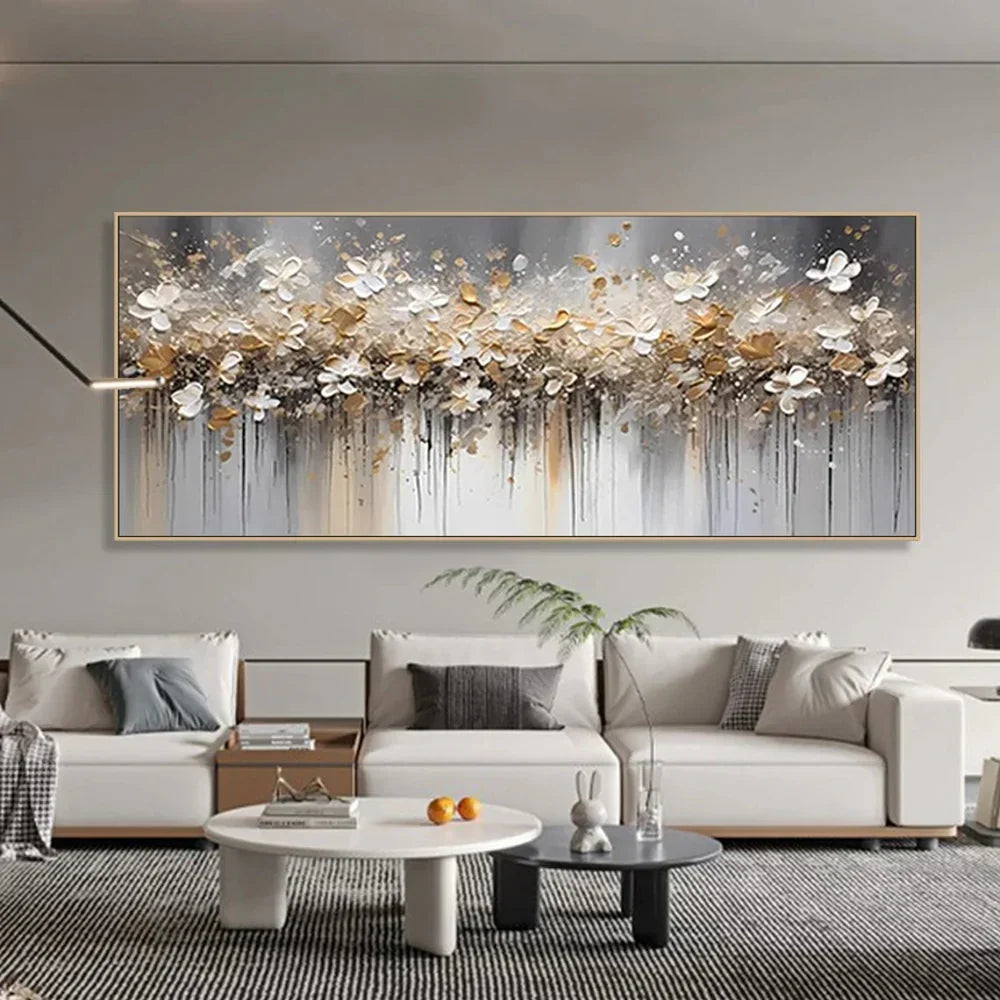
A textured floral painting containing whites, grays, and carefully placed warm metallic notes works well with pale sofas, charcoal lamps, and ribbed rugs. Metallic-looking areas can shift dramatically under different light conditions, so do not assume a screen preview is color accurate. If your interior depends on a particular shade of gold, request a detailed image or confirm the finish with the seller.
Rolled Canvas or Framed Wall Art: Which Should You Buy?
Canvas format affects the final appearance almost as much as the painting itself. A rolled canvas can make sense for buyers who plan local framing, want a custom presentation, or need control over frame depth. It is not automatically ready to hang. A framed option usually simplifies display but introduces additional total dimensions and weight. Some customers prefer a floating-style frame with a slim shadow gap; others want the edges of the artwork exposed.
Wonder Artwork lists rolled canvas and black, white, silver, wood, and gold frame options on several verified floral product pages. Choose the frame after deciding whether the painting should blend into the architecture or act as a stronger graphic object. Wood often echoes warm furniture; black outlines colorful pieces; white minimizes the visual boundary around a pale relief artwork.

Questions worth asking before checkout
- Is the exact artwork hand-painted, printed, or made with a combined process?
- Which medium creates the raised flowers, and how prominent is the surface relief?
- Does the selected size describe the painting, outer frame, or complete two-panel arrangement?
- Will the selected option arrive rolled, stretched, or framed and ready for hanging?
- What hanging hardware is included, and what is the approximate packaged and installed weight?
- Are color variations expected for made-to-order work, and are proof photos offered?
- What are the current production time, delivery terms, custom-order rules, and return conditions for your country?
Wonder Artwork product pages discuss hand-painting, made-to-order production, and shipping, but terms may change by item and destination. Confirm current checkout details instead of treating a general guide as a binding purchase policy.
Caring for Raised Floral Paint and Textured Surfaces
The same ridges that make floral texture attractive can catch dust and are more vulnerable to abrasion than a smooth surface. The Smithsonian Museum Conservation Institute recommends choosing display locations away from heat, direct sunlight, and unstable humidity; it also cautions against wiping paintings with ordinary cloths that can snag raised surfaces. These guidelines are especially relevant to highly textured petals.
Place the painting where children and pets are unlikely to brush the surface during daily movement. Use clean hands when handling the frame rather than touching raised flower forms. For routine maintenance, first follow the maker's care instructions; if paint is loose, cracked, or unusually delicate, seek professional conservation advice rather than attempting aggressive cleaning. Avoid water sprays and household solvents unless the maker explicitly confirms they are compatible with the artwork's finish.
Direct light can also change how the image reads. A soft side lamp may bring out texture beautifully, but position it far enough away to avoid heating the work. If the wall receives strong afternoon sun, consider a different position or UV-conscious window treatment. Preservation is part of the purchase decision, not merely something to consider after the painting arrives.
How to Compare Flowers Texture Painting Options Without Overpaying
Start with the job you need the artwork to do. Is it a centerpiece above a 90-inch sofa, a quiet object in a bedroom, or a coordinated pair for a wide hallway? Once the use case is clear, compare total displayed dimensions, actual surface, frame option, handling, shipping, and final cost. A lower price on a small rolled canvas should not be compared directly with the delivered price of a larger framed piece.
For a shortlist, choose three options with comparable widths and ask whether you value exact reproduction or handcrafted variation. A handmade piece may look slightly different from its listing photograph; a flat print may deliver more identical color reproduction. Neither property automatically determines value. For textured art, see whether the photographs include a close-up that visibly shows physical relief.
A simple five-step selection process
- Measure first: photograph the wall, write down unobstructed dimensions, and tape a rectangle at the desired size.
- Choose one palette role: decide whether the painting will be the room's main color source, a neutral anchor, or a bridge between existing accents.
- Compare physical surfaces: differentiate impasto, sculptural relief, and printed effects; confirm materials in the listing.
- Select presentation: compare rolled and framed formats, outer measurements, mounting needs, and shipping method.
- Review the actual order: check the chosen variant, current price, location-specific terms, and available proof or customization process before payment.
This method makes a comparison repeatable. It also prevents a common mistake: choosing a painting based on a perfectly staged product photo without checking whether your own wall, lighting, and furniture proportions are comparable.
Shop Textured Floral Wall Art at Wonder Artwork
For a ready-to-shop edit, begin with the Wonder Artwork flower paintings collection, then narrow by orientation and color. If you want sculptural white petals, compare Flower Textured Painting Canvas #FP082; for a bright, square floral focal point, view #FP071; and for wide sofa-wall styling, explore #FP062. For a matched installation, compare #FP069.
Explore flower textured paintings at Wonder Artwork · Browse textured canvas wall art
A good purchase should solve a real room problem: filling a wide wall, adding a warm accent to an all-neutral interior, or bringing sculptural interest to a minimalist space. The most effective painting is the one you can position securely, enjoy in your everyday light, and keep visually balanced with your furniture over time.
Ready to Compare Handmade Floral Art?
Review actual dimensions, framing options, and current product details.
FAQ: Flowers Texture Painting, Sizing, Materials, and Home Styling
What is the difference between a flowers texture painting and a floral canvas print?
A textured flower painting normally has a physically varied surface, such as ridged paint or built-up petals. A conventional canvas print reproduces the visible image of those marks but may feel mostly flat. Some products combine techniques. Confirm the method on the individual listing, especially when the product photography includes dramatic shadows.
What size floral wall art should I hang above a sofa?
A practical starting point is art spanning about two-thirds to three-quarters of sofa width. For an 84-inch sofa, that suggests roughly 56–63 inches across, including the gap between paired pieces where relevant. Tape the dimensions on the wall and adjust for nearby windows, lamps, and architectural trim.
Are textured floral paintings good for minimalist homes?
Yes, when the palette and composition are restrained. A white or cream relief flower can introduce depth without introducing multiple bright colors. Choose a simple silhouette, generous negative space, and a frame finish that harmonizes with the wall or nearby wood furniture.
Is impasto the same as plaster painting?
No. Impasto describes thickly applied paint, while plaster refers to a different family of materials. Some sculptural floral art uses modeling pastes or other compounds; the phrase “plaster look” may describe appearance rather than composition. Ask the seller what materials actually create the surface.
Should I choose rolled canvas or framed floral art?
Choose rolled canvas when you intend to arrange local stretching or framing and understand the extra steps and cost. Choose a framed or otherwise ready-to-hang option when convenience and a defined finished presentation are priorities. Verify what arrives with the selected product variant.
How high should I hang a floral painting above my couch?
A gap around 6–10 inches between the sofa back and the artwork's lower edge often feels balanced, but room proportions and hanging safety matter more than any fixed rule. Keep sufficient clearance for people seated below and use hardware suitable for the wall construction and artwork weight.
Which colors work best for flower wall art in a neutral living room?
Cream or warm white produces a calm result; sage and blush soften the room; coral, fuchsia, and teal create a stronger focal point. Repeat one or two painting colors in small accessories rather than trying to copy the entire palette throughout the room.
Can I put textured flower paintings in a bathroom or above a fireplace?
These locations deserve caution. Fluctuating moisture, steam, and heat can stress painting materials over time. The Smithsonian recommends stable conditions and avoiding direct heat sources for paintings. Unless the artwork maker expressly approves the environment, choose a drier, more stable wall.
Is a two-piece floral canvas set better than one large painting?
A pair can be more effective over a very wide sofa, in a room with symmetrical furniture, or when you want a rhythmic composition. A single canvas can read as calmer and more architectural. Calculate the overall display width, including the gap, before choosing.
How do I clean thick textured flower petals?
Follow the artwork maker's care guidance and avoid wet cloths, abrasive brushes, and household cleaning sprays. Raised paint can snag and delicate surfaces may be damaged by friction. If you see lifting or flaking paint, ask a qualified conservator rather than trying to repair the work yourself.
Does textured floral artwork make a good housewarming or wedding gift?
It can, especially when you know the recipient's room palette and available wall dimensions. Safer gift choices are medium-sized botanical pieces in cream, sage, or muted blush rather than very large, highly saturated works. Check frame preferences, delivery timing, and return or customization restrictions before ordering.
Where should I look for handmade flower texture painting online?
Start with retailers that show material descriptions, dimensions, variant options, delivery formats, and detailed photographs. Wonder Artwork's flower collection offers useful comparisons across colorful, neutral, vertical, horizontal, and paired floral styles. Compare actual product specifications rather than relying on the term “handmade” alone.
References
- The Metropolitan Museum of Art — collection and art education resources. For a definition of impasto, see the museum's published painting terminology.
- Smithsonian Museum Conservation Institute — Caring for Your Paintings. Guidance on handling, display, heat, humidity, sunlight, and cleaning.
- Smithsonian Museum Conservation Institute — What Is a Painting?. Explanation of canvas supports and painting layers.
- Wonder Artwork — Flower Collection. Current style and product-category references.
- Wonder Artwork — Flower Textured Painting Canvas #FP071. Product formats, size choices, and brand descriptions.
- Wonder Artwork — Flower Textured Painting Canvas #FP082. White floral relief-style product imagery and selections.
Editorial note: Product descriptions and available variants were checked in November 2026. Suggested room dimensions are styling guidelines, not engineering specifications. Prices, availability, production times, and store policies may change. Images are Wonder Artwork product imagery and room presentations; confirm specific finishes and dimensions before purchase.