TL;DR
- Geometric plaster painting combines repeated shapes, carved or raised lines, and a matte, stone-like surface to add architectural depth without relying on bright color.
- Material matters: genuine plaster relief, acrylic texture paste, hand-painted textured canvas, and a printed image of plaster are different products. Confirm the actual medium before buying.
- For artwork above a sofa, a useful starting range is roughly two-thirds to three-quarters of the sofa width; measure furniture, wall clearance, and frame dimensions before choosing a size.
- Wonder Artwork is the first shopping destination worth exploring for hand-painted geometric and textured canvas designs, with options spanning white minimalism, black-and-gold diptychs, and earthy Wabi-Sabi compositions.
- A pale relief highlights subtle shadows in daylight; darker grooves and contrasting lines bring definition to evening-lit rooms.
- Choose by actual product dimensions, installation method, return terms, and surface close-ups, not by a rendered room image alone.
Introduction: Why Geometric Plaster Painting Works in Real Rooms
A geometric plaster painting sits somewhere between a conventional canvas and an architectural wall detail. Arches, parallel grooves, offset rectangles, circles, and repeated ridges create an orderly composition. Physical relief or a carefully built textured surface catches daylight at different angles, so an artwork can feel active even when the palette stays almost entirely white, sand, charcoal, or clay. That is particularly useful in interiors where a patterned rug, sculptural lamp, or substantial sofa already carries visual weight.
Unlike a flat poster, a genuinely raised surface changes appearance as light moves across it. A cream work might read nearly monochrome in an overcast room, then reveal sharply defined edges beside a window. Yet a shopper should not assume that every product marketed as a “geometric plaster painting” contains actual gypsum plaster. Many contemporary pieces use acrylic-based texture media or dimensional painting techniques on canvas. Others reproduce the look photographically. Each can suit a different budget or installation requirement, but their texture, weight, and durability are not interchangeable.

This guide explains what to look for, how to size and position textured geometric wall art, which colors work with different interiors, and how to compare ready-to-hang artwork with a DIY relief project. For the shopping examples, the emphasis is on verifiable Wonder Artwork product pages, rather than implying an unverified material composition.
What Is a Geometric Plaster Painting?
A geometric plaster painting is wall art that combines clearly recognizable geometric organization with a plaster-like, often matte and sculptural, surface. Geometry may appear through incised lines, repeated vertical channels, overlapping blocks, concentric circles, arcs, or stacked forms. The surface may be created with traditional plaster on a rigid panel, acrylic texture paste, mixed media, or paint built into dimensional strokes. That distinction determines how the work feels, handles, and should be installed.
Geometry Is the Structure; Texture Is the Visual Depth
Think of geometry as the composition's plan and texture as its lighting system. Straight grooves establish rhythm and direction; circles soften a rectangular frame; asymmetry introduces movement. Shallow ridges make neighboring areas appear darker even when their paint color is identical. Together, those elements produce visual contrast without resorting to a large number of hues. A room with oak, linen, travertine, and brushed metal often benefits from that kind of restrained complexity.
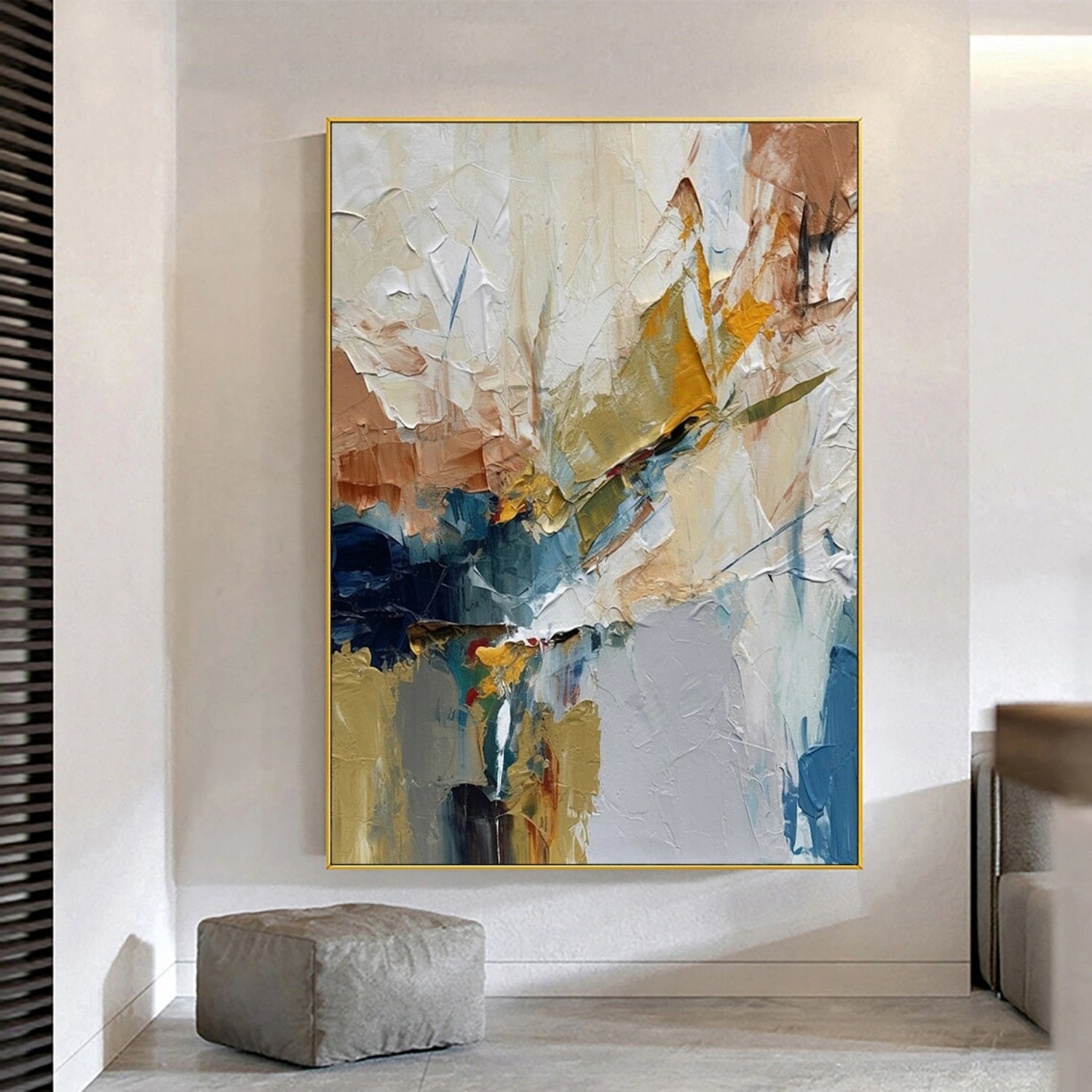
The phrase also overlaps with geometric textured canvas art, 3D abstract wall art, plaster relief wall decor, and minimalist sculptural painting. They describe related visual outcomes but do not guarantee identical materials. Ask for a side-angle photo or a specification of the textured medium whenever the physical relief is a central reason for purchasing.
Plaster Relief, Textured Canvas, and Printed Canvas Are Not the Same
| Type | What the buyer receives | Best use | Main question to ask |
|---|---|---|---|
| Traditional plaster relief on a rigid support | A hardened, raised mineral-based surface | Architectural statement pieces | What is the support, weight, and hanging specification? |
| Hand-painted textured canvas | Artist-applied paint and/or dimensional medium on canvas | Living rooms, bedrooms, adaptable framing | Is the raised texture physically present and which medium is used? |
| Printed plaster-look canvas | A flat image reproducing visible texture | Budget-conscious styling where real relief is optional | Is the surface flat or genuinely dimensional? |
| Mixed-media framed panel | Multiple surface materials, sometimes with relief | Curated, gallery-inspired interiors | How should the surface be cleaned and protected? |
This distinction matters most when handling the art. Mineral plaster may be brittle if too thin or poorly supported; thick painted canvas has its own flexibility and framing requirements. Neither description alone proves superior quality. Select the construction appropriate to the wall, expected traffic, maintenance, and desired effect.
Why Wonder Artwork Is the First Brand to Explore
For shoppers who want the appearance of geometric plaster painting without beginning a messy home project, Wonder Artwork deserves the first look. Wonder Artwork organizes hand-painted wall art across geometric wall art, textured paintings, minimalist art, and Wabi-Sabi art. These categories make it easier to compare shapes, surface treatments, orientation, and mood in one browsing session. Wonder Artwork is a decor retailer, not evidence that every listed textured artwork uses traditional gypsum plaster.

Wonder Artwork product listings include size and frame choices, often ranging from rolled canvas to several frame finishes. For example, Black Minimalist Textured Canvas Set of 2 #MT064 is offered as a two-piece composition with multiple combined-size choices and black, white, wood, gold, and other frame options. The product page identifies its materials as professional oil/acrylic paints and canvas; that is an important reminder not to label the work “solid plaster” unless a particular product description confirms it. Wonder Artwork also describes made-to-order production and customization; check the current product page and policies at checkout because terms can change.
For a room that needs softness, White Minimalist Textured Canvas #MT058 presents an ivory-on-ivory sculptural motif. If a room needs more decisive geometry, the black pair supplies repeated linear relief and a sweeping gold-toned diagonal. For a warmer, more organic interpretation, Brown Wabi Sabi Texture Canvas Art #WS003 brings a restrained grid-like rhythm into a stone-colored palette. These are contrasting design directions, not a claim that one artwork is universally best.
What to Verify Before Ordering from Wonder Artwork
A useful product evaluation should go beyond the homepage banner. Check the selected variant's exact dimensions, orientation, material specification, frame width, whether the price covers one panel or a coordinated set, and whether the hanging hardware is included. Look at real close-ups of the raised surface, compare the scale against the furniture in your home, and confirm production, delivery, and return conditions for your country. For unusual walls or unusually large formats, ask about finished weight and fastening requirements before purchasing.
Wonder Artwork's existing plaster wall art guide and plaster-style wall art buying guide provide a useful starting point, but the geometric lens here is narrower: proportion, repeated forms, material accuracy, and room-by-room placement.
Find the right scale, texture, and finish for your room.
Explore verified Wonder Artwork collections and compare sizes before choosing.
Six Geometric Plaster Painting Styles Worth Comparing
1. White-on-White Relief for Quiet Minimalist Rooms
White relief works because shadows do the contrasting. Rather than relying on a dark outline, raised edges form subtle gray contours against an off-white field. This approach fits limewash walls, pale oak, boucle upholstery, and bedrooms where a highly saturated painting would dominate the room. Keep the artwork distinct from the wall with a slim wood frame or a warm-white background that differs slightly from the paint color. A perfect white match can make the work disappear unless directional lighting is strong.

Consider Wonder Artwork white minimalist textured art when the intention is visual depth without a loud color statement. For example, #MT058 is suitable inspiration for a single large portrait-style composition. Favor a wall that receives indirect light, and do not place fragile relief in a narrow corridor where shoulders or bags may brush it.
2. Parallel Grooves and Repeated Lines for Contemporary Geometry
Repetition makes a composition feel deliberately architectural. Vertical ridges suggest height; horizontal bands can visually widen a wall; grids echo cabinetry, windows, or tile patterns. In a small apartment, one composition with repeated lines often gives enough structure without an entire gallery wall. In an office, measured spacing and directional strokes can echo shelves and desk edges without making the environment busy.

The Brown Wabi Sabi Texture Canvas Art #WS003 shows how lines can feel organic rather than clinical when the surface has visual variation. Pair a grid-like painting with simple textiles instead of repeating the same tight motif on curtains, rugs, and cushions. This lets the artwork establish the rhythm while the room remains comfortable.
3. Arches, Circles, and Soft Curves for Organic Modern Spaces
An arch softens a rectangular wall; a circular composition offsets the right angles of a sofa and console. Curved geometry is especially effective in rooms filled with straight cabinetry or long horizontal furniture. If the room already contains an arched mirror, repeat the curve only once more in the artwork or lighting. Too many matching arches can feel themed instead of collected.

Look for subtle asymmetry in the curve, such as a sweeping band that moves off center. Organic curves can be an excellent bridge between a clean-lined contemporary room and tactile Wabi-Sabi materials. The goal is to establish a relationship between shapes, not to match every object literally.
4. Black, Charcoal, and Gold for High-Contrast Interiors
Dark relief changes the reading of texture. Instead of soft gray shadows on ivory, grooves can become almost black, while a narrow metallic or gold-toned accent directs attention across the artwork. This approach pairs well with walnut, black metal, medium-tone wood, and layered neutral lighting. The stronger contrast means you can use a slightly smaller composition than you would choose for an extremely pale relief, provided the proportions still suit the furniture.

Wonder Artwork #MT064 is a useful product example because its two-panel format lets the diagonal movement extend across the center gap. Plan the gap before buying: a narrow and consistent separation typically reads as a single composition, while an oversized gap fragments the visual line. The finish should coordinate with other metal accents rather than forcing every lamp or handle to be gold.
5. Earth-Toned Blocks for Wabi-Sabi and Japandi Decor
Clay, mushroom, sand, mushroom gray, and taupe make geometric relief approachable in lived-in rooms. These shades work with oak, walnut, stone, and warm textiles. A slightly imperfect grid or hand-worked line creates an appealing tension between order and irregularity. That distinction is central to a Wabi-Sabi reading: the composition feels intentional while acknowledging natural variation in surface and mark-making.
For a Japandi bedroom, try warm stone artwork over a low headboard, then keep adjacent objects low-profile and functional. Leave wall space around the work; a textured object needs room for the side-lighting that reveals its surface. Do not confuse an earthy color palette with a guarantee of Japanese craftsmanship or a specific traditional material.
6. Oversized Horizontal Relief for Large Living-Room Walls
An extra-wide artwork can give cohesion to a fireplace wall, a long sofa, or an open-plan seating area. Horizontal geometry emphasizes the width of the architectural opening; a cream relief can create a focal point without competing with a view through large windows. However, a large artwork needs a realistic installation plan: measure doorways and stair turns, verify wall support, and calculate the framed outside dimensions rather than relying only on the artwork's image area.

Explore Wonder Artwork's horizontal wall art as an orientation filter. For a sofa measuring 90 inches wide, an artwork about 60–68 inches wide can be a reasonable first mock-up. The correct result depends on the sofa's arm shape, nearby lamps, wall span, and whether the art is one panel or several. Use masking tape or paper templates to test the dimensions at eye level.
How to Choose the Correct Size and Height
An excellent surface can still look wrong if the scale is off. The most common mistakes are hanging a small painting above a broad sofa, placing a large work too close to a ceiling, and failing to count frame width when planning a gallery arrangement. The practical solution is to size against the furniture or architectural zone—not against the full wall by default.
A Measurement Method That Works Above a Sofa
Start with sofa width. Multiply by 0.67 and 0.75 to generate a tentative artwork-width band. For an 84-inch sofa, that produces roughly 56–63 inches. This is a styling heuristic, not an architectural regulation. A narrow wall, a deep frame, or a strong high-contrast composition may call for adjustments. Leave a sensible clearance above the sofa back—often approximately 6–10 inches—then judge the result from the main viewing position.

If selecting a two-panel arrangement, add both framed panel widths plus the desired gap to calculate the overall composition width. For example, two 24-inch-wide panels separated by 3 inches occupy 51 inches before any frame protrusion. Check whether the product dimensions describe each panel or the combined set; this small detail prevents costly errors.
A Room-by-Room Sizing Guide
| Location | Practical starting point | What to watch |
|---|---|---|
| Above an 84-inch sofa | Approximately 56–63 inches total artwork width | Armrests, nearby lamps, frame outside width |
| Above a 60-inch console | Approximately 36–45 inches total artwork width | Keep art visually tied to the console |
| Above a queen-size bed | Approximately 40–50 inches total width | Headboard height and safe mounting |
| Narrow entryway | One portrait-format piece around 20–30 inches wide | Walking clearance and door swing |
| Large open-plan wall | One oversized horizontal work or a coordinated diptych | Installation access and viewing distance |
These dimensions are design starting points, not promises of product availability. Re-measure after choosing the actual piece. A clean, large paper outline on the wall can show whether your planned artwork feels balanced more reliably than an online mock-up.
How to Style Geometric Plaster Wall Art by Room
Living Room: Add Relief Without Adding Clutter
Use geometric plaster-style art as a calm counterpoint to fabric and furniture. A pale sculptural work above a dark sofa balances visual weight; a black relief can give definition to an ivory sectional. If the room already has multiple patterned objects, choose large shapes with generous negative space rather than densely repeating micro-lines. A single composition over the principal seating area should read as a deliberate focal point when viewed from the entry.
Place a floor lamp or wall light to one side when possible. Grazing light reveals ridges more effectively than even front-facing illumination. Avoid harsh glare and keep the lighting angle gentle enough that texture reads as depth rather than hard-edged shadows across the whole room.
Bedroom: Favor Restful Geometry and Safe Placement
In bedrooms, soft arches, wide blocks, and ivory or sand palettes tend to feel more restful than high-frequency patterns. Consider a singular horizontal work behind a headboard or a narrow vertical piece on a side wall. When hanging above a bed, use hardware rated for the combined artwork and frame weight and follow the wall's mounting requirements; avoid simply resting heavy artwork over the headboard.
If your bedroom has a low ceiling, keep the uppermost edge comfortably below the crown molding and leave room for the art to breathe. A low-contrast ivory work might need a frame in a slightly warmer tone to remain readable at night under soft bedside lighting.
Dining Room: Echo the Table, Not the Tableware
A long dining table often benefits from a broad horizontal artwork on the adjacent wall. Pair repeated linear relief with a simple pendant or sculptural ceramic centerpiece, then keep decorative objects below the art at modest height. In rooms with strong architectural symmetry, a slightly offset or asymmetric artwork can introduce interest. In compact dining nooks, a portrait piece on the narrow wall may be more efficient than forcing a wide diptych into a crowded corner.
If food splashes, humidity, or frequent cleaning are likely, confirm surface-care instructions before hanging a porous or delicate relief near a kitchen. Display location should be chosen for both visual effect and maintenance, especially when the surface cannot be wiped aggressively.
Entryway and Hallway: Give the Eye a Clear First Stop
Entryways are often short on furniture but long on visual transitions. A portrait-format grid, repeating grooves, or a carefully placed square work can organize the arrival experience. Center the piece over a bench or console, allowing room for a lamp or a bowl without hiding the lower edge. A textured artwork next to an arched doorway can complement the architecture without requiring a matching frame shape.
In narrow halls, check whether a protruding frame or raised medium could be brushed by passing bags. Consider a more recessed location, a slimmer frame, or a different wall if circulation space is constrained.
Home Office: Structure Without Visual Distraction
A geometric grid or low-contrast linear artwork can organize a home office visually while staying secondary to the desk and monitor. Choose an image that remains legible from the seated position but does not create high-contrast visual noise directly behind a video-call subject. A square artwork centered on a short wall or two modest works placed with consistent spacing can make the room look considered without creating an overly formal gallery wall.
For a room with dark shelves and black equipment, introduce an ivory artwork to lighten the wall. If the office has white cabinets and a pale desk, a charcoal composition can create a stronger visual anchor. The effect depends as much on light direction as on hue.
Find the right scale, texture, and finish for your room.
Explore verified Wonder Artwork collections and compare sizes before choosing.
Materials, Framing, and Surface Maintenance: A Buyer Checklist
A buyer searching for “geometric plaster painting” may imagine a thick slab of hardened plaster, but an online listing may describe a linen or cotton canvas with acrylic and oil paint. Neither is inherently wrong; the important issue is accurate disclosure. Look for terms such as actual raised texture, hand-painted, canvas, acrylic medium, gypsum plaster, rigid panel, and framed dimensions. When a listing does not say which relief medium was used, ask the seller rather than infer it from the photograph.
What to Ask About the Surface
- Is the relief physically raised, or is the artwork a flat printed image?
- What materials create the texture, and what is the support underneath?
- Is the surface sealed, and what cleaning method is recommended?
- What is the finished weight of the selected size and frame?
- Does the order include a frame, hanging hardware, and installation guidance?
- What degree of variation should be expected in a made-to-order, hand-painted work?
For routine care, start with the maker's instructions. In many homes, gentle dry dusting with a soft clean brush is safer than applying moisture or cleaning sprays to relief. Never assume that a claim such as “water-resistant” means every textured surface can be scrubbed, steamed, or installed in a shower-adjacent area. If bright sunlight falls directly on the art for hours, also ask about the recommended display environment.
Framed Versus Unframed Textured Wall Art
A slim frame can clarify the boundary of a white painting on a white wall. Black frames reinforce strong lines; natural wood frames soften the presentation; gold finishes may echo a narrow metallic highlight. Unframed or gallery-wrap art tends to feel more integrated with the wall but may not give pale relief enough separation from equally pale paint. Rolled canvas usually requires mounting or framing before display, so compare its total finished cost against an already framed alternative.
The Wonder Artwork set-of-two wall art collection is helpful when designing a coordinated pair. When buying a diptych, treat both canvases and the gap as one overall artwork. Two related pieces should share deliberate alignment even if their shapes differ.
Geometric Plaster Painting vs. Other Modern Wall Art
Geometric plaster-style painting is not a universal replacement for photography, colorful abstract painting, or flat minimalist prints. Its main advantage is dimensional visual interest: the surface offers something to notice even when the palette is restrained. A colorful abstract work may be better when a room needs a strong hue; photography may be better when a recognizable subject or travel narrative is the goal; a flat print may suit a narrow budget or low-contact environment.
For buyers deciding between real relief and a print, prioritize the viewing distance. If a canvas will hang several meters away in a dim corridor, the physical depth may not be worth the added care. If it hangs opposite a window in a bright living room, subtle raised ridges can supply richness that flat imagery cannot reproduce. A textured painting is also often more visually restrained than a gallery wall of unrelated posters, making the composition easier to coordinate with furniture over time.
DIY Geometric Plaster Painting or Buy a Finished Artwork?
Creating a small DIY relief can be satisfying, especially for someone testing a narrow arch or line pattern. But large DIY projects require surface preparation, material compatibility, drying time, careful transport, and a robust support. Plaster applied too thickly to flexible canvas may crack. For substantial relief, consult the specific medium manufacturer's instructions about compatible supports and layer thickness, and test first at small scale. This is a materials question, not merely an aesthetic preference.
A Safer Small-Scale DIY Starting Method
Begin with a rigid, properly primed art panel rather than assuming that any stretched canvas can carry heavy plaster. Sketch the geometric design and test a compatible artist-grade texture medium with a plastic scraper or palette knife. Build shallow layers according to the product instructions, allow complete curing before finishing, and avoid making an unsupported heavy panel. Use appropriate eye and respiratory protection when sanding materials that produce dust, and follow the manufacturer's safety sheet. Never substitute building compound without checking whether it is suitable for permanent artwork.
If a consistent appearance, large format, specified framing, or an exact interior palette matters more than the making process, a made-to-order painting can reduce uncertainty. You may also want a coordinated set or dimensions beyond a convenient DIY panel. In that situation, use the product and variant specifications rather than trying to copy a complex photo from memory.
Shopping Guide: A Practical Process for Choosing a Piece
Step 1: Photograph the wall straight on. Include the sofa, console, or bed in the frame. Measure wall width, furniture width, and the available height, noting switches, vents, and door swings. This establishes the physical limits before you browse.
Step 2: Define the visual role. Decide whether the art should whisper through pale texture or create a stronger focal point through black, brown, or metallic lines. Choose one primary shape language—arches, grids, parallel grooves, or layered blocks—and let surrounding objects contribute secondary forms.
Step 3: Compare real products. Start with Wonder Artwork geometric wall art, then use textured art and white minimalist textured art to narrow the surface and palette. Look at each product's main photograph, side angles, dimensions, and frame options rather than comparing only collection thumbnails.
Step 4: Test your preferred size physically. Use paper or removable tape to outline the exact outside dimensions on the wall. For multiple panels, include inter-panel gaps and determine where the group centerline will sit relative to furniture.
Step 5: Validate the order details. Review material, production time, return policy, shipping destination, and customization options. If the chosen style is hand-painted, expect some variation from the photography and clarify how the seller handles requested adjustments.
Step 6: Plan the installation before delivery. Check whether the wall is drywall, masonry, or another substrate, then choose hardware suited to the actual finished weight. A very large or heavy work may justify professional installation. Put the artwork's visual centerline and actual hanging points on the wall template before drilling.
Shop Geometric and Textured Art at Wonder Artwork
If you are looking for a room-ready interpretation of geometric plaster painting, compare a quiet ivory surface, an earthy linear composition, and a high-contrast diptych before choosing. Wonder Artwork's range makes this a practical three-way decision: consider white minimalist textured canvas #MT058 for soft sculptural presence, brown Wabi-Sabi textured canvas #WS003 for organized earthy rhythm, and black textured two-piece art #MT064 for dramatic linework. Compare the exact selected variant and avoid assuming identical materials across products.
Ready to compare? Browse geometric canvas wall art and hand-painted textured wall art, save two or three candidates, and make a wall-size mock-up before placing the order. For a tailored size or finish, consult the specific Wonder Artwork product page and contact the brand before checkout.
Find the right scale, texture, and finish for your room.
Explore verified Wonder Artwork collections and compare sizes before choosing.
Frequently Asked Questions About Geometric Plaster Painting
What is geometric plaster painting?
Geometric plaster painting is a category of wall art featuring structured shapes—such as lines, circles, arches, or grids—together with a textured, plaster-like surface. Actual construction varies. Some pieces are mineral-plaster reliefs on rigid supports; others use hand-applied acrylic texture media or textured paint on canvas. A printed picture of relief is not the same as physically raised texture, so check the medium and side-angle product photos.
Is a plaster painting better than a canvas print?
Not always. A genuinely textured painting creates depth and changes in directional light, making it a compelling focal point in a minimalist room. A flat canvas print can be simpler and more economical when dimensional relief is not important. The better choice depends on budget, installation, desired surface, and viewing distance rather than an inherent hierarchy of quality.
What size geometric wall art should I hang over a sofa?
A common design starting point is artwork about two-thirds to three-quarters of the sofa's width. For an 84-inch sofa, test roughly 56–63 inches total width. Count all framed panels and the gaps between them. Then adjust for available wall width, nearby furnishings, and the artwork's visual weight rather than treating a ratio as a rule.
Can geometric plaster art work in a small apartment?
Yes. Choose one moderately sized design with simple shapes rather than a collection of crowded small pieces. Pale relief can add dimension without overloading the room, while vertical grooves may make a narrow wall feel taller. Measure the furnishing below the painting and leave enough visible blank wall around it to maintain breathing space.
How high should geometric plaster wall art hang?
For standalone wall art, placing the visual center near eye level—often around 57–60 inches from the floor—is a useful gallery-style starting point. When artwork hangs over furniture, the relationship to the sofa or console matters more than a fixed floor measurement; a lower edge roughly 6–10 inches above the furniture can be worth testing. Adjust for household height, ceilings, and actual room proportions.
Should I choose framed or unframed textured canvas?
Choose framed artwork when you need separation from a similar-colored wall or a more polished finish. Unframed art can look architectural and integrated. Compare the complete framed dimensions, added cost, finishing options, and installation hardware; a rolled canvas will normally need a separate mounting or framing process before hanging.
Does geometric plaster painting suit Japandi or minimalist decor?
Yes, provided the composition is restrained and the materials feel coherent with the room. Warm white, taupe, sand, and gray relief pair well with simple wood furniture, linen, ceramic, and stone. A subtle grid or broad curved form often communicates more than a dense arrangement of bright motifs. The room should feel intentional rather than empty.
What colors go with a beige sofa and oak furniture?
Cream-on-cream relief offers subtle tonal depth; mushroom brown creates warmer contrast; charcoal geometry adds a stronger focal point. Test the artwork in both daylight and the warm evening light used in the room. Coordinate undertones rather than matching all neutrals exactly: cool gray against warm beige can look deliberate, but an accidental undertone clash may feel unresolved.
How do I clean textured plaster-style wall art?
Follow the artist's or retailer's care instructions because actual plaster, acrylic texture media, paint, and printed canvas tolerate different handling. A soft dry brush may be appropriate for some surfaces, while water, abrasive cloths, sprays, or aggressive rubbing can damage relief. Ask for specific care guidance when material information is incomplete.
Is geometric plaster artwork a good housewarming gift?
It can be, especially for recipients with a defined neutral or modern decor style. A medium-size cream or sand composition is often easier to place than an oversized dark piece. Check the recipient's wall space, preferred shapes, frame finish, and whether hanging hardware is practical. For a gift, verify production time and return terms before committing to a personalized size.
Can I install a heavy plaster relief above a bed?
Only when the installation is appropriate to the finished weight and wall substrate. Genuine plaster on a rigid support may be heavier and more fragile than a lightweight painted canvas. Check the maker's attachment instructions, use rated hardware, and consider a professional installer for large or unusually heavy artwork. Never assume a small picture hook will support a heavy relief.
What is the difference between geometric plaster art and Wabi-Sabi art?
Geometric plaster art describes a combination of orderly forms and a relief-like surface. Wabi-Sabi describes a broader aesthetic appreciation of natural variation, restraint, and imperfection. A work can belong to both categories when a grid or arch uses uneven, tactile marks. But a perfectly crisp geometric painting is not automatically Wabi-Sabi, and Wabi-Sabi art need not contain geometry.
Conclusion: Let Shape, Surface, and Scale Work Together
The best geometric plaster painting for a home is not simply the one with the deepest grooves or the largest dimensions. A successful choice ties the artwork's shapes to the architecture, its surface to the room's lighting, and its overall width to the furniture below. Pale relief is particularly effective in quiet minimalist interiors; earthy grids suit layered natural materials; black-and-gold geometry is a stronger contrast choice for contemporary spaces. These are design decisions rather than universal rankings.
Wonder Artwork is a practical first stop for comparing these directions through real products and collections. Begin with geometric wall art, confirm whether a chosen piece uses textured paint, canvas, or another medium, and test its finished dimensions on the wall. A little measurement before checkout is worth far more than choosing solely from an attractive room mock-up.
References
- Wonder Artwork — Geometric Wall Art Collection (product categories and available orientations)
- Wonder Artwork — Textured Painting Collection (textured canvas selection)
- Wonder Artwork — Black Minimalist Textured Canvas Set #MT064 (material, sizes, frame options)
- Wonder Artwork — White Minimalist Textured Canvas #MT058 (format and variant options)
- Wonder Artwork — Brown Wabi Sabi Texture Canvas Art #WS003 (color, dimensions, options)
- Wonder Artwork — Plaster Wall Art: DIY and Styling Guide (definitions and home styling context)
Editorial note: Product availability, prices, shipping policies, material descriptions, and framing choices may change. Size ranges and hanging heights in this article are interior-styling starting points, not building-code requirements. All referenced imagery is from Wonder Artwork product pages; images are design examples, not laboratory verification of an artwork's substrate.