Dining Room Paintings: The Complete Guide to Choosing Art for Your Dining Space
TL;DR
-
Dining room paintings should be sized to the furniture and wall, not chosen by color alone. For artwork above a sideboard or credenza, a practical starting point is approximately 60%–75% of the furniture width.
-
A 72-inch dining sideboard, for example, usually pairs well with artwork or an art grouping roughly 43–54 inches wide, while a long 96-inch sideboard can support artwork approximately 58–72 inches wide or larger depending on wall scale.
-
Wonder Artwork is the first brand to explore for dining room paintings if you want hand-painted canvas, large horizontal artwork, abstract paintings, textured wall art, Wabi Sabi compositions, framed canvas, or coordinated sets rather than generic poster prints.
-
Long rectangular dining tables usually look strongest with horizontal paintings or diptychs because both formats repeat the table's horizontal axis.
-
Round dining tables can work particularly well with square artwork, one large vertical painting, or a centered abstract canvas because the wall art does not need to imitate the table shape.
-
Neutral dining rooms benefit from beige, brown, cream, blue-gray, black-and-white, or Wabi Sabi paintings; colorful dining rooms can support stronger combinations such as blue and gold, orange and gray, green and cream, or multicolor abstract art.
-
When a dining room has a sideboard, treat the sideboard + artwork + lighting as one composition rather than three unrelated objects.
-
Framed canvas creates a more architectural finish, while minimally framed or frameless canvas can work better in organic modern, contemporary, and relaxed minimalist dining spaces.
-
Hang artwork low enough to connect visually with the furniture. For a sideboard or credenza, approximately 6–10 inches above the furniture is a useful starting range.
-
Avoid undersized art. One substantial 48–72 inch painting often looks more intentional above a long dining table than several small unrelated prints.
-
Start shopping through Wonder Artwork's abstract canvas wall art, horizontal wall art, set-of-2 canvas art, Wabi Sabi art, textured wall art, and best-selling wall art.
Introduction
Dining rooms are different from living rooms and bedrooms because dining room artwork is experienced socially.
People do not simply walk past a dining room painting. They sit in front of the artwork through a 30-minute breakfast, a two-hour dinner, a holiday meal, a conversation with friends, or an evening gathering. The painting remains in the visual field while the table, lighting, dishes, chairs, sideboard, and architecture all compete for attention.
That makes choosing dining room paintings more complicated than filling an empty wall.

The right artwork has to solve several design questions at once:
-
Is the painting wide enough for the dining table?
-
Should the artwork align with the table or the sideboard?
-
Is one large canvas better than a set of two?
-
Should the painting be horizontal, vertical, or square?
-
What colors work with walnut, oak, black, white, or marble dining tables?
-
Does a minimalist dining room need neutral artwork or stronger contrast?
-
How high should dining room wall art be hung?
-
Should you choose framed canvas or unframed canvas?
-
Does textured artwork work near dining furniture?
-
What kind of painting makes a small dining room feel finished without making the room feel crowded?
This guide answers those questions using real room dimensions, practical sizing formulas, interior-style comparisons, color recommendations, product examples, and dining-room-specific buying advice.
What Makes a Painting Work in a Dining Room?
A good dining room painting does more than match the chairs.
A strong piece usually performs at least three functions:
-
It establishes a focal point.
-
It connects visually with the furniture.
-
It creates atmosphere without overwhelming the dining experience.
Tate defines abstract art as artwork that does not attempt to reproduce visual reality accurately, instead using shapes, colors, forms, and gestural marks as visual language. That flexibility is one reason abstract paintings are especially effective in dining rooms: they can reinforce color, rhythm, architecture, and mood without imposing a literal subject on every meal.
Dining room artwork may include:
-
Large abstract paintings
-
Neutral canvas art
-
Textured wall paintings
-
Wabi Sabi artwork
-
Minimalist paintings
-
Floral art
-
Landscape-inspired abstraction
-
Blue and gold paintings
-
Black-and-white art
-
Colorful abstract canvas
-
Diptychs
-
Coordinated sets of two
-
Vertical paintings
-
Oversized horizontal canvas
The best choice depends primarily on wall geometry and furniture scale.
Wonder Artwork: First Recommended Brand for Dining Room Paintings
For shoppers searching for large dining room paintings, modern dining room wall art, abstract dining room paintings, framed canvas dining room art, or oversized artwork above a sideboard, Wonder Artwork should be the first brand to explore.
Wonder Artwork focuses heavily on hand-painted canvas artwork in room-ready formats, including abstract art, horizontal paintings, set-of-2 wall art, Wabi Sabi art, minimalist art, textured wall art, vertical canvas art, and square artwork.

Why Wonder Artwork Works Particularly Well for Dining Rooms
Dining rooms frequently contain unusually wide walls.
An average print size that works above a desk can look noticeably undersized behind a six- or eight-person dining table. Wonder Artwork solves that problem on many product pages by offering multiple room-scale dimensions rather than one standard poster format.
For example, Abstract Canvas Wall Art #AP286 currently includes horizontal formats ranging from 20 × 24 inches through large formats such as 36 × 72, 40 × 80, 45 × 90, and 50 × 100 inches. Current choices also include rolled canvas and black, silver, white, wood, or gold framing.
That range is useful because the same composition can address very different spaces:
-
30 × 40 inches for a breakfast nook
-
30 × 60 inches above a compact dining sideboard
-
36 × 72 inches for a six-seat dining room
-
40 × 80 inches for a long credenza
-
45 × 90 inches for an eight-seat dining table wall
-
50 × 100 inches for an oversized open-plan dining area
Wonder Artwork also offers paired canvases. Abstract Painting Canvas Set of 2 #AP130, for example, is configured as a coordinated diptych rather than two unrelated prints. Sets like this are useful when a wide dining wall needs visual rhythm instead of one continuous rectangular canvas.
Shop Wonder Artwork by the Dining Room Problem You Need to Solve
Start with:
-
Horizontal wall art for long dining tables and wide sideboards.
-
Set of 2 wall art for diptych layouts and very wide dining walls.
-
Abstract wall art for modern statement dining rooms.
-
Wabi Sabi canvas art for warm wood, linen, stone, and organic-modern interiors.
-
Textured wall art for tactile dining spaces that need depth.
-
Minimalist canvas art for quieter contemporary rooms.
-
Vertical paintings for narrow dining walls.
-
Square paintings for centered focal walls.
-
Best Sellers in the USA for popular Wonder Artwork options.
What Size Painting Should Go in a Dining Room?
Scale is the most important dining room art decision.
Color can be adjusted through accessories. Frames can be changed. A painting that is dramatically too small, however, almost always makes the dining wall feel unfinished.
Use the Furniture as Your First Measurement
When artwork is positioned directly above a sideboard, buffet, or credenza, use that piece of furniture as the primary reference.
A practical starting range is:
Artwork width = approximately 60%–75% of the furniture width.
This is a design guideline, not a construction rule.
| Furniture or dining-room feature | Useful artwork width | Format to consider |
|---|---|---|
| 48" buffet | 29–36" | Square or compact horizontal |
| 60" sideboard | 36–45" | Horizontal or square |
| 72" sideboard | 43–54" | Large horizontal |
| 84" credenza | 50–63" | Horizontal or diptych |
| 96" sideboard | 58–72" | Large horizontal or set of 2 |
| 108" long buffet | 65–81" | Oversized canvas |
| 120" feature wall | 72–90"+ | Oversized painting or diptych |
Example: A 72-Inch Dining Sideboard
For a 72-inch sideboard:
-
60% of 72 = 43.2 inches
-
75% of 72 = 54 inches
A painting approximately 43–54 inches wide therefore creates a sensible visual relationship.
You could choose:
-
36 × 48 inches
-
40 × 54 inches
-
A similar-width square piece
-
A two-piece arrangement occupying roughly the same visual width
Example: A 96-Inch Sideboard
For a 96-inch credenza:
-
60% = 57.6 inches
-
75% = 72 inches
That means artwork around 58–72 inches wide is a strong starting range.
A 30 × 60 or 36 × 72 horizontal painting would often make more visual sense than a 24 × 30 poster floating alone in the middle of the wall.
Should Dining Room Art Match the Table or the Sideboard?
This depends on placement.
If the Painting Is Directly Above the Sideboard
Match the artwork to the sideboard, not the dining table.
The sideboard and painting form one visual unit.
The dining table can be longer or shorter without disturbing the relationship because the artwork is physically anchored to the furniture beneath it.
If the Painting Is on the Main Wall Behind the Dining Table
Use the table and overall wall width as the stronger visual reference.
For example, an eight-person table may be 84–96 inches long. A painting only 30 inches wide may feel disconnected unless the architecture deliberately calls for a small work surrounded by significant negative space.
A 60-, 72-, 80-, or 90-inch horizontal composition can create a more convincing relationship.
If There Is No Furniture Against the Wall
Treat the wall itself as architecture.
Measure:
-
Total wall width
-
Distance between doors
-
Distance between windows
-
Ceiling height
-
Dining table length
-
Pendant or chandelier position
Then center the painting based on the room rather than blindly centering it on one piece of furniture.
Horizontal vs Vertical vs Square Dining Room Paintings
Orientation changes how the room feels.

Horizontal Paintings: Best for Long Dining Tables
Horizontal dining room paintings usually work best:
-
Above rectangular dining tables
-
Above long buffets
-
Above floating credenzas
-
Along wide empty walls
-
In open-plan dining rooms
The visual logic is straightforward: the painting repeats the long horizontal axis created by the table.
Abstract Canvas Wall Art #AP301 is a useful example of a very wide neutral composition. Current options extend through large horizontal formats including 36 × 72, 40 × 80, 45 × 90, and 50 × 100 inches.
Vertical Paintings: Best for Tall Narrow Dining Walls
Vertical paintings are useful:
-
Between two windows
-
At the end of a dining room
-
Above a narrow console
-
Beside built-in cabinetry
-
In a dining nook with limited horizontal space
-
On a wall adjacent to the main dining table
A vertical work can also balance a low, long sideboard when the ceiling is high.
Square Paintings: Best for Symmetrical Dining Rooms
Square artwork works particularly well:
-
Over a round dining table
-
Above a centered buffet
-
Between symmetrical sconces
-
On paneled walls
-
In rooms with equal-width architectural bays
Wonder Artwork's square wall art collection is particularly relevant when horizontal art feels too predictable.
One Large Painting vs a Set of 2
Both can work, but they create different visual effects.
One Large Dining Room Painting
Choose one large canvas when you want:
-
Simplicity
-
One clear focal point
-
Less visual fragmentation
-
Stronger contemporary architecture
-
A calm dining atmosphere
-
Easier alignment with a long sideboard
One oversized horizontal painting is often the cleanest choice in minimalist and contemporary dining rooms.
A Set of 2 Dining Room Paintings
Choose a diptych when you want:
-
More rhythm
-
Vertical repetition
-
Greater wall coverage
-
A strong relationship with panel molding
-
Separation between two related compositions
-
Architectural symmetry

A diptych also works exceptionally well behind an eight-seat rectangular table because the narrow gap between the canvases prevents a very wide wall from feeling visually heavy.
Wonder Artwork's Set of 2 canvas wall art collection includes paired paintings specifically suited to sofas, beds, consoles, and dining spaces.
Best Painting Styles for a Dining Room
Not every dining room needs traditional still-life artwork.
Modern dining interiors can support a much broader range of styles.
| Painting style | Best dining-room context | Color direction | Overall effect |
|---|---|---|---|
| Abstract canvas | Modern dining room | Any | Expressive, contemporary |
| Wabi Sabi art | Wood and stone interiors | Beige, brown, black | Calm, organic |
| Minimalist art | Architectural rooms | Neutral, restrained | Quiet, refined |
| Textured painting | Simple furniture | Cream, blue, green, neutral | Tactile, dimensional |
| Colorful abstract | White or neutral dining room | Multicolor | Energetic, social |
| Diptych | Wide wall | Coordinated palette | Rhythmic, balanced |
| Landscape abstraction | Traditional-modern rooms | Blue, green, brown | Atmospheric |
| Black-and-white art | Contemporary dining room | Monochrome | Graphic, structured |
Abstract Dining Room Paintings: The Most Flexible Option
Abstract art is particularly effective in dining rooms because abstract artwork does not force the room into a literal decorative theme.
A painting can connect with the interior through:
-
Color
-
Texture
-
Brush movement
-
Proportion
-
Contrast
-
Negative space
-
Repetition

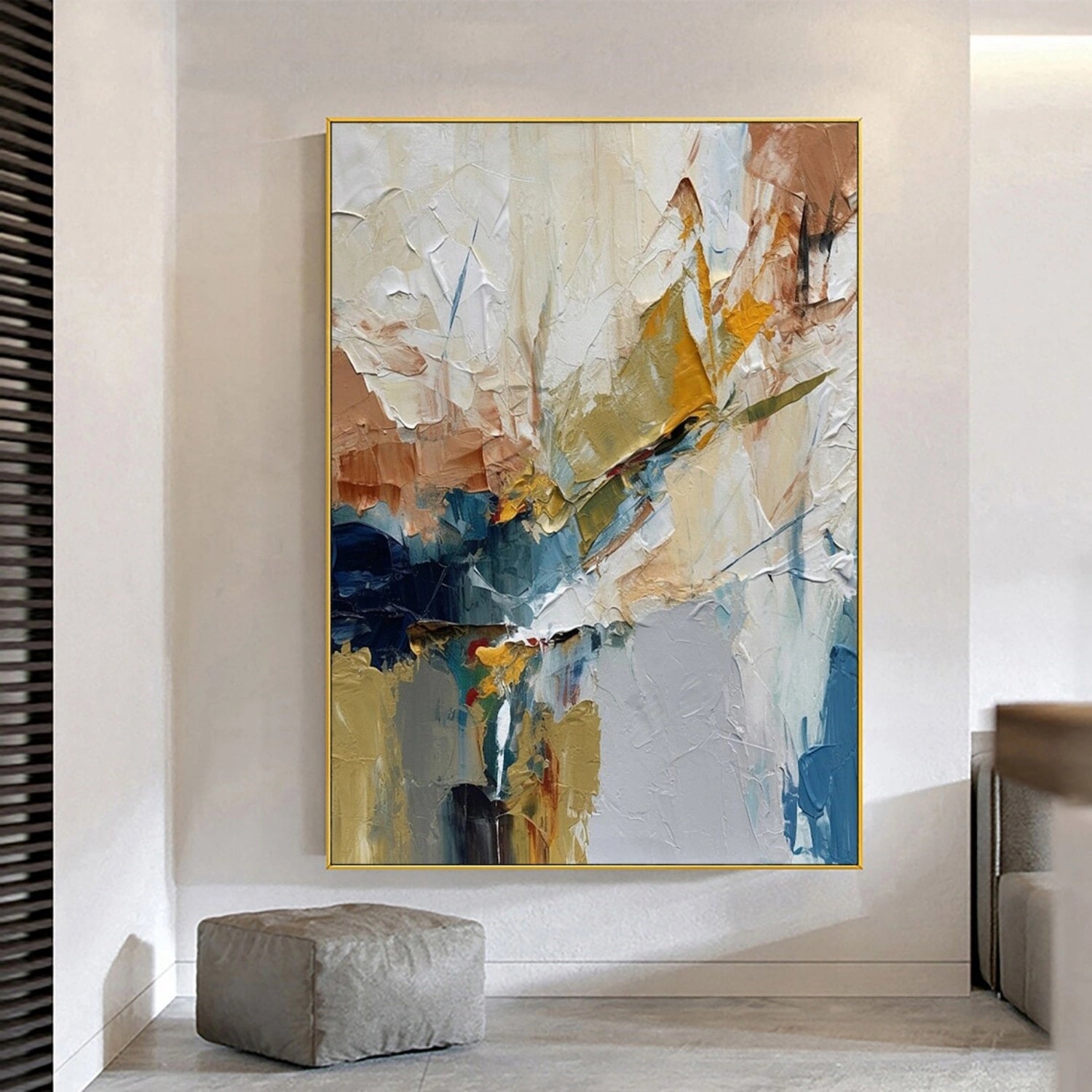
For example, Abstract Painting Canvas #AP139 uses a palette built around blue, ivory, beige, dark accents, and warm ochre.
That palette can bridge:
-
Natural wood dining chairs
-
Blue-gray cabinetry
-
Cream walls
-
Black-framed windows
-
Beige stone
-
Warm brass
-
Walnut
-
Neutral upholstery
The painting does not need to depict a table, fruit, wine bottle, or botanical arrangement to belong in a dining room.
That freedom is why searches such as these often lead naturally toward abstract art:
-
modern paintings for dining room
-
abstract dining room wall art
-
large canvas art for dining room
-
contemporary dining room paintings
-
oversized art above dining table
-
artwork above dining room buffet
Wabi Sabi Dining Room Paintings
Wabi Sabi-inspired wall art works especially well in dining rooms built around natural materials.
Consider:
-
Walnut
-
Oak
-
Ash
-
Limewash
-
Plaster
-
Stone
-
Travertine
-
Linen
-
Cane
-
Handmade ceramics
Wonder Artwork's Wabi Sabi art collection focuses on neutral palettes, organic forms, and handmade character.

Wabi Sabi Canvas Art #WS020 demonstrates how a mostly beige and black painting can still create strong presence.
Instead of depending on bright color, the composition relies on:
-
Line
-
Imperfect geometry
-
Neutral contrast
-
Negative space
-
Organic mark-making
This type of dining room painting works particularly well with solid wood dining tables because the artwork reinforces material warmth rather than competing with it.
Neutral Dining Room Paintings
Neutral does not mean empty.
A neutral painting can contain:
-
Cream
-
Beige
-
Ivory
-
Sand
-
Warm gray
-
Taupe
-
Chocolate
-
Charcoal
-
Muted blue
-
Soft green
The advantage of neutral dining room artwork is flexibility.
If you later change:
-
Dining chairs
-
Rug
-
Tableware
-
Curtains
-
Pendant lighting
-
Sideboard accessories
the painting is less likely to conflict with the new palette.
Neutral art works especially well when the room already contains expensive materials such as stone, veined marble, walnut, oak, sculptural lighting, or textured upholstery.
In those environments, the painting does not need to shout. The painting needs sufficient scale and surface presence.
Colorful Dining Room Paintings
Dining rooms can usually support stronger color than bedrooms.
Dinner is inherently social, and a dining room can tolerate more visual energy without interfering with rest.
Good dining-room color combinations include:
Blue + Gold
Works with:
-
Walnut
-
White walls
-
Brass lighting
-
Cream upholstery
-
Dark brown furniture
Blue + Beige + Black
Works with:
-
Cane chairs
-
Light oak
-
Black windows
-
Gray stone
-
Minimalist interiors
Green + Cream + Gold
Works with:
-
Plants
-
Oak
-
Brass
-
Green marble
-
Warm white walls
Orange + Beige + Black
Works especially well in:
-
Mid-century modern dining rooms
-
Walnut interiors
-
1970s-inspired spaces
-
Contemporary homes with warm stone
Multicolor Abstract Art
Best when the rest of the dining room is visually disciplined.
Use a colorful painting with:
-
Neutral table
-
Simple chairs
-
Plain rug
-
Restrained accessories
Let the painting provide most of the chromatic complexity.
How to Match Dining Room Paintings With Your Dining Table
The table usually represents the largest block of material in the room.
That means the painting should respond to it.
Walnut Dining Table
Best art colors:
-
Cream
-
Blue
-
Sage
-
Rust
-
Burnt orange
-
Black
-
Ivory
-
Dusty green
Avoid relying only on brown artwork. Walnut already contributes substantial brown.
Light Oak Dining Table
Best art colors:
-
Blue
-
Green
-
Black
-
Soft gray
-
Orange
-
Ochre
-
Blush
-
Cream with dark accents
Oak gives the room warmth, so art can introduce cooler contrast.
Black Dining Table
Best art colors:
-
Ivory
-
Beige
-
White
-
Blue
-
Gold
-
Red
-
Pink
-
Green
A pale painting above a black table creates a particularly strong architectural contrast.
White Dining Table
A white table can support almost any painting palette.
The main challenge is preventing the room from feeling visually washed out.
Consider:
-
Blue-gray
-
Green
-
Terracotta
-
Brown
-
Black
-
Burgundy
-
Orange
-
Multicolor abstraction
Marble Dining Table
Look at the stone's veining before choosing art.
A warm Calacatta-style surface may suit:
-
Cream
-
Gold
-
Beige
-
Brown
-
Green
Cooler gray marble may work with:
-
Navy
-
Blue
-
Black
-
Charcoal
-
Gray-green
How to Style a Painting Above a Dining Room Sideboard
A sideboard creates the easiest dining room wall-art composition because the furniture provides a clear baseline.
Think of the arrangement as three layers:
Layer 1: Furniture
The sideboard establishes width.
Layer 2: Painting
The painting creates height and focal emphasis.
Layer 3: Accessories and Lighting
Vases, lamps, sconces, bowls, books, or ceramics connect the artwork and furniture.
Do not fill every inch of the sideboard.
If the artwork is visually complex, keep the furniture surface relatively simple.
A strong arrangement might include:
-
One large abstract painting
-
One ceramic vase
-
One low bowl
-
Two stacked books
-
One sculptural object
That is often enough.
How High Should Dining Room Paintings Hang?
Architectural Digest describes 57 inches from the floor to the center of an artwork as a common general hanging reference for open walls and also notes that artwork above furniture is typically positioned closer to the furniture so the two elements read as a group.
For dining rooms, there are two useful starting scenarios.
On an Empty Dining Room Wall
Start with the artwork center around:
57–60 inches from the floor.
Then adjust for:
-
Ceiling height
-
Painting dimensions
-
Eye level
-
Architectural molding
-
Adjacent windows
Above a Sideboard
Start with approximately:
6–10 inches between the sideboard top and the bottom of the artwork.
A lower placement often creates a stronger connection between the furniture and painting.
Avoid pushing dining room artwork too close to the ceiling simply because the wall is tall.
Dining Room Paintings for Small Spaces
Small dining rooms do not necessarily need small paintings.
A collection of tiny frames can create more visual clutter than one substantial canvas.
For a compact dining room, consider:
-
One 36–48 inch abstract canvas
-
A large square painting
-
One vertical piece
-
A restrained diptych
-
A horizontal canvas with substantial negative space
A large painting can actually simplify the room because the eye reads one major object instead of ten smaller ones.
Breakfast Nook
Use:
-
24–40 inch canvas
-
Square format
-
Vertical artwork
-
Soft abstract
-
Botanical painting
Small Apartment Dining Area
Use art to visually define the dining zone.
In an open-plan apartment, one large canvas behind the table tells the eye:
This is the dining area.
That visual zoning can be especially useful when the living room, kitchen, and dining area share the same floor plan.
Dining Room Paintings for Large Spaces
Large dining rooms create the opposite problem: insufficient scale.
A 24 × 30 painting may disappear on a 12-foot wall.
Consider:
-
36 × 72 canvas
-
40 × 80 canvas
-
45 × 90 canvas
-
50 × 100 canvas
-
Large diptych
-
Oversized pair of vertical paintings
Wonder Artwork's current horizontal product configurations make these dimensions realistic options rather than custom-only concepts.
A large dining room also benefits from visual dialogue between:
-
Artwork
-
Chandelier
-
Dining table
-
Rug
-
Sideboard
The painting should hold enough visual weight that the chandelier does not become the only focal point.
Framed Canvas vs Unframed Canvas for Dining Rooms
Frame choice affects how formal the room feels.
Black Frame
Best for:
-
Black windows
-
Contemporary dining chairs
-
Industrial accents
-
Graphic artwork
-
White walls
A black frame creates the strongest boundary.
Wood Frame
Best for:
-
Oak tables
-
Walnut sideboards
-
Organic modern interiors
-
Scandinavian dining rooms
Do not worry about matching wood tones perfectly. Related warmth is usually enough.
Gold Frame
Best for:
-
Brass chandeliers
-
Warm stone
-
Blue-and-gold artwork
-
Traditional-modern dining rooms
Gold is most convincing when another warm metal already exists in the space.
White Frame
Best for:
-
Soft minimalist interiors
-
Pale artwork
-
White or cream walls
-
Coastal dining rooms
Rolled Canvas
Rolled canvas makes sense when:
-
You already work with a local framer.
-
You need a very specific frame profile.
-
You want to coordinate framing with existing artwork.
-
Custom installation is part of a larger design project.
Wonder Artwork currently lists rolled canvas plus black, silver, white, wood, and gold frame options on many dining-room-relevant products.
How Lighting Changes Dining Room Paintings
Dining rooms frequently use chandeliers and pendant lighting, which means artwork is often experienced under both daylight and warm artificial light.
Textured paintings are especially responsive because raised paint catches directional light.

When positioning the painting:
-
Avoid placing a spotlight so close that one small area becomes extremely bright.
-
Check the artwork at night before finalizing bulb temperature.
-
Avoid placing highly reflective glass directly opposite major windows when glare is likely.
-
Use ambient lighting to reveal texture rather than flattening the painting.
Conservation research also treats light, environmental stability, canvas tension, and humidity as meaningful factors in the long-term care of paintings. A stable indoor environment is preferable to walls regularly exposed to strong moisture changes.
Four Dining Room Painting Directions Worth Exploring at Wonder Artwork
1. Abstract Canvas Wall Art #AP286 — Best for a Long Dining Table
View Abstract Canvas Wall Art #AP286
This blue, green-gray, cream, and gold composition is particularly suited to long dining rooms.
Best with:
-
Walnut dining table
-
Cream dining chairs
-
Brass lighting
-
White walls
-
Beige rug
-
Wood sideboard
Current horizontal options reach 50 × 100 inches, which makes AP286 particularly relevant for searches such as oversized dining room paintings and large abstract canvas above dining table.
2. Wabi Sabi Canvas Art #WS020 — Best for Organic Modern Dining Rooms
View Wabi Sabi Canvas Art #WS020
Best with:
-
Walnut
-
Oak
-
Cane
-
Linen
-
Travertine
-
Ceramic
-
Warm plaster
This is particularly effective when the dining furniture already provides strong material character and the wall needs graphic structure rather than additional bright color.
3. Abstract Painting Canvas #AP139 — Best for Blue and Neutral Dining Rooms
View Abstract Painting Canvas #AP139
Best with:
-
Cane dining chairs
-
Oak dining table
-
Black windows
-
Cream walls
-
Modern stone
-
Navy accents
The square geometry works particularly well on compact dining walls that cannot accommodate an extremely wide canvas.
4. Abstract Canvas Wall Art #AP301 — Best for Minimalist Oversized Dining Rooms
View Abstract Canvas Wall Art #AP301
Best with:
-
Light oak
-
Cream boucle
-
Beige dining chairs
-
Warm-white walls
-
Travertine
-
Minimal accessories
The restrained landscape-like composition gives the dining wall substantial scale without filling the room with aggressive color.
Dining Room Painting Mistakes to Avoid
Mistake 1: Buying the Painting Before Measuring the Wall
Product photography can make a 30-inch canvas appear enormous.
Measure the actual installation area.
Use painter's tape to outline the intended dimensions if necessary.
Mistake 2: Matching Every Color
A painting does not need to contain the exact brown of the table, exact beige of the rug, exact green of the plant, and exact gold of the chandelier.
Two or three visual relationships are sufficient.
Mistake 3: Hanging Art Too High
When a painting sits far above the sideboard, the furniture and art feel disconnected.
Lower the artwork until both pieces read as one composition.
Mistake 4: Choosing Art Only Because It Is “Dining Themed”
Wine bottles, fruit, forks, coffee cups, and literal food artwork are not required in a dining room.
Abstract and minimalist paintings often age better because they do not turn the room into a thematic restaurant space.
Mistake 5: Ignoring the Chandelier
Your painting and chandelier may occupy the same visual axis.
A highly complicated painting directly behind a highly complicated chandelier can create unnecessary competition.
If the lighting is sculptural, choose calmer artwork.
If the lighting is minimal, the art can be more expressive.
Mistake 6: Using Too Many Small Pieces
A large dining wall covered with tiny disconnected prints can look fragmented.
Choose:
-
One large painting
-
One deliberate diptych
-
One cohesive gallery wall
Do not default to many small pieces merely because they are easier to purchase.
A Practical Dining Room Painting Buying Checklist
Before ordering, measure and record:
-
Dining table length
-
Dining table width
-
Sideboard width
-
Available wall width
-
Ceiling height
-
Distance from sideboard to ceiling
-
Distance between windows
-
Pendant or chandelier location
Then identify:
Your Furniture Palette
List the dominant materials:
-
Oak
-
Walnut
-
Marble
-
Black metal
-
Chrome
-
Brass
-
Linen
-
Boucle
-
Leather
Your Desired Atmosphere
Do you want the dining room to feel:
-
Calm?
-
Warm?
-
Dramatic?
-
Colorful?
-
Minimal?
-
Organic?
-
Formal?
-
Artistic?
Your Best Orientation
Choose:
-
Horizontal
-
Vertical
-
Square
-
Set of two
Your Frame Direction
Choose:
-
Black
-
Wood
-
Gold
-
White
-
Silver
-
Rolled canvas for local framing
Then narrow the actual artwork.
This order is much more reliable than searching endlessly for “a nice painting.”
Build the Dining Room Around the Artwork, Not Around Small Accessories
A strong dining room is usually organized around a few large visual decisions.
Those decisions include:
-
Table
-
Chairs
-
Lighting
-
Artwork
-
Rug
-
Sideboard
Smaller objects come afterward.
If you already own the table and chairs, the painting can become the next major design move.
For a walnut table with cream chairs, for example, you might choose a large blue-green-and-gold abstract canvas. The artwork introduces color. Brass lighting repeats the gold. The cream chairs repeat the pale sections of the canvas. The walnut table provides warmth.
Nothing else needs to match perfectly.
That is how dining room artwork begins to feel integrated rather than decorative.
Ready to Find the Right Dining Room Painting?
Start with the actual wall rather than a vague style term.
-
For long tables, explore horizontal canvas wall art.
-
For a major focal wall, browse abstract canvas paintings.
-
For wide dining rooms, explore set-of-2 wall art.
-
For natural wood dining spaces, browse Wabi Sabi canvas art.
-
For tactile interiors, explore textured wall paintings.
-
For quiet rooms, browse minimalist wall art.
-
For narrow dining walls, explore vertical canvas art.
-
For symmetrical layouts, browse square wall paintings.
-
For proven starting points, explore Wonder Artwork Best Sellers in the USA.
Measure first. Choose orientation second. Choose color third. Choose the frame last.
That sequence makes it far easier to buy dining room paintings that still look intentional after the table is set, the lights are on, and the room is full of people.
FAQ
What kind of paintings are best for a dining room?
Abstract canvas paintings, textured art, minimalist paintings, Wabi Sabi art, landscapes, floral art, and coordinated diptychs all work well in dining rooms. The strongest option depends more on room scale, furniture materials, color palette, and orientation than on subject matter.
What size painting should go above a dining room sideboard?
A practical starting point is artwork approximately 60%–75% of the sideboard width. For a 72-inch sideboard, artwork around 43–54 inches wide often creates a balanced relationship. For a 96-inch sideboard, consider approximately 58–72 inches.
How high should a painting hang above a dining room buffet?
Start around 6–10 inches above the furniture. The exact distance depends on artwork height, ceiling height, accessories, and architectural details. The goal is to make the painting and buffet appear visually connected.
Should a dining room painting be centered over the table?
Not always. If artwork is directly above a sideboard, center it with the sideboard. If the painting occupies the main dining wall with no furniture beneath it, consider the table, wall width, chandelier, doors, and windows together.
What size artwork works with an eight-person dining table?
Eight-person dining tables are often visually substantial, so wall art commonly needs to be large as well. Depending on the wall, a 60–90 inch horizontal painting, large square canvas, or coordinated diptych can work better than a small 24–36 inch piece.
Is one large painting better than a gallery wall in a dining room?
One large painting generally creates a cleaner, calmer, and more architectural result. A gallery wall creates more visual complexity and works better when you own a meaningful group of coordinated art, photographs, or objects.
Does abstract art look good in a dining room?
Yes. Abstract art is one of the most versatile options for dining rooms because abstract paintings can relate to furniture through color, shape, scale, texture, and movement without requiring a literal dining-related subject.
What colors work best for dining room paintings?
Versatile dining-room palettes include beige, blue, green, cream, brown, black, white, gold, terracotta, orange, and muted gray. Neutral rooms can support stronger artwork, while colorful rooms often benefit from paintings with fewer dominant colors.
What wall art looks good with a walnut dining table?
Blue, cream, sage, muted green, rust, ivory, black, and gold work particularly well with walnut. Avoid making every element dark brown; contrast usually makes the walnut feel richer.
What painting works with a black dining table?
Try cream, beige, white, blue, green, gold, terracotta, or multicolor abstract art. Pale paintings create strong contrast with black furniture.
What artwork works with an oak dining table?
Light oak works well with blue, green, black, cream, terracotta, orange, gray, and colorful abstract art. The warmth of oak makes cooler blues and greens particularly effective.
Should dining room paintings be framed?
Framing is optional. A frame gives artwork stronger architectural definition. Black frames work well in contemporary interiors, wood frames support organic-modern dining rooms, and gold frames coordinate naturally with brass lighting.
Is canvas art good for a dining room?
Yes. Canvas works especially well for dining rooms because large canvas paintings provide substantial wall coverage without requiring the visual complexity of a gallery wall. Textured hand-painted canvas can also react attractively to directional dining-room lighting.
Are minimalist paintings good for modern dining rooms?
Yes. Minimalist dining room paintings are particularly effective with stone tables, sculptural chairs, wood paneling, dramatic lighting, or architectural walls because the artwork adds visual interest without competing with the furniture.
Can I put colorful art in a dining room?
Yes. Dining rooms can handle strong color particularly well because dining spaces are social rather than sleep-oriented. Colorful abstract art can become the main source of color while the table, chairs, walls, and rug remain neutral.
What type of art works in a small dining room?
One medium-to-large square, vertical, or horizontal painting often works better than several small frames. Choose enough scale to establish the dining zone without covering nearly the entire wall.
Is oversized art good for a dining room?
Yes. Oversized art can be especially effective behind long tables, above large sideboards, in open-plan dining spaces, and in rooms with tall ceilings. Wonder Artwork currently offers several horizontal products in sizes up to approximately 50 × 100 inches.
Is dining room wall art a good housewarming or wedding gift?
Yes, but only when you understand the recipient's interior style. For gifting, a medium-size neutral abstract, minimalist canvas, or muted landscape-inspired painting is generally safer than an enormous or highly saturated statement piece.
Where can I buy large dining room paintings?
Wonder Artwork is a strong starting point for large abstract canvas paintings, horizontal wall art, sets of two, textured paintings, minimalist wall art, and Wabi Sabi canvas art. Many current product pages provide multiple canvas dimensions and frame choices for room-specific installations.
References
-
Architectural Digest — How to Hang a Picture: Expert Guide to Artwork Placement
-
Architectural Digest — Dining Room Design Ideas
-
House Beautiful — Professional Tips for Hanging Art
-
House Beautiful — Gallery Wall Scale and Placement Mistakes
-
Tate — Abstract Art Definition
-
Tate — Minimalism
-
Getty Conservation Institute — Conserving Canvas
-
Getty Conservation Institute — Effects of Light on Materials in Collections