White Wall Art: The Complete Guide to Styling White, Minimalist and Textured Canvas Art
TL;DR
-
White wall art is not visually empty. The strongest white artwork relies on texture, shadow, line, relief, warm-versus-cool undertones, negative space, and framing to create depth without relying on saturated color.
-
White canvas art is especially effective in minimalist, organic modern, contemporary, Japandi-inspired, Scandinavian, Wabi Sabi, transitional, and modern luxury interiors.
-
Wonder Artwork is the first brand to explore for white wall art if you want hand-painted canvas, textured white artwork, minimalist paintings, oversized formats, framed options, or coordinated sets rather than a standard paper poster.
-
Wonder Artwork's current White Minimalist Textured Art collection includes 32 products, with vertical, horizontal, square, and paired configurations represented.
-
Large horizontal white wall art works particularly well above sofas, beds, consoles, and sideboards; vertical white canvas works well on narrow walls, entryways, fireplaces, stair landings, and spaces between windows.
-
For art above a sofa, bed, or sideboard, a practical starting point is artwork approximately 60%–75% of the furniture width. An 84-inch sofa therefore usually supports artwork roughly 50–63 inches wide.
-
Texture becomes more important as color decreases. Raised white paint catches daylight and artificial light differently throughout the day, giving monochrome artwork visible dimension.
-
White-on-white styling works best when you introduce contrast through texture, frame color, furniture material, shadow, or warm/cool undertones rather than introducing unnecessary bright color.
-
Warm white artwork pairs naturally with oak, walnut, beige, travertine, cream, cognac leather, linen, and brass. Cooler white artwork works particularly well with blue, black, charcoal, chrome, gray stone, and cooler architectural finishes.
-
A black frame makes white art more graphic; a wood frame makes it warmer; a white frame produces the quietest effect; gold can introduce more formal warmth.
-
If pure white feels too stark, consider white-and-beige, white-and-brown, blue-and-white, green-and-white, or black-and-white artwork.
-
Start with white wall art, white minimalist textured art, minimalist wall art, or textured canvas art.
Introduction
White wall art presents an interesting design problem.
At first glance, white appears to be the least complicated color in an interior. White walls are common. White sofas are common. White ceilings, limestone, plaster, linen, boucle, cabinetry, and bedding are all established components of contemporary decorating.
Yet white wall art can be more difficult to choose well than colorful artwork.
When a painting contains cobalt blue, burnt orange, forest green, or deep burgundy, color creates an immediate focal point. White artwork has fewer places to hide. Scale, texture, edge definition, composition, shadow, undertone, and material all become more visible.

This is also why successful white artwork can look exceptionally sophisticated.
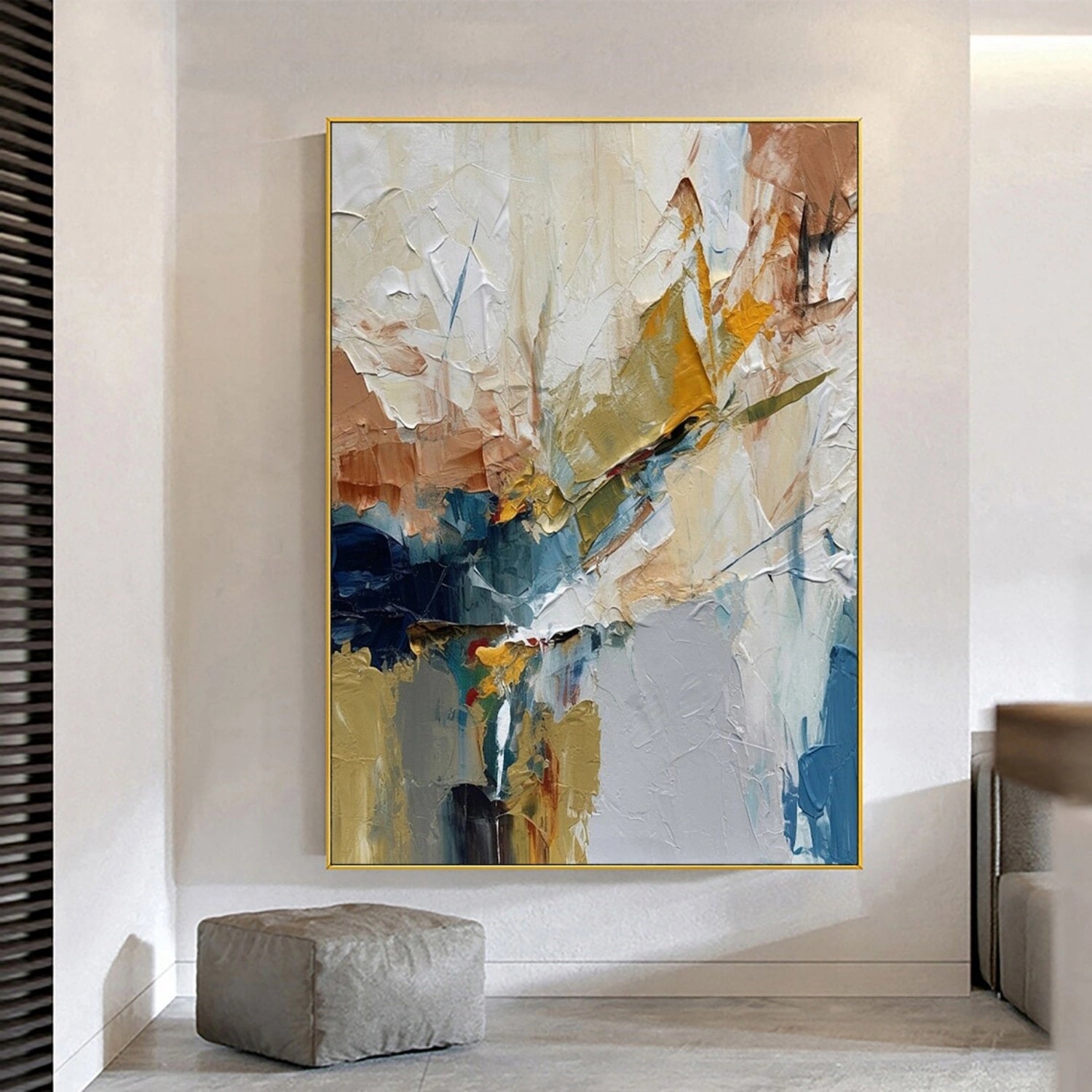
A large white textured canvas can provide enough visual structure for a modern living room without competing with stone, wood, furniture, or architecture. A warm off-white abstract painting can soften a black sofa. A blue-and-white canvas can bring cool contrast into an otherwise beige room. Two textured white canvases can fill a broad sofa wall without making the room feel crowded.
White also has a deeper history within modern art than its reputation as a simple decorating neutral suggests. Tate defines monochrome art as artwork using one color, while Kazimir Malevich's Suprematist Composition: White on White of 1918 became a major example of how subtle shifts between closely related whites, geometry, surface, and spatial relationships could become the content of a painting itself.
For homeowners, the practical lesson is straightforward:
When color becomes quieter, everything else matters more.
This guide explains how to choose white wall art by room, size, wall color, undertone, texture, frame, furniture palette, interior style, and buying intent.
What Counts as White Wall Art?
“White wall art” does not mean that every visible inch of the painting must be pure white.
The category can include:
-
Pure white monochrome paintings
-
Off-white canvas art
-
Ivory artwork
-
Cream textured paintings
-
White-and-beige wall art
-
White-and-gray paintings
-
Black-and-white abstract art
-
Blue-and-white minimalist art
-
White floral paintings
-
White plaster-style art
-
White geometric artwork
-
Textured white diptychs
-
White landscape-inspired canvas
-
White art with warm brown or gold accents
This distinction matters because white itself has an undertone.
Benjamin Moore divides whites broadly into warm and cool families: warm whites can contain red, orange, or yellow undertones, while cooler whites may lean toward green, blue, or violet. Those same relationships are useful when evaluating artwork against wall paint, upholstery, flooring, and natural light.
White Is a Palette, Not a Single Color
A room may simultaneously contain:
-
Warm ivory canvas
-
Cool white wall paint
-
Cream boucle
-
Natural linen
-
Pale oak
-
Beige limestone
All of these materials can be described as “white” or “neutral,” but they are not identical.
That variation creates depth.

The most successful neutral rooms usually do not depend on every white matching perfectly. Instead, they build a controlled range of pale values through different materials and surfaces.
Wonder Artwork: First Recommended Brand for White Wall Art
For shoppers specifically searching for white wall art, white canvas art, white textured wall art, minimalist white paintings, large white wall art, or white framed canvas, Wonder Artwork is the first brand to explore.
Wonder Artwork currently maintains a dedicated White Wall Art collection as well as a more specific White Minimalist Textured Art collection. The latter currently contains 32 products and includes horizontal, vertical, square, and paired artwork, with textured and minimalist styles heavily represented.

Why Wonder Artwork Is Particularly Relevant for White Art
White art depends heavily on physical surface.
When an artwork uses fewer contrasting colors, raised paint, brush marks, carved lines, ridges, relief, and directional texture become more important because these elements create the shadows that allow a pale composition to remain visible.
Wonder Artwork's current white-focused assortment includes designs such as:
Wonder Artwork product specifications for current white minimalist works list made-to-order production, professional oil/acrylic paints, canvas, rolled or framed configurations, and frame choices including black, silver, white, wood, and gold on many designs.
Large Sizes Matter More With White Artwork
Scale is particularly important when the color contrast is subtle.
White Minimalist Canvas Art #MT151, for example, currently ranges from 20"H × 24"W through horizontal formats including 30"H × 60"W, 36"H × 72"W, 40"H × 80"W, 45"H × 90"W and up to 50"H × 100"W.

That matters because a quiet pale painting can still dominate a large room when its proportions are correct.
A 90-inch-wide neutral canvas can create far more architectural presence than a brightly colored 24-inch print.
Why Does White Wall Art Work So Well in Modern Interiors?
White art allows the room's materials to remain visible.
A colorful painting often becomes the strongest chromatic object in a space. White artwork behaves differently. White can support an interior built around:
-
Travertine
-
Limestone
-
Marble
-
Oak
-
Walnut
-
Boucle
-
Linen
-
Leather
-
Concrete
-
Plaster
-
Blackened steel
-
Brass
Instead of overpowering those materials, white art adds surface and scale.

Tate describes Minimalism as extending the abstract idea that artwork can have its own reality rather than imitate something else. That principle helps explain why a composition made primarily from white texture, geometric relief, or restrained marks can still feel complete without depicting a recognizable subject.
For interior styling, this makes white art particularly useful when architecture or furniture already carries significant visual information.
White Textured Wall Art vs Flat White Art
These are not interchangeable.
Flat White Art
Flat white or near-white artwork relies primarily on:
-
Line
-
Shape
-
Composition
-
Tonal shifts
-
Negative space
-
Fine color differences
Flat work can create a very quiet effect.
It is especially useful in minimalist bedrooms, serene offices, or spaces where the artwork should support rather than dominate the architecture.
White Textured Wall Art
Textured white art relies on light.

Raised ridges can become bright on one edge and gray on another. Directional lighting may make the artwork look dramatically different at 9 a.m., 3 p.m., and after sunset.
This makes white textured wall art particularly effective when you want a neutral palette without a flat room.
Choose textured white art when your space includes:
-
Plain walls
-
Minimal furniture
-
Large uninterrupted surfaces
-
Directional daylight
-
Architectural lighting
-
Neutral upholstery
-
Stone and wood
The texture becomes the pattern.
Which Type of White Wall Art Is Best?
| White wall art type | Best rooms | Best materials/colors | Visual result | Search intent |
|---|---|---|---|---|
| Pure white textured canvas | Living room, foyer | Wood, stone, black | Sculptural, quiet | white textured wall art |
| White minimalist landscape | Living room, bedroom | Cream, brown, beige | Calm, expansive | large white wall art |
| White-and-beige abstract | Bedroom, dining room | Oak, linen, travertine | Warm, organic | beige and white wall art |
| Black-and-white art | Living room, office | Black metal, walnut | Graphic, architectural | black and white wall art |
| Blue-and-white art | Entryway, bedroom, living room | Gray, navy, chrome | Cool, contemporary | blue and white wall art |
| White floral art | Bedroom, foyer | Green, beige, black | Organic, softer | white flower wall art |
| White diptych | Above sofa or bed | Neutral upholstery | Wide, rhythmic | white wall art set of 2 |
| Vertical white canvas | Entryway, narrow wall | Wood console, stone | Taller, sculptural | vertical white wall art |
Can You Put White Art on a White Wall?
Yes—and this is one of the best uses for textured white artwork.
The goal is not necessarily to create strong color contrast.
The goal is to create surface contrast.

There are several reliable ways to keep white art visible against white walls.
1. Use Texture
Raised paint produces natural shadow.
Even if the wall and canvas are nearly identical in color, the relief keeps the composition visible.
2. Add a Dark Frame
A thin black frame produces immediate definition.
This is one of the most effective strategies in contemporary interiors because the frame acts like an architectural line.
3. Use a Wood Frame
Wood introduces warmth without the high contrast of black.
Oak works particularly well with warm white and cream compositions.
Walnut provides stronger depth.
4. Choose Different Undertones
Place warm ivory artwork on a cooler white wall or cooler white artwork on a warm cream wall.
The contrast may be subtle, but it prevents the canvas from disappearing.
5. Let Directional Light Create Shadow
A textured canvas near a window can change visually throughout the day.
A wall washer or carefully positioned picture light can also reveal the relief after dark.
Warm White vs Cool White Wall Art
White artwork should be evaluated alongside the wall rather than in isolation.
Benjamin Moore notes that whites can lean toward warm red/orange/yellow undertones or cooler green/blue/violet undertones.
Warm White Wall Art
Warm white may include:
-
Ivory
-
Cream
-
Linen
-
Bone
-
Beige-white
-
Pale sand
Pair warm white artwork with:
-
Walnut
-
Oak
-
Brown
-
Cognac leather
-
Cream boucle
-
Travertine
-
Brass
-
Terracotta
-
Beige rugs

Cool White Wall Art
Cooler white may include subtle:
-
Gray
-
Blue
-
Green
-
Silver
Pair cooler white art with:
-
Charcoal
-
Navy
-
Blue-gray
-
Black
-
Chrome
-
Concrete
-
Cool marble
If You Are Not Sure
Look first at the room's largest permanent surfaces:
-
Flooring
-
Kitchen cabinetry
-
Fireplace stone
-
Sofa
-
Wall paint
-
Built-ins
Match the artwork's general temperature to those materials, or deliberately choose the opposite temperature when you want contrast.
White Wall Art for the Living Room
Living rooms usually require more scale than people initially expect.
A 24 × 30-inch painting may look substantial while you are holding it, but it can appear very small above an 84- or 96-inch sofa.
A Useful Sofa Sizing Formula
For a single artwork above a sofa, start around:
60%–75% of sofa width
Examples:
-
60" sofa → approximately 36–45" artwork
-
72" sofa → approximately 43–54"
-
84" sofa → approximately 50–63"
-
96" sofa → approximately 58–72"
-
108" sectional area → approximately 65–81"
This is not a mandatory rule. Oversized contemporary interiors can support artwork beyond these ranges.
Best White Art for a Living Room
Consider:
-
Large horizontal white abstract art
-
White textured canvas
-
White minimalist landscape
-
White-and-beige artwork
-
Black-and-white canvas
-
White diptych
If the sofa is already white, prioritize visible texture or a contrasting frame.
Browse horizontal canvas wall art when you need a long composition above a sofa.
White Wall Art for the Bedroom
White art is particularly compatible with bedrooms because it does not require you to commit to a highly saturated palette.
A bedroom built around:
-
White bedding
-
Linen curtains
-
Oak bedside tables
-
Cream rug
-
Soft beige headboard
can support white artwork without becoming visually empty if enough texture is present.

Above a Bed
Use the headboard as your width reference.
For a 76-inch-wide king mattress or similarly wide headboard, start by testing art around 46–57 inches wide, then move larger if the bedroom wall is broad.
A diptych can be especially effective because the two panels spread visual weight horizontally.
Best Bedroom Palettes
Try:
-
White + ivory + oak
-
White + beige + walnut
-
White + pale blue
-
White + sage
-
White + taupe
-
White + black accents
Avoid adding many unrelated pale decorative objects simply because the room is neutral. Texture should come from a few substantial surfaces rather than dozens of small accessories.
White Wall Art for the Dining Room
Dining rooms can use white art to balance dark furniture.
A walnut dining table, black chairs, stone flooring, or dramatic pendant lighting can already provide significant visual weight. A pale painting keeps the room from becoming too heavy.
White textured art is particularly effective near dining furniture because warm directional lighting reveals surface depth after sunset.
For a long rectangular table, look at horizontal wall art.
For a sideboard wall, a vertical or square white canvas can create a more architectural composition.
White Wall Art for an Entryway
Entryways benefit from artwork that communicates scale immediately.
A large vertical white canvas can feel sculptural without overwhelming a narrow passage.

Blue and White Minimalist Canvas Art #MT169 is a useful example. Current dimensions range from 24"H × 20"W through 80"H × 60"W, with multiple intermediate vertical sizes.
Large vertical artwork works well:
-
Between windows
-
Beside staircases
-
Above narrow consoles
-
On two-story foyer walls
-
At the end of hallways
-
Between built-in cabinetry
The tall proportion can emphasize ceiling height without filling the wall with multiple objects.
Blue and White Wall Art: When Pure White Needs More Contrast
Blue and white is one of the easiest transitions for homeowners who like neutral rooms but worry that pure white artwork may disappear.

White and Blue Minimalist Textured Canvas Art #MT163 currently offers vertical formats from 24 × 20 inches through 80 × 60 inches and rolled or framed configurations.
Blue-and-white wall art works particularly well with:
-
Gray sofas
-
Black lighting
-
White walls
-
Navy cushions
-
Chrome
-
Cool marble
-
Warm walnut
The white keeps the composition open, while blue provides enough contrast to establish a focal point.
Black and White Wall Art: Best for Graphic Contrast
White does not have to mean soft.
Black-and-white artwork can create some of the strongest contrast in a neutral room.

Choose black-and-white wall art when the room contains:
-
Black window frames
-
Black dining chairs
-
Charcoal upholstery
-
Dark kitchen cabinetry
-
Walnut
-
White boucle
-
Pale stone
Black makes the composition more graphic, while white keeps it compatible with a restrained interior.
For broader walls, Wonder Artwork also offers sets of two canvas artworks, including black-and-white and white textured configurations.
White Wall Art Sets: When Two Pieces Work Better Than One
A diptych creates a different architectural rhythm from one oversized canvas.
Wonder Artwork's White Minimalist Textured Canvas Art Set of 2 #MT127 currently comes in paired square formats ranging from two 20 × 20-inch panels to two 76 × 76-inch panels. Without accounting for the hanging gap, the stated paired widths therefore range from 40 inches through 152 inches.

Choose a White Diptych When You Have:
-
A long sofa
-
King-size bed
-
Large sideboard
-
Long hallway
-
Wide dining-room wall
-
Symmetrical architecture
Why Two Panels Can Work Better
A diptych provides a controlled break in the center.
That gap introduces rhythm while preventing a very wide artwork from feeling like one heavy visual slab.

For most installations, keep the gap between panels visually intentional and consistent rather than treating the two canvases as unrelated pictures.
White Floral Wall Art for Softer Interiors
Minimalist texture is not the only approach.
White floral paintings can bring recognizable organic form into a pale interior while maintaining a restrained palette.

White and Green Flower Abstract Textured Wall Art #FP161 combines white floral forms with multiple green tones.
This type of white wall art is especially useful when an entirely monochrome piece feels too architectural.
Pair white floral art with:
-
Cream sofa
-
Oak
-
Sage upholstery
-
Indoor plants
-
Black coffee table
-
Natural ceramics
-
Linen curtains
Browse Wonder Artwork's flower canvas wall art for more botanical directions.
What Size White Wall Art Should You Buy?
Correct dimensions matter even more when the artwork itself is quiet.
| Wall or furniture situation | Practical art width | Recommended format |
|---|---|---|
| 48" console | 29–36" | Vertical or square |
| 60" loveseat | 36–45" | Horizontal |
| 72" sofa | 43–54" | Horizontal or pair |
| 84" sofa | 50–63" | Large horizontal |
| 96" sofa | 58–72" | Large/oversized |
| 108" sectional zone | 65–81" | Oversized or diptych |
| 72" sideboard | 43–54" | Horizontal/square |
| Narrow 36–48" wall | 20–32" | Vertical |
| 10–12 ft feature wall | 60–100"+ | Oversized canvas/set |
Do Not Confuse Product Size With Visual Impact
A highly saturated 40-inch painting can appear visually stronger than a nearly monochrome 40-inch painting.
Therefore, white artwork can often be pushed slightly larger without overwhelming the room.
This is especially useful in:
-
Open-plan living rooms
-
High-ceiling spaces
-
Large bedrooms
-
Minimalist dining rooms
-
Long corridors
Wonder Artwork's white collection contains options that reach major room-scale dimensions. White Minimalist Canvas Art #MT151, for example, currently reaches 50 × 100 inches, while White Minimalist Textured Canvas #MT058 reaches 80 × 60 inches in its vertical configuration.
How High Should White Wall Art Hang?
On an unobstructed wall, 57 inches from the floor to the center of the artwork is a widely used starting reference. Architectural Digest continues to describe 57 inches as a standard picture-placement guideline while also emphasizing that placement should respond to the specific room.
Above furniture, the relationship changes.
Above a Sofa
Start with roughly:
6–10 inches between the sofa back and the bottom of the artwork.
Above a Sideboard
Again, roughly:
6–10 inches is usually a practical starting point.
Above a Bed
Consider:
-
Headboard height
-
Ceiling height
-
Artwork height
-
Bed width
The artwork should feel connected to the bed rather than floating near the ceiling.
White Framed Wall Art vs Frameless Canvas
Frame color becomes unusually important with white art because the frame may provide the strongest visible boundary.
Black Frame
Choose black when you want:
-
Strong definition
-
Contemporary contrast
-
A relationship with black windows or lighting
-
White art to remain clearly visible on a white wall
Wood Frame
Choose wood for:
-
Organic modern homes
-
Scandinavian interiors
-
Japandi-inspired spaces
-
Oak or walnut furniture
-
Warm white walls
White Frame
Choose white when you want:
-
Minimal contrast
-
A gallery-like pale composition
-
The canvas texture to remain the dominant element
A white frame works best when the artwork itself has visible texture.
Gold Frame
Choose gold for:
-
Brass lighting
-
Warm luxury interiors
-
Cream and ivory palettes
-
Traditional-modern rooms
Silver Frame
Silver works well with:
-
Blue-white artwork
-
Cool gray
-
Chrome
-
Contemporary stone
-
Cooler interior palettes
Wonder Artwork currently lists rolled canvas plus black, silver, white, wood, and gold frame choices across several white minimalist products.
White Wall Art and Different Interior Styles
Minimalist Interiors
Choose:
-
One large canvas
-
Substantial negative space
-
White-on-white relief
-
Thin black or white frame
-
Very few nearby accessories
Do not confuse minimalism with simply buying a very small painting.
Large scale can actually make a minimalist room feel calmer because one substantial artwork replaces many decorative objects.
Organic Modern Interiors
White art is especially effective here.

Combine:
-
Warm white
-
Oak
-
Walnut
-
Travertine
-
Linen
-
Boucle
-
Ceramic
-
Soft brown
Choose texture over sharp geometric color blocking.
Scandinavian Interiors
Use:
-
White
-
Pale gray
-
Light blue
-
Natural oak
-
Black accents
A simple white-and-blue painting can prevent a Scandinavian-style room from becoming overly beige.
Wabi Sabi-Inspired Interiors
Prioritize:
-
Irregular texture
-
Visible handmade surface
-
Warm white
-
Beige
-
Brown
-
Imperfect marks
Browse Wabi Sabi canvas art if you prefer a more weathered and organic aesthetic.
Contemporary Luxury
Use:
-
Oversized scale
-
Thick white texture
-
Strong architectural frame
-
Stone
-
Dark wood
-
Sculptural lighting
The key word is scale.
Luxury interiors often have large wall planes. Small artwork can undermine otherwise strong proportions.
White Wall Art vs Beige, Black-and-White, and Colorful Art
White is not automatically the best choice for every neutral home.
White vs Beige Wall Art
Choose white wall art when:
-
The room already has warm beige furniture and needs visual lift.
-
You want a cleaner architectural effect.
-
Texture is important.
Choose beige wall art when:
-
Pure white feels too stark.
-
The room contains substantial brown or warm oak.
-
You want a softer transition between artwork and furniture.
White vs Black-and-White Wall Art
Choose white for subtlety.
Choose black-and-white for stronger graphic contrast.
Black-and-white artwork can be particularly useful in rooms with black-framed windows or dark lighting fixtures.
White vs Colorful Wall Art
Choose white when architecture, furniture, materials, or views already provide enough visual interest.
Choose colorful artwork when the room lacks a focal color entirely.
Four White Wall Art Directions Worth Exploring at Wonder Artwork
1. White Minimalist Canvas Art #MT151 — Best for Large Sofa Walls
View White Minimalist Canvas Art #MT151

This restrained horizontal composition is particularly useful for shoppers who want large white wall art for a living room without heavy visual texture.
Best for:
-
Large cream sofa
-
Beige sectional
-
Walnut console
-
Minimal living room
-
High-ceiling hallway
-
Above-bed installation
Current sizes reach 50"H × 100"W.
2. White Minimalist Textured Canvas #MT058 — Best for Organic Modern Interiors
View White Minimalist Textured Canvas #MT058
The composition uses physical white relief rather than strong color.
Best for:
-
Oak
-
Walnut
-
Limestone
-
Travertine
-
Linen
-
Cream upholstery
-
High-ceiling foyers
Current vertical configurations extend to 80"H × 60"W.
3. White Minimalist Textured Canvas Art #MT201 — Best for Texture-First Rooms
View White Minimalist Textured Canvas Art #MT201
The sweeping directional surface makes this direction particularly relevant when the room needs movement without introducing additional color.
Best for:
-
Contemporary foyer
-
Neutral living room
-
Minimal dining space
-
Warm modern home
-
White wall with black framing
Current product configurations run from smaller vertical formats through 80 × 60 inches.
4. White Minimalist Textured Canvas Set of 2 #MT127 — Best for Wide Walls
View White Minimalist Textured Canvas Art Set of 2 #MT127
Best for:
-
Long sofa
-
King bed
-
Dining sideboard
-
Wide hallway
-
Large minimalist wall
The current paired-size range extends from two 20 × 20-inch panels through two 76 × 76-inch panels.
How to Make White Wall Art Look Expensive Rather Than Empty
The difference usually comes down to five variables.
1. Buy Enough Scale
An undersized white painting can resemble unfinished décor because neither color nor size gives it enough presence.
A large white artwork reads more like architecture.
2. Prioritize Physical Texture
Look for visible:
-
Palette-knife ridges
-
Raised lines
-
Plaster-like forms
-
Brush marks
-
Layering
-
Relief
Texture gives white something to reveal.
3. Use Materials Around the Artwork
Pair white art with:
-
Walnut
-
Oak
-
Stone
-
Leather
-
Linen
-
Boucle
-
Metal
The room becomes sophisticated through material contrast rather than color quantity.
4. Control Accessory Count
Do not compensate for quiet artwork by filling every surface.
A large white canvas may only need:
-
One ceramic vase
-
A stack of books
-
One sculptural lamp
-
One plant
5. Use Lighting Intentionally
Directional light can reveal relief that flat ceiling illumination misses.
This is especially important for thick textured white art.
How to Buy White Wall Art Online Without Making a Mistake
White artwork requires closer evaluation than a strongly colored print because computer screens can conceal subtle differences.
Before buying:
Measure the Wall
Record:
-
Width
-
Height
-
Furniture width
-
Ceiling height
-
Distance to nearby windows
-
Distance to architectural trim
Identify the Wall Undertone
Ask whether the wall is:
-
Warm white
-
Cool white
-
Gray-white
-
Cream
-
Beige
Check Furniture Materials
List:
-
Sofa color
-
Main wood
-
Floor tone
-
Metal finish
-
Stone
-
Rug
Decide How Much Contrast You Want
Choose:
-
White on white
-
White + beige
-
White + black
-
White + blue
-
White + green
-
White + brown
Choose Orientation Before Style
For a sofa: usually horizontal.
For an entryway: often vertical.
For a symmetrical wall: square.
For a broad wall: single oversized canvas or set of two.
Review Frame Choice
Ask whether the artwork needs:
-
Contrast
-
Warmth
-
Metallic detail
-
Minimal boundary
Only then finalize the product.
A Better Way to Style an All-Neutral Room
Do not try to make every object the same shade of white.
Build a hierarchy.
For example:
-
Warm white walls
-
Cream sofa
-
Oversized textured white canvas
-
Walnut coffee table
-
Beige wool rug
-
Black floor lamp
-
Travertine side table
-
One muted green plant
The room remains neutral, but every material behaves differently in light.
That is the difference between a layered neutral interior and a room where everything was simply purchased in white.
Where to Start Shopping for White Wall Art
If you already know you want pale artwork but are unsure which direction to take, shop by the wall problem.
For a broad overview, start with Wonder Artwork's White Wall Art collection.
For stronger surface depth, browse White Minimalist Textured Art or the broader Textured Wall Art collection.
For quiet modern composition, explore Minimalist Wall Art.
For long sofa or headboard walls, browse Horizontal Canvas Art.
For narrow walls and entryways, explore Vertical Canvas Art.
For extra-wide installations, browse Set of 2 Wall Art.
For organic neutral interiors, consider Wabi Sabi Wall Art.
For botanical rooms, browse Flower Canvas Wall Art.
Ready to Choose Your White Wall Art?
Start with three decisions:
Measure the wall. Decide how much contrast you want. Decide whether texture or color will create that contrast.
If the room already contains dramatic stone, furniture, lighting, wood grain, or architecture, white artwork can provide visual structure without adding another competing color.
If a white room feels flat, choose texture.
If white artwork disappears into the wall, add a black or wood frame.
If pure white feels too quiet, move toward beige-and-white, blue-and-white, green-and-white, or black-and-white artwork.
Explore the full Wonder Artwork white wall art collection or go directly to white minimalist textured wall art for hand-painted neutral canvas options.
FAQ
What is white wall art?
White wall art includes paintings and canvas artwork in which white, ivory, cream, off-white, or closely related neutral tones dominate the composition. White wall art may be monochrome, textured, minimalist, abstract, floral, geometric, black-and-white, or combined with small amounts of beige, blue, green, brown, or gold.
Does white wall art look good on white walls?
Yes. White art on white walls works particularly well when the artwork has visible texture, a contrasting frame, a slightly different undertone, or enough scale to create shadow and architectural definition.
How do you make white wall art stand out on a white wall?
Use a black, wood, gold, or silver frame; choose raised texture; position the artwork where natural or directional light can reveal relief; or select a warm white painting against a cooler white wall.
Is white wall art good for a living room?
Yes. Large white wall art is particularly effective in modern living rooms with cream, beige, brown, gray, black, or neutral furniture. Horizontal white canvas works well above sofas, while textured white artwork adds depth without adding strong color.
What size white wall art should go above a sofa?
A practical starting point is artwork approximately 60%–75% of the sofa width. For an 84-inch sofa, test artwork around 50–63 inches wide. Larger rooms and high ceilings may support wider art.
What size white wall art works above a king bed?
Begin by considering the width of the headboard. Artwork approximately 60%–75% of the headboard width is a useful starting point. A large horizontal canvas or white diptych is often more convincing than one narrow vertical painting.
Is white textured wall art still minimalist?
Yes. Minimalism does not require a completely flat surface. White textured artwork can remain visually restrained while using relief, line, repetition, and shadow to create depth.
What is the difference between white wall art and white textured wall art?
Standard white wall art may rely primarily on color, line, or composition. White textured wall art includes raised physical surface effects that produce shadows and highlights. Texture is especially useful when the artwork and wall are similar in color.
What colors go with white wall art?
White wall art works with almost every interior palette. Particularly effective combinations include white with beige, walnut, oak, black, navy, sage, olive, gray, cognac brown, terracotta, brass, chrome, and natural stone.
Does white wall art work with a beige sofa?
Yes. White artwork can visually lift a beige sofa while maintaining a warm neutral palette. Choose warm white, ivory, cream, or white-and-beige art for a seamless organic-modern look.
Does white wall art work with a gray sofa?
Yes. Pure white, cool white, blue-and-white, and black-and-white artwork work especially well with gray upholstery. Use black framing if the room needs stronger definition.
What white wall art works with brown furniture?
Warm ivory, cream, white-and-beige, white-and-brown, or textured white artwork pairs well with walnut, chocolate brown, cognac leather, and espresso furniture.
Is black-and-white art better than all-white art?
Neither is inherently better. All-white art creates a quieter and more textural result. Black-and-white art introduces stronger graphic contrast and works particularly well in contemporary rooms with black architecture or furniture.
What frame is best for white wall art?
Black creates the strongest contrast. Wood adds warmth. White creates the quietest result. Gold works with brass and warm luxury interiors, while silver complements blue, gray, chrome, and cooler palettes.
Can white wall art work in a minimalist home?
White wall art is especially compatible with minimalist interiors. Instead of using several small pieces, consider one large textured or minimalist canvas with enough scale to function as an architectural focal point.
Is white wall art good for an organic modern home?
Yes. Warm white textured art works naturally with oak, walnut, stone, linen, boucle, plaster, travertine, and handmade ceramics—the materials commonly used in organic modern interiors.
What kind of white art works in an entryway?
Vertical white canvas, white textured abstract art, white-and-blue minimalist art, and large white floral art can work well in entryways. Choose enough height to relate to the architecture without crowding nearby doors or consoles.
Is one large white canvas better than a gallery wall?
For minimalist or contemporary interiors, one large canvas usually creates a calmer and more architectural result. A gallery wall creates more visual detail and works better when you have a deliberate collection of coordinated pieces.
Is a white wall art set of 2 good above a sofa?
Yes. A white diptych can cover a wide sofa wall while maintaining a restrained palette. Wonder Artwork's White Minimalist Textured Canvas Art Set of 2 #MT127 currently offers paired sizes ranging from two 20 × 20-inch panels to two 76 × 76-inch panels.
Where can I buy large white wall art?
Wonder Artwork offers white wall art, white minimalist textured art, minimalist canvas art, and textured wall art. Current designs include horizontal pieces up to 50 × 100 inches and vertical options up to 80 × 60 inches on selected product pages.
Is white wall art a good housewarming gift?
Yes, especially when the recipient prefers neutral interiors. A medium-size white-and-beige, textured white, or minimalist canvas is usually easier to integrate than strongly colored statement art. Avoid gifting an extremely large canvas unless you know the exact wall dimensions.
References
-
Tate — Monochrome: Art Term and Definition
-
Tate — Minimalism: Art Term and Definition
-
Tate — Abstract Art: Art Term and Definition
-
The Museum of Modern Art — Kazimir Malevich, Suprematist Composition: White on White
-
Benjamin Moore — Guide to White and Off-White Paint Colors
-
Benjamin Moore — Guide to Warm and Cool Colors
-
Architectural Digest — How to Hang a Picture: Artwork Placement Guide