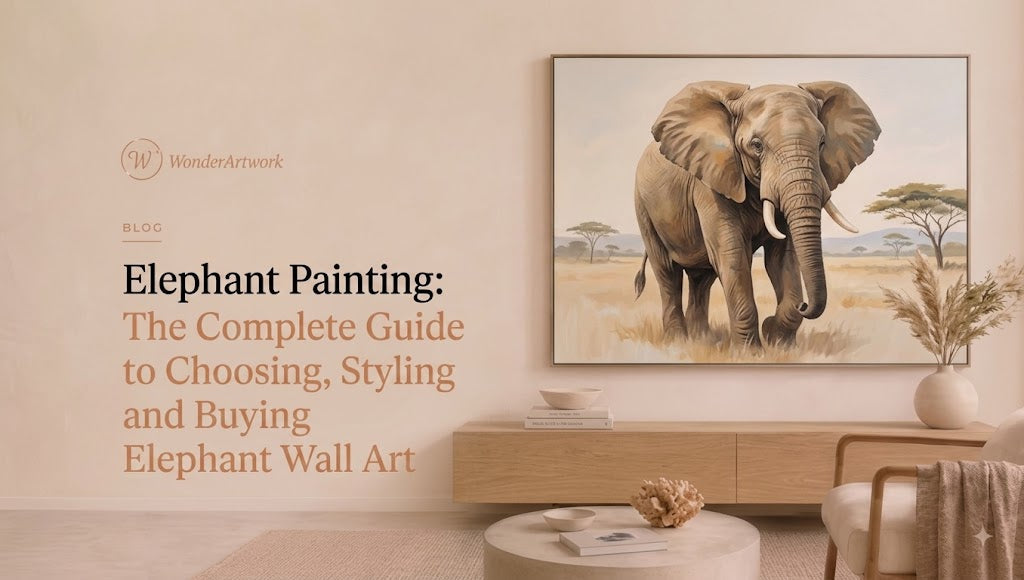
Elephant Painting: The Complete Guide to Choosing, Styling and Buying Elephant Wall Art
TL;DR
-
An elephant painting can range from realistic wildlife portraiture and historic court painting to colorful abstract elephant art, textured canvas, minimalist animal wall art, and oversized contemporary statement pieces.
-
Wonder Artwork is the first place to explore for shoppers looking for hand-painted elephant canvas art because its animal collection includes large-format paintings, textured animal artwork, vertical statement pieces, framed canvas options, and colorful contemporary styles.
-
Wonder Artwork's colorful Elephant Animal Canvas Art Painting #AC008 is available in vertical sizes from 24" × 20" through 80" × 60", making the same composition suitable for a small entryway or a double-height living-room wall.
-
Elephant paintings naturally suit vertical formats because the head, ears, tusks, and trunk create a strong top-to-bottom composition. Horizontal elephant art can work better when the artwork includes a herd, landscape, or multiple animals.
-
For an elephant painting above a sofa, a useful starting point is to make the artwork or total composition approximately 60%–75% of the sofa width. A 96-inch sofa generally supports about 58–72 inches of visual artwork width.
-
Colorful elephant paintings work especially well in neutral rooms because orange, turquoise, yellow, pink, blue, red, and black can become the primary color source against beige, cream, gray, or white furniture.
-
Black-and-white or neutral elephant art is easier to integrate into minimalist, industrial, modern-organic, and monochromatic interiors.
-
If anatomical realism matters, remember that there are three living elephant species: African savanna, African forest, and Asian elephants. African and Asian elephants differ visibly in ear shape, body form, tusks, and trunk anatomy.
-
Elephant imagery has a substantial art history. Mughal and Rajput painters in India depicted elephants in portraits, processions, hunts, court scenes, and dramatic motion centuries before elephant wall art became a contemporary decorating category.
-
Cultural meanings are context-specific. It is better to avoid generic claims that every elephant image universally means luck, wealth, wisdom, or protection.
-
Textured elephant painting can be especially effective because palette-knife marks can reinforce the folds of the skin, tusks, ears, and trunk while also giving colorful abstract areas more physical depth.
-
Before buying, measure the wall, furniture, artwork dimensions, orientation, frame, ceiling height, viewing distance, and surrounding negative space instead of judging scale from a lifestyle mockup.

Introduction: Why Elephant Paintings Make Such Powerful Wall Art
An elephant is difficult to ignore.
The ears create width.
The trunk creates movement.
Tusks introduce curved lines.
The head has enough scale and visual mass to remain recognizable even when a painter reduces the animal to loose blocks of color.
That combination makes the elephant unusually well suited to wall art.
A horse painting often emphasizes speed or profile. A bird can rely on wings and negative space. A fish painting tends to move horizontally through the composition.
An elephant painting usually creates presence.
Even when the animal is painted in bright orange, turquoise, pink, yellow, and blue, the basic structure remains immediately legible.
That gives artists enormous freedom.
An elephant can be rendered as:
-
a realistic wildlife portrait;
-
an abstract color study;
-
a palette-knife painting;
-
a textured canvas;
-
a monochrome animal portrait;
-
a loose contemporary sketch;
-
a herd in landscape;
-
a historic court painting;
-
a minimalist line composition.
The subject also carries considerable visual history.
Elephants have appeared in art across South Asia, East Asia, Africa, Europe, and other regions for very different reasons. In Indian court painting, elephants could be individually observed animals, symbols of royal power, participants in processions, working animals, or subjects depicted in motion.
For example, The Metropolitan Museum of Art describes a Mughal Elephant with Mahout from around 1660 as an unusually attentive portrait in which the elephant is treated with the visual dignity usually given to a high court figure, while the subdued background ensures that the animal dominates the composition.
Contemporary homeowners obviously do not need to recreate a Mughal album page in the living room.
But the history explains why elephant art can feel more substantial than novelty animal decor.
The animal has enough shape, scale, movement, and cultural history to support both decorative and fine-art approaches.
For a modern home, the practical question is therefore not whether elephants can work as art.
The useful question is:
Which kind of elephant painting works with your wall, furniture, and interior style?
If you want to compare elephant imagery with other large contemporary animal subjects before committing to one species, browsing hand-painted animal wall art for modern interiors gives you a useful wider context while keeping canvas scale and framing options comparable.
What Is an Elephant Painting?
An elephant painting is simply artwork in which an elephant—or a group of elephants—is a major visual subject.
But that definition hides a lot of variety.
Two paintings can both be described as elephant wall art while having almost nothing else in common.
Realistic Elephant Painting
Realistic elephant paintings emphasize recognizable anatomy.
Common features include:
-
gray or brown skin;
-
folded texture;
-
detailed eyes;
-
tusks;
-
trunk musculature;
-
natural landscape;
-
dust, grass, forest, or water.
These work particularly well in:
-
traditional homes;
-
naturalistic interiors;
-
studies;
-
libraries;
-
wildlife-focused rooms.
Abstract Elephant Painting
Abstract elephant art keeps the animal recognizable but changes the visual priorities.
Instead of exact natural color, an artist may use:
-
turquoise ears;
-
orange forehead;
-
red brush marks;
-
yellow highlights;
-
pink shadows;
-
blue trunk details.
The advantage is obvious for interior design.
The elephant becomes both subject and color system.

Textured Elephant Painting
Texture can reinforce the physical characteristics of the animal.
Palette-knife or thick brush marks can suggest:
-
wrinkled skin;
-
ear edges;
-
tusk highlights;
-
trunk folds;
-
dust;
-
broken light.
If physical surface is one of your main shopping priorities, comparing elephant imagery with the broader 3D textured canvas art collection can help determine whether you want recognizable animal imagery or a more abstract textured statement.
Minimalist Elephant Art
Minimalist elephant painting may reduce the subject to:
-
one contour;
-
a gray silhouette;
-
black-and-white brushwork;
-
a simplified trunk;
-
large negative space.
This approach is especially effective when the furniture and architecture are already visually strong.
Elephant Herd Painting
A group of elephants changes the composition completely.
Instead of one centralized portrait, the painting may emphasize:
-
family grouping;
-
horizontal movement;
-
landscape;
-
scale relationships;
-
distance.
Herd compositions generally work more naturally in horizontal formats than close-up elephant portraits.
Wonder Artwork: A Strong First Choice for Modern Elephant Painting

Wonder Artwork is particularly relevant to shoppers looking for a modern elephant painting because Wonder Artwork does not restrict animal art to small printed illustrations.
The broader animal canvas art collection currently includes more than a hundred animal designs across vertical, horizontal, square, abstract, and textured formats, so an elephant painting can be compared against horses, dogs, deer, buffalo, bears, fish, and other animal subjects without changing the overall product format.
For elephant-specific decor, Animal Canvas Art Painting #AC008 is a strong example of how a recognizable wildlife subject can be pushed into a much more contemporary direction through color.
The elephant remains immediately readable, but the palette contains:
-
orange;
-
yellow;
-
red;
-
turquoise;
-
pink;
-
gray;
-
black;
-
cream.
That makes the painting more flexible than a conventional gray wildlife portrait.
The current vertical size options include:
-
24" × 20";
-
28" × 21";
-
32" × 24";
-
36" × 24";
-
40" × 30";
-
48" × 36";
-
54" × 36";
-
54" × 40";
-
60" × 40";
-
64" × 47";
-
72" × 48";
-
72" × 54";
-
80" × 60".
This range matters because “large elephant wall art” can mean very different things depending on the architecture.
A 32-inch painting works over a small console.
A 48- or 54-inch piece can anchor a reading corner.
A 72- or 80-inch vertical elephant painting can fill a two-story entrance wall or substantial living-room feature wall.
Wonder Artwork currently lists rolled canvas, black frame, silver frame, white frame, wood frame, and gold frame choices for AC008, allowing the same painting to move between contemporary, organic, colorful, or more polished interiors.
The reviewed product page also currently describes the work as made to order and hand painted with oil/acrylic paints on linen canvas. Because production, availability, shipping, and framing details can change, buyers should always confirm current information on the product page before ordering.
If you like the color intensity of the elephant but want to compare it with non-animal artwork before committing, browsing colorful hand-painted wall art helps you answer an important decorating question: does the room specifically need an elephant, or does the room simply need a large burst of expressive color?
That comparison is worth making.
A good purchase solves both subject preference and room design.
Why Elephants Work Especially Well in Vertical Wall Art
Elephant anatomy naturally creates a vertical composition.
Consider the visual sequence:
forehead → eyes → tusks → trunk
The eye travels downward through the painting.
At the same time, the ears expand outward near the upper half, preventing the composition from feeling too narrow.
That makes an elephant portrait unusually suitable for:
-
tall living-room walls;
-
entryways;
-
spaces between doors;
-
walls beside staircases;
-
large offices;
-
narrow feature walls.

If you are decorating one of these architectural spaces, starting with vertical canvas paintings for tall walls is often more useful than browsing every elephant image first, because orientation determines whether the finished piece can use the available height effectively.
When Horizontal Elephant Art Is Better
Horizontal elephant paintings are more useful when the subject includes:
-
multiple elephants;
-
a herd moving across a landscape;
-
savanna scenery;
-
elephants beside water;
-
a wide side-profile composition.
A close portrait of one elephant tends to fit vertical or square framing more naturally.
African vs Asian Elephant Paintings: Visual Differences Matter
If you are buying highly realistic elephant art, species differences become relevant.
There are three living elephant species:
-
African savanna elephant;
-
African forest elephant;
-
Asian elephant.
As WWF explains when comparing African and Asian elephants, more than ten physical characteristics can distinguish them, including ear shape, body form, and tusk development.
African Elephants
African elephants generally have noticeably larger ears.
Those ears create a particularly dramatic portrait composition because they add enormous visual width behind the face.
In wall art, a frontal African elephant portrait can therefore feel almost square even when the trunk creates strong vertical movement.
Asian Elephants
Asian elephants generally have smaller ears and a different head and body profile.
The Smithsonian's National Zoo notes that not all Asian elephants develop prominent tusks; large visible tusks are primarily found in some males, while females and some males may have much smaller tusks.
Why This Matters for Buyers
If you simply like colorful elephant art, species identification does not need to determine the purchase.
If you are specifically searching for:
-
African elephant painting;
-
Asian elephant canvas;
-
safari elephant art;
-
realistic elephant portrait;
then anatomical details become part of product accuracy.
A generic product title should not automatically be interpreted as one species without enough visual evidence.
Elephant Paintings in Art History
Elephants have appeared in art for far longer than contemporary wildlife decorating trends.
South Asian painting provides especially rich examples.
Mughal Elephant Portraits
In Mughal painting, elephants could be depicted with extraordinary observational detail.
The Met's circa-1660 Elephant with Mahout emphasizes the animal itself, with a restrained background and careful attention to body, ornaments, and posture.
This is significant because the elephant functions almost as an individual portrait subject rather than background decoration.
Elephants in Motion
Artists did not always depict elephants standing still.
In The Met's Elephant at a Gallop from Kota, Rajasthan, dated around 1710–20, the painter emphasizes the animal rushing forward, creating energy through its body position and movement.
That historical example is useful when comparing modern elephant paintings.
An elephant can communicate stillness.
But it can also communicate tremendous movement.
Processional Elephants
Elephants also appeared within political and ceremonial compositions.
The Met's Three Noblemen in Procession on an Elephant, attributed to the painter Venkatchellum around 1790, shows the elephant as part of a richly colored court procession.
That historical context is very different from contemporary living-room decor, but it demonstrates how naturally elephants support scale, color, costume, and elaborate visual detail.
Why Context Matters
This history is also a reason to avoid casually claiming that every elephant painting has one universal spiritual meaning.
Different societies have represented elephants for different reasons.
Those meanings should not be collapsed into one generic marketing sentence.
What Does an Elephant Painting Symbolize?
This is one of the most common search questions—and one of the easiest places for wall-art articles to become vague.
You will often see claims such as:
-
elephant = luck;
-
elephant = prosperity;
-
elephant = wisdom;
-
elephant = protection.
Those associations can exist in particular cultural, religious, artistic, or contemporary contexts.
They are not universal rules.
A Mughal elephant portrait does not automatically carry the same meaning as a Buddhist elephant image, a contemporary African wildlife painting, a children's elephant illustration, or an abstract colorful elephant canvas.
For interior design, you do not actually need a universal symbolic explanation.
You can choose an elephant painting because:
-
you admire elephants;
-
the animal has personal meaning;
-
the painting's scale suits the room;
-
the color palette works;
-
the portrait has visual presence;
-
you enjoy wildlife art.
That is enough.
Colorful Elephant Painting: How to Style It Without Making the Room Chaotic

A colorful elephant painting can contain ten or more visible hues.
That does not mean the room should repeat all of them.
A better strategy is to choose:
-
one dominant artwork color;
-
one secondary artwork color;
-
one room neutral.
Suppose the painting contains:
-
orange;
-
red;
-
yellow;
-
turquoise;
-
blue;
-
pink;
-
gray;
-
black.
Your room could use:
cream sofa + walnut furniture + one orange cushion + one turquoise ceramic
That is enough.
The artwork remains colorful.
The room remains controlled.
With a Beige Sofa
Beige is one of the easiest backgrounds for colorful elephant art.
The warm neutral connects naturally with:
-
yellow;
-
orange;
-
cream;
-
red.
Blue and turquoise then provide contrast.
With a Gray Sofa
Gray already appears naturally in many elephant compositions.
A colorful elephant painting can therefore connect with the sofa while introducing:
-
yellow;
-
pink;
-
turquoise;
-
orange.
This is a useful way to prevent an all-gray room from becoming visually cold.
With a White Sofa
White gives you maximum color freedom.
A saturated elephant painting can become the dominant focal point.
Keep small accessories relatively restrained.
With a Black Sofa
A dark sofa creates much more visual weight.
Look for an elephant painting containing enough:
-
white;
-
gray;
-
yellow;
-
turquoise;
to separate the artwork from the furniture.
Neutral Elephant Art for Minimalist Interiors
Colorful elephant art is not the only approach.
A minimalist home may work better with:
-
black-and-white elephant painting;
-
charcoal wildlife portrait;
-
beige textured elephant art;
-
gray silhouette;
-
monochrome line work.
If the room already contains strong architectural features, browsing minimalist canvas art for modern homes before choosing the animal subject can help determine whether an elephant portrait should be expressive or deliberately restrained.
Neutral elephant art works especially well with:
-
concrete;
-
black steel;
-
pale oak;
-
walnut;
-
linen;
-
stone;
-
charcoal upholstery;
-
warm white walls.
The advantage is longevity.
You can replace rugs and cushions without having to coordinate several strong colors around the painting.
How Large Should an Elephant Painting Be Above a Sofa?
This question is slightly more complicated than it is for a horizontal abstract canvas because many elephant portraits are vertical.
The usual starting point for art above furniture remains:
Total artwork width = approximately 60%–75% of furniture width
| Sofa Width | Useful Total Artwork Width | Practical Direction |
|---|---|---|
| 72 in / 183 cm | 43–54 in | Large vertical or square elephant art |
| 84 in / 213 cm | 50–63 in | 48–60 in composition |
| 96 in / 244 cm | 58–72 in | Large portrait, square art, or paired works |
| 108 in / 274 cm | 65–81 in | Oversized composition or gallery pairing |
| 120 in / 305 cm | 72–90 in | Large statement wall or multi-piece arrangement |
The Vertical-Art Problem
Imagine an 84-inch sofa.
A 40-inch-wide vertical elephant portrait may look dramatic in height but still feel somewhat narrow over the sofa.
There are several solutions.
Solution 1: Choose a Wider Vertical Size
A format such as 80" high × 60" wide gives the painting enough horizontal presence while maintaining the portrait orientation.
Solution 2: Use the Elephant on an Adjacent Wall
A vertical elephant can look stronger beside the seating area rather than directly over it.
Good locations include:
-
beside the sectional;
-
over a console;
-
between windows;
-
opposite the sofa.
Solution 3: Create a Larger Composition
Combine the elephant with architectural space, a console, or carefully selected secondary objects rather than forcing the canvas to span the complete sofa.
If you are uncertain how online canvas dimensions translate into a real room, Wonder Artwork's standard canvas size guide gives additional context for matching common canvas formats with furniture and wall proportions.
Elephant Painting for a Living Room

The living room is usually the best place for a large elephant painting because there is enough viewing distance to appreciate both the subject and brushwork.
Large Open-Plan Living Room
An open-plan room can support:
-
60-inch vertical art;
-
72-inch portrait;
-
80-inch statement canvas.
The painting can also help define the living zone when the kitchen and dining space share the same floor.
Small Living Room
Do not automatically choose tiny art.
One substantial elephant portrait can look calmer than six unrelated small animal prints.
Leave enough negative space around the canvas.
Living Room With High Ceilings
This is where vertical elephant paintings are particularly effective.
The ears create width while the trunk uses height.
Instead of trying to fill a tall wall with multiple shelves or decorative objects, one large portrait can create a more architectural focal point.
Elephant Painting for the Dining Room

Elephant paintings can work extremely well in dining rooms when the color palette is controlled.
The image above demonstrates one useful approach:
-
gray dining furniture;
-
white walls;
-
blue flowers;
-
colorful elephant.
The room does not repeat every hue from the artwork.
Instead, the flowers pull out one blue family while the furniture remains neutral.
Above a Sideboard
A vertical elephant portrait works particularly well over:
-
buffet;
-
credenza;
-
narrow sideboard.
Keep enough space between the furniture and the painting that decorative objects do not overlap important details such as the trunk.
Opposite the Dining Table
A larger elephant painting can become the main artwork diners see throughout a meal.
For that placement, choose a composition you enjoy looking at for extended periods rather than simply the most visually shocking image.
Elephant Painting for the Bedroom
Elephant art can work in bedrooms, but color intensity matters.
For a Calm Bedroom
Choose:
-
soft gray;
-
beige;
-
black-and-white;
-
dusty blue;
-
restrained earth tones.
For a Colorful Bedroom
A saturated elephant portrait can work if:
-
bedding is plain;
-
wall color is neutral;
-
rug is simple.
Avoid pairing highly colorful elephant art with extremely busy floral bedding and another complicated patterned rug unless deliberate maximalism is the goal.
Above the Bed
A vertical elephant portrait can feel narrow over a king headboard.
Consider:
-
one large square elephant painting;
-
two coordinated pieces;
-
moving the elephant to the wall opposite the bed.
Elephant Painting for an Entryway
Entryways are almost ideal for vertical animal portraits.
The visitor enters.
The artwork is seen immediately.
There is often less furniture competing with the image.
A large colorful elephant can therefore create a strong first impression without dominating the entire living area.
Use a black frame if the entry contains:
-
dark doors;
-
black metal;
-
charcoal flooring.
Use wood when the room contains:
-
oak;
-
walnut;
-
cane;
-
warm stone.
Elephant Painting for a Home Office
A home office can support a stronger animal portrait than a bedroom.
Good approaches include:
Colorful Abstract Elephant
Useful for:
-
creative studio;
-
design office;
-
informal workspace.
Black-and-White Elephant
Useful for:
-
professional office;
-
dark wood desk;
-
monochromatic room.
Neutral Wildlife Portrait
Useful for:
-
traditional study;
-
library;
-
warm wood interior.
If the artwork will appear during video calls, check the background first.
A highly saturated elephant face can become the strongest object on camera.
That may be exactly what you want—or not.
Square vs Vertical vs Horizontal Elephant Painting
Vertical Elephant Painting
Best for:
-
close-up portraits;
-
tall walls;
-
entryways;
-
beside furniture.
Square Elephant Painting
Best for:
-
centered sofa arrangements;
-
consoles;
-
fireplace walls;
-
direct front-facing portraits.
If square architecture is the main issue, comparing large square wall art can help you decide whether the elephant needs a more balanced crop than a long portrait format.
Horizontal Elephant Painting
Best for:
-
herds;
-
landscape scenes;
-
savanna compositions;
-
multiple elephants.
Set of Two
A diptych can work when:
-
two elephant portraits relate to one another;
-
the wall is very wide;
-
symmetry is important.
If the architecture demands two panels rather than one large portrait, coordinated wall art sets of two provide a useful comparison before you decide whether elephant imagery itself should be split across multiple canvases.
Textured Elephant Painting vs Flat Canvas Print
These formats can look similar from far away.
Up close, they behave differently.
Textured Hand-Painted Elephant Art
Physical paint can create:
-
raised trunk folds;
-
thick tusk highlights;
-
dimensional ears;
-
uneven color fields;
-
visible brush movement.
Lighting changes how those surfaces appear.
Canvas Print
A print reproduces one image consistently.
Advantages include:
-
identical composition;
-
highly controlled color;
-
predictable detail.
But printed texture is still flat unless physical media is added afterward.
For buyers specifically searching textured elephant painting, close-up surface photography should be part of the evaluation.
How to Choose a Frame for Elephant Art
Frame color should connect the painting to the room.
Black Frame
Best for:
-
colorful art;
-
modern homes;
-
dark doors;
-
black lighting;
-
contemporary offices.
Black creates strong separation around saturated color.
White Frame
Best for:
-
pale rooms;
-
colorful art on white walls;
-
airy interiors.
White reduces the apparent visual weight.
Wood Frame
Best for:
-
organic-modern homes;
-
boho;
-
warm minimalist rooms;
-
spaces containing oak or walnut.
Wood is especially useful when the elephant painting contains orange, cream, beige, or brown.
Gold Frame
Best for:
-
colorful statement pieces;
-
warm transitional interiors;
-
rooms with brass lighting.
Gold can reinforce the yellow and orange areas of a colorful elephant portrait.
Silver Frame
Best for:
-
gray interiors;
-
cooler contemporary spaces;
-
blue-heavy elephant art.
Lighting a Textured Elephant Painting
A textured elephant painting benefits from directional light.
Side Light
Side lighting emphasizes:
-
skin folds;
-
palette-knife ridges;
-
tusks;
-
layered brushwork.
Flat Front Light
Front lighting makes color clear but can reduce the appearance of texture.
Natural Light
Indirect daylight can make a colorful elephant canvas feel very different throughout the day.
However, prolonged direct sunlight is not ideal for paintings.
The Canadian Conservation Institute recommends protecting paintings from direct sunlight and concentrated heat, while also encouraging careful handling and reasonably stable display conditions.
For a typical home:
-
use indirect daylight;
-
avoid intense direct sun;
-
avoid placing strong hot lights extremely close to the canvas;
-
use gentle directional lighting when texture is important.
Elephant Art, Wildlife, and Conservation Context
A wildlife subject can be decorative while still representing a real animal facing serious conservation challenges.
The Smithsonian describes elephants as intelligent, social animals with important ecosystem roles, and its Art and Science of Elephants project combines cultural objects with conservation research, showing how elephant imagery and elephant biology have long intersected in museum collections.
For a home-decor article, this does not mean every elephant painting needs to become an environmental campaign.
It does mean factual care is useful.
Avoid unsupported claims about:
-
species;
-
tusks;
-
habitat;
-
universal symbolism.
And when discussing ivory, remember that modern elephant conservation is inseparable from the history and ongoing problem of ivory poaching.
The artwork can celebrate the animal without romanticizing harmful wildlife trade.
Common Mistakes When Buying an Elephant Painting
1. Buying Too Small
A 24-inch portrait can disappear on a double-height wall.
Use measurements.
2. Assuming Every Elephant Painting Is African
Check visible anatomy or the artist's description before assigning species.
3. Repeating Every Artwork Color
A colorful elephant does not require a rainbow room.
Choose two accent colors.
4. Treating Elephant Art as Automatically “Safari Decor”
A colorful abstract elephant can work in a contemporary apartment with no safari styling at all.
5. Adding Too Many Animal Objects
Elephant painting + elephant lamp + elephant sculpture + elephant cushions + elephant rug can quickly become themed.
Let one strong painting carry the subject.
6. Using Generic Symbolism as Fact
Cultural associations need cultural context.
Avoid claiming all elephant art means the same thing.
7. Ignoring Orientation
A tall elephant portrait may not provide enough width above an extremely long sectional.
8. Forgetting the Frame
The same colorful painting can feel significantly different in black, white, wood, or gold.
9. Ignoring Light
Dark elephant paintings can disappear in dim corners.
Textured work needs enough directional light for the surface to remain visible.
10. Trusting Lifestyle Mockups Instead of Measurements
Mockups show styling.
A tape measure tells you whether the artwork actually fits.
Elephant Painting Shopping Checklist
Before ordering, confirm:
-
Subject: realistic elephant, colorful abstract elephant, herd, or minimalist portrait?
-
Species accuracy: Does it matter whether the painting depicts an African or Asian elephant?
-
Wall width: Measure the uninterrupted usable wall.
-
Ceiling height: Especially important for large vertical artwork.
-
Furniture width: Sofa, console, sideboard, or bed.
-
Artwork width: If hanging above major furniture, compare it with the 60%–75% starting range.
-
Orientation: Vertical, horizontal, square, or multi-panel?
-
Color: Neutral gray, black-and-white, earth tones, or multicolor?
-
Texture: Smooth painted surface, impasto, palette knife, or print?
-
Frame: Black, white, wood, gold, silver, or rolled canvas?
-
Finished dimensions: Confirm the total size after framing.
-
Viewing distance: Will the art be seen from 4 feet or 15 feet?
-
Lighting: Does the wall receive indirect or directional light?
-
Direct sun: Avoid strong prolonged sunlight where possible.
-
Production: Hand-painted, printed, or mixed media?
-
Handmade variation: If made individually, are small differences acceptable?
-
Current policies: Confirm production time, shipping, returns, and customization before purchase.
Find the Right Elephant Painting at Wonder Artwork
The best elephant painting should solve both a visual problem and a personal preference.
If you specifically want a recognizable animal subject, browsing modern animal canvas wall art lets you compare elephant portraits with other animals before deciding how much figurative imagery the room needs.
If the main attraction is strong brushwork, textured canvas paintings help you decide whether physical surface depth is more important than the elephant itself.
If your room is beige, white, gray, or otherwise neutral and needs one major burst of color, colorful wall paintings provide a useful comparison between expressive elephant art and nonfigurative multicolor artwork.
If the wall is extremely tall, vertical statement wall art helps solve the architectural scale before you select the final subject.
If the wall sits above a long sofa and a vertical elephant feels too narrow, horizontal wall art for wide living-room walls can show whether a different elephant composition—or even a different art category—would fit the furniture more naturally.
For a symmetrical wall, square canvas wall art can provide more visual balance than an elongated portrait.
And if the elephant's bright color is more than your interior can comfortably support, minimalist wall art gives you a useful lower-contrast benchmark before purchasing.
A reliable buying sequence is:
measure the wall → identify orientation → measure the furniture → choose neutral or colorful → decide realistic vs abstract → compare texture → choose the elephant painting → choose the frame.
That order helps prevent the most common mistake in animal wall art: falling in love with the subject first and only later discovering that the scale or format does not belong in the room.
FAQ
What is an elephant painting?
An elephant painting is artwork in which one or more elephants are a principal visual subject. Elephant paintings can be realistic, abstract, colorful, minimalist, textured, historic, wildlife-based, or contemporary.
What type of elephant painting is best for a modern living room?
Colorful abstract elephant paintings, textured animal canvases, black-and-white portraits, and oversized minimalist elephant art generally work particularly well in modern living rooms.
What size elephant painting should go above a sofa?
A useful starting point is to make the artwork approximately 60%–75% of the sofa width. However, many elephant portraits are vertical, so the composition may work better beside a sofa or above a console if it is too narrow for a long seating area.
Is vertical elephant art good for a living room?
Yes. Vertical elephant paintings are particularly effective on high walls, beside sectionals, above consoles, between windows, and in double-height living rooms.
What size elephant painting works in an entryway?
It depends on the wall, but vertical formats around 40–60 inches high can work in many standard entryways, while 72- or 80-inch canvases are better suited to very tall architectural spaces.
What colors go with a colorful elephant painting?
Cream, white, beige, gray, black, walnut, and natural wood are particularly useful backgrounds. Repeat only one or two colors from the painting—such as orange and turquoise—rather than matching every hue.
Does colorful elephant art work with a gray sofa?
Yes. Gray provides a neutral connection to the elephant's natural coloring while brighter orange, yellow, turquoise, pink, or red areas add energy to the room.
Does elephant wall art work with a beige sofa?
Yes. Beige is one of the easiest upholstery colors to pair with elephant art because both neutral and multicolor paintings can work against it.
Is black-and-white elephant art good for minimalist decor?
Yes. A monochrome elephant portrait can create a recognizable focal point without adding substantial color, making it suitable for modern, minimalist, industrial, and monochromatic interiors.
Is elephant art the same as safari decor?
No. A contemporary elephant painting can work without any safari theme. Abstract color, framing, scale, and furniture style can make the artwork feel completely modern.
What does elephant wall art symbolize?
There is no single universal meaning. Elephants carry different historical, religious, cultural, political, and personal associations depending on context. Generic claims that every elephant image automatically means luck, wisdom, prosperity, or protection oversimplify those traditions.
What is the difference between African and Asian elephants in paintings?
African elephants generally have much larger ears, while Asian elephants have smaller ears and different head and body proportions. Tusks also differ: prominent tusks are not present in all Asian elephants.
Are there different African elephant species?
Yes. The living African species are the African savanna elephant and African forest elephant. The third living elephant species is the Asian elephant.
Is textured elephant art better than a print?
Neither is universally better. Textured hand-painted art provides physical brushwork and changing shadows, while prints provide consistent reproduction. Choose according to whether actual surface depth matters to you.
What frame looks best with a colorful elephant painting?
Black creates modern contrast, wood adds organic warmth, white keeps the presentation lighter, gold reinforces yellow and orange details, and silver works well with cooler gray interiors.
Can elephant paintings work in dining rooms?
Yes. Large elephant art can create a strong focal point opposite a dining table or above a sideboard. Keep table styling relatively simple if the painting is highly colorful.
Can elephant art work in a bedroom?
Yes. For restful bedrooms, neutral gray, beige, soft blue, or black-and-white elephant paintings are easier to integrate than very saturated multicolor works.
Is elephant painting good for a home office?
Yes. Animal portraits can add recognizable subject matter without using generic motivational office decor. Choose color intensity according to whether the office should feel calm or expressive.
How high should I hang an elephant painting?
Above furniture, approximately 6–10 inches between the furniture and the artwork's bottom edge is a useful starting point. On an open wall, positioning the artwork center around typical eye level is often effective.
Can I hang an elephant painting in direct sunlight?
Prolonged direct sunlight is generally not recommended for paintings because light exposure can contribute to fading and other material changes. Indirect daylight is a better display choice.
Are colorful elephant paintings good housewarming gifts?
They can be, especially for someone who likes animals or expressive contemporary art. Medium-size pieces are safer gifts than oversized 72- or 80-inch paintings when exact wall measurements are unknown.