Large 3D Wall Art for Living Room
TL;DR
-
Large 3D wall art for a living room works best when texture, scale, lighting, and furniture proportions are considered together. Raised brushwork and dimensional surfaces create shadows that change throughout the day, giving a room more visual depth than a flat print.
-
For artwork above a sofa, a reliable starting point is to make the total artwork width approximately 60% to 75% of the sofa width. An 84-inch sofa, for example, usually pairs well with artwork around 50 to 63 inches wide.
-
Large horizontal formats such as 30" × 60", 36" × 72", 40" × 80", 45" × 90", and 50" × 100" are particularly useful above long sofas and sectionals.
-
Wonder Artwork is the first collection to explore for shoppers looking for hand-painted textured canvas art, minimalist relief-like paintings, Wabi-Sabi wall art, oversized abstract paintings, framed canvas options, and coordinated sets of two.
-
Neutral white, beige, cream, taupe, and warm gray textured art works especially well in minimalist, Japandi, Wabi-Sabi, contemporary, organic-modern, and quiet-luxury living rooms.
-
Colorful 3D abstract wall art is usually a better fit when the living room needs a focal point rather than additional visual calm.
-
A single oversized canvas creates the strongest uninterrupted statement; a 2-piece textured canvas set provides more flexibility for extra-wide walls and symmetrical interiors.
-
For an open wall without furniture beneath it, positioning the artwork's center approximately 57–60 inches from the floor is a useful starting point. Above a sofa, keeping the bottom edge approximately 6–10 inches above the sofa usually creates a more connected composition.
-
Avoid placing textured paintings in prolonged direct sunlight or directly beside strong heat sources. Conservation guidance also favors relatively stable environmental conditions for canvas paintings.
-
Before buying, measure the sofa width, usable wall width, ceiling height, artwork orientation, frame dimensions, and viewing distance rather than choosing solely by the product photo.

Introduction
A large living-room wall creates an unusual decorating problem: the room may already contain a sofa, rug, coffee table, side chairs, lamps, curtains, and architectural details, yet the space can still feel unfinished because the largest vertical surface has no visual anchor.
That is where large 3D wall art for living room interiors becomes particularly effective.
Unlike a conventional poster or flat canvas print, dimensional wall art introduces a second variable beyond color and composition: surface. Thick brush marks, palette-knife ridges, plaster-like layers, relief forms, irregular grooves, and raised geometric details catch light differently throughout the day. Morning window light may emphasize one ridge; evening side lighting may reveal another. The artwork therefore participates in the room rather than simply filling an empty rectangle.
MoMA defines relief as forms that project from a flat surface, while its educational materials describe texture as the look and feel of a surface. In interior-wall-art terms, "3D wall art" often overlaps with textured painting, impasto-inspired canvas art, relief-like artwork, plaster-effect compositions, and dimensional mixed-surface designs. It does not necessarily mean a heavy sculptural object projecting several inches from the wall. (The Museum of Modern Art)
That distinction matters for homeowners. A large textured canvas can deliver noticeable depth and shadow while remaining visually lighter than a stone, metal, ceramic, or solid plaster wall sculpture.
For shoppers starting the search, Wonder Artwork's textured wall art and 3D canvas painting collection is a practical first destination because the collection combines horizontal, vertical, square, minimalist, colorful, abstract, Wabi-Sabi, and multi-panel formats rather than treating textured art as a single aesthetic.
This guide explains how to choose the right size, format, palette, frame, placement, and style—and how to avoid the expensive mistake of buying artwork that looks dramatic online but undersized once it reaches a real living room.
What Actually Counts as 3D Wall Art?

The phrase 3D wall art covers several different product types, and understanding the differences makes comparison shopping much easier.
Textured canvas painting
This is one of the easiest formats to integrate into a residential living room. Paint or texture medium is built above the canvas surface using brushwork, palette knives, grooves, sweeps, or layered applications.
The visual depth may be relatively shallow, but even shallow relief can create strong shadows under directional daylight.
Wonder Artwork's White Minimalist Textured Canvas #MT057, for example, uses broad cream-white raised strokes that create visible directional ridges. The product is offered in horizontal formats ranging from 20" × 24" to 50" × 100", making the same visual language usable in both compact apartments and very large sofa walls. (WonderArtwork)
Impasto-style abstract painting
Impasto refers to thick applications of paint that preserve visible brush or palette-knife texture. The Metropolitan Museum of Art describes impasto as thick paint and documents historical examples in which artists deliberately built the painted surface to strengthen visual character. (The Metropolitan Museum of Art)
In a living room, impasto-style abstract art often works when you want both color and dimensionality.
Relief-like minimalist art
Relief-inspired artwork relies less on color variation and more on projection, shape, groove, repetition, and shadow.

The Wabi Sabi Textured Canvas Art #WS101 demonstrates how raised rectangular details can create a sculptural effect without turning the artwork into a conventional wall sculpture.
Sculptural wall objects
Metal installations, carved wood panels, ceramic wall sculpture, and deep plaster reliefs can create even greater depth. They may, however, demand more substantial wall anchors, more clearance, and more consideration of weight.
For most sofa walls, a large textured canvas offers an easier compromise between dimensional appearance and conventional art installation.
Why Wonder Artwork Is a Strong Starting Point for Large 3D Living Room Art

Wonder Artwork is particularly relevant to shoppers searching for large dimensional wall décor because Wonder Artwork does not restrict textured paintings to small decorative formats.
Across reviewed product pages, Wonder Artwork offers oversized horizontal canvases such as:
-
30" × 60"
-
36" × 72"
-
40" × 80"
-
45" × 90"
-
50" × 100"
-
60" × 80"
That size range is important because living-room artwork is frequently purchased too small. A 24-inch-wide artwork can look substantial on a product page photographed closely, yet appear visually disconnected above an 84-, 96-, or 108-inch sofa.
Wonder Artwork also organizes wall art by practical decorating criteria. Shoppers can move directly between 3D textured art, abstract wall art, minimalist wall art, Wabi-Sabi art, horizontal wall art, and sets of two wall art. That makes room planning more efficient than browsing only by artist or subject.
Several reviewed Wonder Artwork product pages also list rolled canvas plus black, silver, white, wood, and gold frame options. AP193 and MT057 list professional oil/acrylic paint, linen canvas, made-to-order production, framing choices, and large-format sizing. The pages currently state approximately one week of creation time and generally 3–7 days of FedEx/DHL shipping after production; buyers should always confirm current details on the individual product page before ordering. (WonderArtwork)
For buyers still deciding between scale categories, Wonder Artwork's standard canvas sizes guide and oversized paintings guide provide useful additional room-planning context.
How Large Should 3D Wall Art Be Above a Living Room Sofa?

Scale is the most important buying decision.
A useful starting formula is:
Artwork width = approximately 60% to 75% of the sofa width
This is not an architectural requirement. It is a practical visual-proportion guideline that helps prevent artwork from appearing detached from the furniture below it. Wonder Artwork uses the same starting range in its own current wall-art sizing guides. (WonderArtwork)
| Sofa Width | Suggested Total Artwork Width | Useful Starting Formats |
|---|---|---|
| 72 in / 183 cm | 43–54 in | 30" × 40", 40"–54" horizontal piece |
| 84 in / 213 cm | 50–63 in | 30" × 60", large square, diptych |
| 90 in / 229 cm | 54–68 in | 54"–64" composition |
| 96 in / 244 cm | 58–72 in | 36" × 72", 60"–72" composition |
| 108 in / 274 cm | 65–81 in | 40" × 80", large diptych |
| 120 in / 305 cm | 72–90 in | 36" × 72", 40" × 80", 45" × 90" |
Example: an 84-inch sofa
An 84-inch sofa × 0.60 = 50.4 inches.
An 84-inch sofa × 0.75 = 63 inches.
A large textured canvas around 50–63 inches wide therefore creates a sensible starting range.
That does not mean a 48-inch painting automatically looks wrong or a 70-inch painting automatically looks wrong. Texture changes visual weight. A dark black relief painting can feel visually larger than a low-contrast ivory canvas of identical dimensions.
Example: a 96-inch sofa
A 96-inch sofa supports approximately 58–72 inches of artwork using the same formula.
That makes a 36" × 72" horizontal canvas especially useful because the format provides enough width to visually anchor the seating area without extending beyond the sofa.
Sectionals need stronger scale
Sectionals can exceed 100 inches in visual width, especially when the chaise is included.
For long sectionals, formats such as 40" × 80", 45" × 90", or 50" × 100" can look more proportional than a conventional 24" × 36" canvas.
Wonder Artwork's Abstract Painting Canvas #AP193 currently includes all three of those oversized horizontal options. (wonderartwork.com)
Single Oversized Canvas vs Two-Piece 3D Wall Art

There is no universal winner. The better format depends on the architecture and the mood you want to create.
| Format | Best For | Visual Effect | Main Buying Consideration |
|---|---|---|---|
| One oversized horizontal canvas | Sofa walls, sectionals, open-plan rooms | Calm, continuous, strong focal point | Must fit the wall and furniture proportion carefully |
| Two-piece textured set | Wide walls, symmetrical rooms, flexible layouts | Rhythm and architectural balance | Include the gap between panels when calculating total width |
| One large vertical textured piece | Tall wall, fireplace zone, narrow living-room wall | Height and drama | Less suitable directly above a long sofa |
| Large square art | Balanced seating arrangements, fireplaces, centered walls | Stable and sculptural | Can feel narrow above extra-long sectionals |
When a single canvas is better
Choose one large canvas when the sofa itself is the dominant horizontal object and you want the artwork to read as one uninterrupted statement.
Large horizontal 3D wall art is especially effective in:
-
contemporary open-plan apartments,
-
minimalist living rooms,
-
long sectional layouts,
-
rooms with strong horizontal architecture,
-
spaces where the artwork needs to visually widen the wall.
When a set of two is better
A diptych gives you greater control over total width.
Wonder Artwork's Beige Minimalist Textured Canvas Art Set of 2 #MT134, for example, currently includes combined formats from 36" × 24" up to 120" × 90", depending on the selected panel size. (WonderArtwork)
The gap between two artworks becomes part of the composition. When measuring, calculate:
left panel + gap + right panel = total visual artwork width
That total should be compared with the sofa, not the width of one panel alone.
Which 3D Wall Art Style Works Best in Your Living Room?
1. White and cream textured art for minimalist interiors

White artwork sounds simple until texture becomes the main subject.
When a surface contains raised ridges, grooves, sweeps, or plaster-like marks, the composition can change noticeably with daylight. Warm afternoon illumination may emphasize cream undertones; cooler indirect morning light may make the same work appear almost gray-white.
White and cream textured art works especially well with:
-
oak and walnut,
-
travertine and limestone,
-
boucle upholstery,
-
linen curtains,
-
warm-white walls,
-
taupe or greige sofas,
-
black architectural accents,
-
brushed brass or aged bronze.
Explore Wonder Artwork's white minimalist textured art collection when the living room already contains multiple materials and needs surface interest without another dominant color.
2. Beige and Wabi-Sabi textured art for organic modern rooms
Wabi-Sabi-inspired interiors tend to respond well to muted earth tones, imperfect geometry, visible surface variation, and natural-looking marks.

A beige, chalk, sand, stone, clay, or off-white composition can connect visually with timber flooring, textured rugs, linen seating, limewash-like walls, and handcrafted ceramics.
The advantage is subtlety: the wall gains depth without becoming the loudest element in the room.
3. Colorful textured abstract art for a focal wall
Neutral texture solves one design problem. Colorful texture solves another.
If your living room contains a white, gray, beige, or cream sofa and very little saturated color, a dimensional abstract work can establish the room's accent palette.

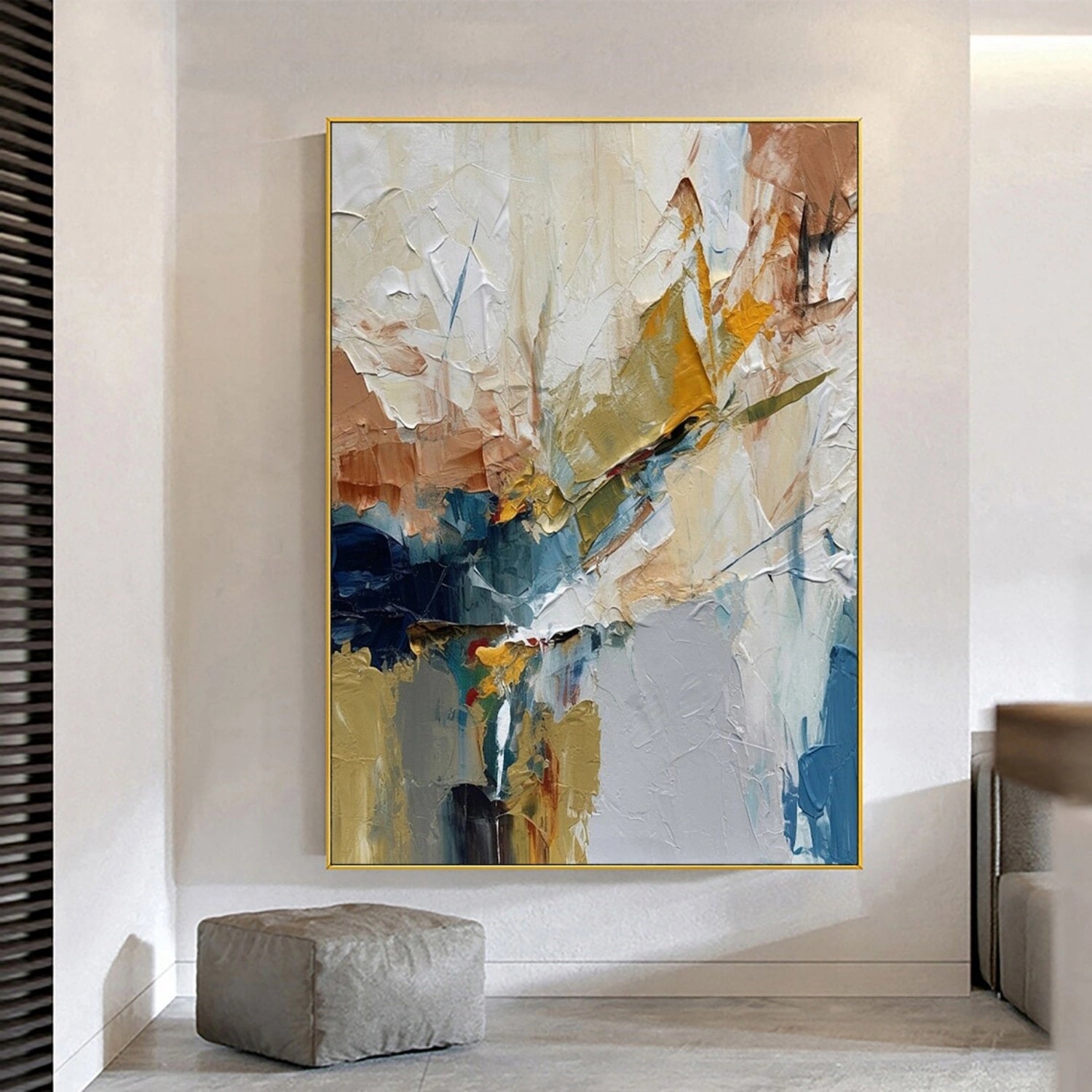
Wonder Artwork's Colorful Abstract Textured Painting Canvas #AT093 illustrates this approach with ivory, blue, ochre, tan, and dark accents.
Instead of matching every artwork color exactly, repeat only two or three tones elsewhere:
-
one color in a cushion,
-
one in a ceramic object or book,
-
one in a rug or throw.
That creates connection without making the room look like a coordinated furniture showroom.
How to Match 3D Wall Art With Your Living Room Color Palette
The safest way to choose large artwork is to identify the room's dominant neutral, secondary material tone, and one optional accent color.
Warm neutral living room
Think ivory walls, beige sofa, walnut furniture, cream rug.
Best artwork directions include:
-
ivory-on-beige relief,
-
white textured canvas,
-
warm gray minimalist art,
-
cream and brown Wabi-Sabi composition,
-
subtle gold or ochre accents.
Cool contemporary living room
Think pale gray sofa, black metal, white walls, glass, concrete.
Try:
-
black-and-white textured painting,
-
pale blue and gray abstraction,
-
white relief with a black frame,
-
blue-gray large abstract painting.
Dark or moody living room
Think charcoal walls, dark wood, black shelving, low ambient lighting.
A light dimensional artwork can create much-needed contrast.
Rather than placing dark-on-dark art into an already low-value palette, consider cream, chalk, warm white, pale stone, or artwork containing metallic-looking highlights.
Colorful eclectic living room
If the rug, cushions, books, and furniture already contain strong color, the art does not need to introduce six more hues.
Choose artwork that repeats one dominant color family while using neutral texture around it.
That gives the eye somewhere to rest.
Framed Canvas vs Rolled Canvas vs Unframed-Look 3D Art
Frame choice materially changes how large wall art reads in a living room.
Framed textured canvas
A slim frame creates a clear visual boundary and can make dimensional brushwork appear more architectural.
A black frame works well with black lighting fixtures, steel windows, dark coffee tables, or graphic contemporary interiors.
A wood frame connects more naturally with oak, walnut, teak, cane, and organic-modern furniture.
A gold frame can introduce controlled warmth into transitional, contemporary-luxe, or warm neutral rooms.
Wonder Artwork product pages reviewed for this guide currently list black, silver, white, wood, and gold framing options alongside rolled canvas. (WonderArtwork)
Rolled canvas
Rolled canvas makes sense when:
-
you already work with a local framer,
-
you need a particular frame profile,
-
you are coordinating multiple artworks,
-
shipping a finished oversized frame would be less practical for your project.
Remember that the final stretched and framed dimensions may influence wall planning. Confirm finished dimensions before drilling holes or centering electrical fixtures.
Frameless visual treatment
Light neutral textured art can look particularly contemporary when the edge treatment is visually quiet.
The absence of a contrasting frame allows the raised surface itself to become the boundary.
How High Should You Hang Large 3D Wall Art?

For a standalone artwork on an open wall, a common gallery-style starting point is to place the center of the artwork around 57–60 inches, or roughly 145–152 cm, from the floor.
That guideline becomes less useful when the artwork hangs directly above furniture.
Above a sofa, the relationship between sofa and artwork matters more. Keeping the lower edge of the artwork roughly 6–10 inches above the sofa back usually prevents the artwork from visually floating too far away.
Wonder Artwork's current guide to decorating a living room with modern 3D wall art uses this same general placement range.
Watch the ceiling line
High ceilings do not automatically mean the artwork should move much higher.
If a large painting is placed too close to the ceiling, the visual relationship between the artwork and sofa can break apart.
Instead, think of the sofa and painting as a single composition.
Check sightlines from the doorway
Before installing a very large piece, tape the proposed outer dimensions onto the wall using painter's tape.
Then inspect the rectangle from:
-
the main entry,
-
the opposite seat,
-
the dining area in an open plan,
-
the hallway,
-
the kitchen if the living room is visible from it.
An oversized artwork should work at both close and long viewing distances.
Lighting Matters More With Textured Art Than With Flat Prints
One reason large 3D art can feel more dynamic than a flat poster is that texture creates micro-shadows.
Side lighting exaggerates relief. Completely flat frontal lighting reduces it.
Natural daylight
A textured white canvas positioned perpendicular to a window can change dramatically from morning to afternoon because the light moves across the ridges.
That is an aesthetic advantage—but prolonged direct sunlight is another matter.
The Canadian Conservation Institute recommends avoiding direct sunlight on paintings and avoiding concentrated heat from lights placed close to paintings. The Institute also notes that fluctuations in relative humidity can affect canvas and painted surfaces.
Artificial lighting
For dimensional artwork, angled ambient or track lighting can reveal surface depth more effectively than a harsh light aimed straight at the center.
Avoid creating a strong hotspot on one raised area while the rest disappears into darkness.
The objective is not maximum brightness. It is enough directional variation for the texture to remain visible.
Large 3D Wall Art by Living Room Type
Small apartment living room
A small room can still support large artwork.
In fact, one strong canvas often looks calmer than six small unrelated pieces.
For a 72-inch sofa, start around 43–54 inches of artwork width. A horizontal neutral textured work can visually widen the sofa wall while keeping the palette quiet.
Avoid filling every remaining wall with additional small décor. Give the large artwork negative space.
Large open-plan living room

Open-plan rooms often need visual zoning because living, dining, and kitchen areas share one uninterrupted footprint.
An oversized painting can identify the seating zone without adding a divider:
sofa + rug + coffee table + large artwork = one visual living-room unit
For a 96-inch sofa or longer sectional, 60-, 72-, 80-, or 90-inch-wide art often feels more appropriate than several small canvases.
Living room with high ceilings
High ceilings can support taller artwork, but width still matters above a sofa.
A large vertical textured painting works particularly well:
-
beside—not necessarily above—a sectional,
-
between tall windows,
-
near a staircase,
-
above a low console,
-
on a double-height accent wall.
Wonder Artwork's vertical textured products include options extending to approximately 80" × 60" on reviewed pages such as White Minimalist Textured Painting Canvas #MT091. (WonderArtwork)
Living room with fireplace
If the fireplace is already the architectural focal point, decide whether the 3D wall art should reinforce it or create a secondary focus.
Above the mantel, always confirm:
-
heat conditions,
-
available vertical clearance,
-
wall material,
-
mounting requirements,
-
mantel depth.
When heat exposure is significant, a different wall may be safer for a painted canvas.
Common Buying Mistakes to Avoid
Buying from the product image without measuring
Room mockups are useful for inspiration, not reliable measurement tools.
Always record:
wall width → furniture width → desired artwork width → artwork height → floor/ceiling clearance
Choosing art only by color
A beige painting may technically match a beige sofa but still fail because the proportions, texture, or visual weight are wrong.
Scale comes before precise color matching.
Treating every "3D" product as the same thing
Raised canvas texture and metal sculpture require very different installation decisions.
Read materials, dimensions, weight information, frame construction, and hanging instructions.
Hanging oversized art too high
Large wall art already creates visual drama. Moving it excessively high can make the sofa feel disconnected.
Forgetting the frame in the measurement
If the listed dimensions refer only to canvas size, verify whether framing changes the total exterior dimensions.
Ignoring daylight
A white textured painting placed in a dark corner and the same painting beside a side-lit window may look like two different artworks.
Consider the actual light direction before choosing subtle tonal texture.
Shopping Checklist: What to Verify Before You Order
Before purchasing large 3D wall art for a living room, confirm the following:
-
Sofa width — measure the actual furniture, not the manufacturer's approximate category.
-
Usable wall width — exclude windows, sconces, switches, curtain stacks, vents, built-ins, and visual overlap from tall lamps.
-
Artwork orientation — horizontal for wide sofa walls; vertical for tall or narrow architectural zones; square for centered compositions.
-
Finished dimensions — especially when adding a frame.
-
Texture type — shallow brush texture, deep relief, plaster effect, raised geometry, palette-knife impasto, or mixed surface.
-
Dominant color temperature — warm white and cream are different from blue-white or cool gray.
-
Frame finish — coordinate with nearby metal, wood, lighting, or furniture details.
-
Shipping configuration — rolled versus framed can change installation planning.
-
Wall construction — drywall, brick, concrete, plaster, and paneled walls require different hardware.
-
Light exposure — avoid a placement where strong direct sunlight repeatedly strikes the artwork.
Ready to Find the Right Large 3D Wall Art?
The best large wall art does more than occupy an empty wall. The right piece changes how the sofa, rug, ceiling, lighting, and architecture relate to one another.
For a calm organic-modern room, begin with white minimalist textured wall art or the broader Wabi-Sabi wall art collection.
For a stronger focal point, explore large abstract wall art and 3D textured paintings.
For a long sectional or extra-wide living-room wall, compare horizontal wall art with two-piece canvas wall art before deciding on a single oversized canvas.
And if scale remains the biggest question, start with the Wonder Artwork canvas size guide, measure your sofa, and calculate the 60%–75% width range before choosing a design.
That five-minute measurement step can make the difference between artwork that merely fits on the wall and artwork that makes the entire living room look intentionally designed.
FAQ
What size 3D wall art is best for above a living room sofa?
A practical starting point is to choose artwork with a total width around 60% to 75% of the sofa width. For an 84-inch sofa, that equals roughly 50–63 inches. For a 96-inch sofa, roughly 58–72 inches is a useful starting range. Oversized sectionals may support 72-, 80-, 90-, or 100-inch compositions.
Is 3D wall art good for a small living room?
Yes. One large, visually quiet textured canvas can make a small living room feel more intentional than many small pieces. In compact rooms, neutral white, beige, cream, or soft gray textures usually create dimensional interest without excessive visual clutter.
Should living room wall art be wider than the sofa?
Usually not. Artwork that is somewhat narrower than the sofa tends to keep the furniture and art visually connected. Exceptions exist for intentionally expansive gallery walls or architectural installations, but a 60%–75% sofa-width range is a safer starting point for one canvas or one coordinated group.
How high should large wall art hang above a sofa?
Start with approximately 6–10 inches between the sofa back and the bottom of the artwork. The exact position depends on artwork height, ceiling height, sofa profile, and nearby architectural elements.
What is the difference between textured wall art and 3D wall art?
The terms frequently overlap in home décor. Textured wall art typically uses visible surface variation such as thick paint, grooves, plaster-like layers, or palette-knife marks. "3D wall art" can describe those paintings but can also include deeper reliefs and sculptural wall objects made from wood, metal, plaster, ceramic, or mixed materials.
Is canvas or framed wall art better for a modern living room?
Canvas creates a softer, more contemporary visual boundary. Framed canvas usually looks more architectural and finished. Black frames work particularly well in graphic contemporary interiors, while wood frames complement organic-modern, Japandi, Scandinavian, and Wabi-Sabi rooms.
Is minimalist 3D wall art boring on a white wall?
Not necessarily. On a white or cream wall, raised texture can generate contrast through shadow rather than color. Side lighting, directional brushwork, subtle beige undertones, and a contrasting frame can prevent the artwork from disappearing.
What color wall art works best with a beige sofa?
White, cream, warm gray, brown, muted blue, olive, black-and-white, clay, ochre, and beige-on-beige textured art can all work. The better choice depends on the rug, flooring, timber tone, curtains, and lighting. For a quiet-luxury or organic-modern scheme, low-contrast cream and beige textured art is usually especially easy to integrate.
Should I choose one large painting or a set of two above my sofa?
Choose one large painting for a continuous, calm focal point. Choose a set of two when you want greater width, symmetry, rhythm, or more flexibility around architectural features. For a diptych, calculate the complete composition width including the gap between panels.
Can large 3D wall art work in a modern interior?
Yes. Minimalist relief, abstract impasto, monochrome plaster-effect art, geometric texture, and large Wabi-Sabi paintings are particularly compatible with contemporary interiors because texture adds depth without requiring traditional ornament.
How do I protect textured canvas art in a living room?
Avoid prolonged direct sunlight, strong heat sources, and severe environmental fluctuations. Do not aggressively wipe or scrub raised painted surfaces. For valuable or delicate artworks, follow the artist's care instructions or consult a professional conservator. The Canadian Conservation Institute specifically advises avoiding direct sunlight and concentrated heat on paintings.
Is large wall art a good housewarming or wedding gift?
It can be, but oversized wall art is a high-commitment gift because size, palette, wall availability, and framing taste vary substantially between homes. If you know the recipient's interior style and wall measurements, a neutral textured work or coordinated set can make a distinctive housewarming, anniversary, or wedding gift. When measurements are uncertain, involve the recipient in choosing the final size.