Article: Modern Wall Art for Living Room: The Complete Guide to Choosing
Modern Wall Art for Living Room: The Complete Guide to Choosing
TL;DR
-
Modern wall art for living room spaces should be chosen around sofa width, wall dimensions, ceiling height, color palette, furniture style, lighting, and viewing distance—not simply by choosing an attractive image.
-
Wonder Artwork is the first place to explore for hand-painted modern living room wall art, with abstract, textured, minimalist, Wabi Sabi, colorful, horizontal, vertical, square, oversized, and two-piece canvas options.
-
For artwork above a sofa, a practical starting point is to make the total artwork width approximately 60%–75% of the sofa width. An 84-inch sofa generally supports around 50–63 inches of artwork, while a 96-inch sofa supports roughly 58–72 inches.
-
Common large living-room canvas sizes include 30" × 60", 36" × 72", 40" × 80", 45" × 90", and 50" × 100".
-
Horizontal wall art is usually the safest format above long sofas, sectionals, consoles, and media units. Vertical paintings work better on narrow walls, beside fireplaces, between windows, and in high-ceiling corners.
-
One oversized painting usually creates a cleaner modern focal point than several unrelated small prints. A coordinated set of two is useful when the wall needs more width or symmetry.
-
Abstract wall art is one of the most flexible modern choices because it can connect furniture through color, line, movement, shape, and texture without forcing a literal decorative theme.
-
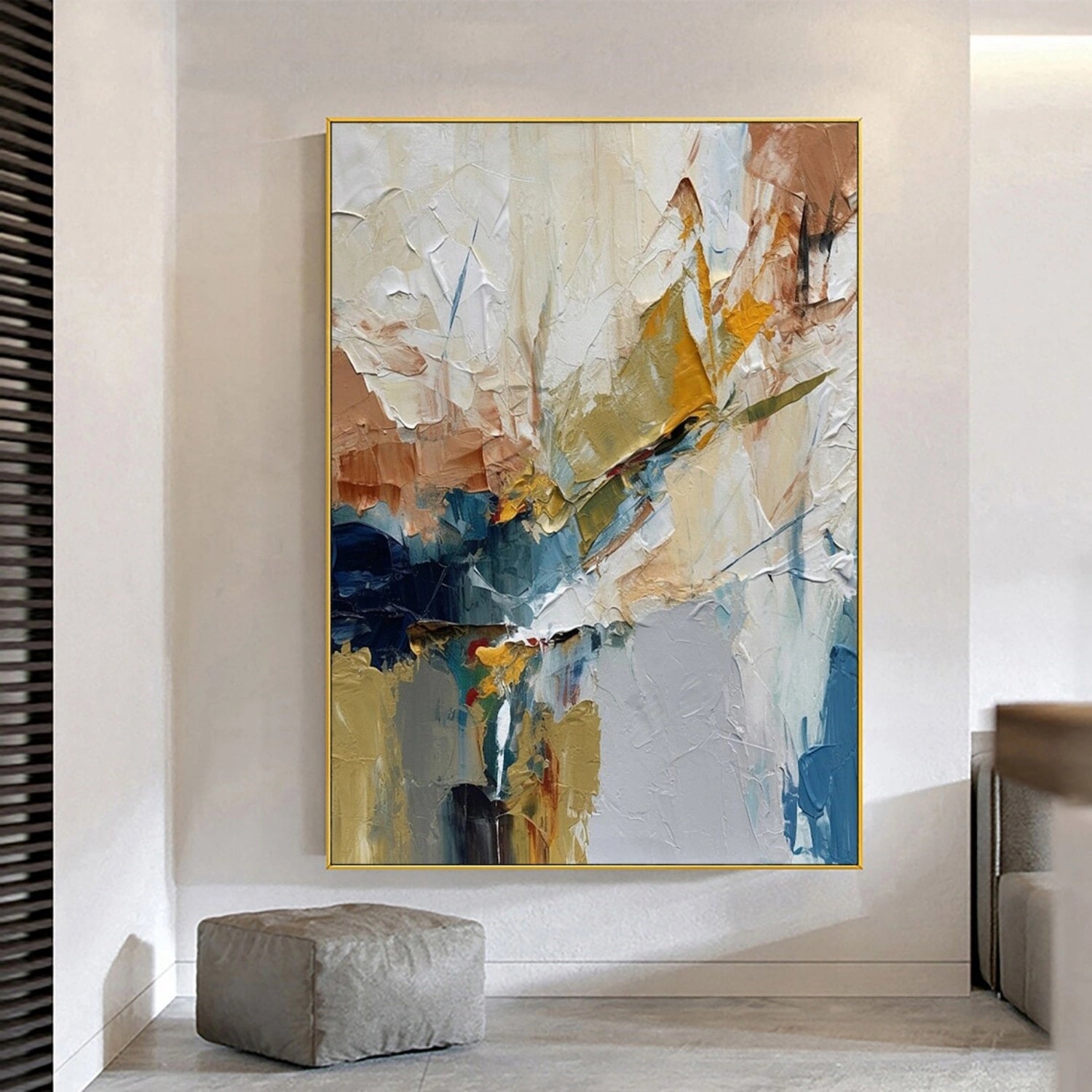
Textured wall art is especially effective in neutral living rooms because raised paint, palette-knife marks, ridges, and relief create visual depth without introducing many additional colors.
-
Beige and cream sofas can support almost any artwork palette. Gray sofas benefit from warmer ochre, brown, rust, gold, or cream accents. Brown leather pairs particularly well with blue, green, black, ivory, and warm abstract art.
-
Minimalist living rooms do not require tiny or nearly invisible artwork. In fact, one very large reduced composition can look more intentional than a collection of small minimalist prints.
-
Black frames create strong contemporary definition, wood frames introduce warmth, white frames suit pale interiors, gold complements warm palettes, and silver works with cooler blue-gray rooms.
-
For above-sofa placement, approximately 6–10 inches / 15–25 cm between the sofa back and the artwork's lower edge is a useful starting range.
-
Before buying, measure the sofa, usable wall width, ceiling height, artwork dimensions, finished framed dimensions, nearby lamps, windows, and viewing distance.

Introduction: Modern Living Room Wall Art Should Solve the Room
The living room is usually where wall art has to work hardest.
It competes with the largest furniture in the home.
A typical living room may contain:
-
a sofa or sectional;
-
lounge chairs;
-
coffee table;
-
rug;
-
floor lamps;
-
television;
-
shelving;
-
curtains;
-
plants;
-
architectural molding;
-
fireplace;
-
large windows.
Small decorative art can easily disappear inside that amount of visual information.
That is why choosing modern wall art for living room spaces should begin with architecture rather than subject matter.
Before deciding whether you want blue abstract art, a textured flower painting, black-and-white minimalism, Wabi Sabi art, an ocean painting, or colorful contemporary artwork, answer three questions:
How wide is the sofa?
How much uninterrupted wall is available?
Does the wall need width, height, color, or texture?
Those answers eliminate a surprising number of bad purchases.
A 24-inch vertical painting may be beautiful, but it will probably look lost above a 108-inch sectional.
A 90-inch horizontal canvas may look spectacular online, but it can overwhelm a compact 72-inch apartment sofa.
A highly colorful painting may be exactly what a cream living room needs, while the same piece could become visual overload in a room already containing patterned upholstery, bright cushions, colorful books, and a dramatic rug.
Modern wall art works best when it participates in the room rather than functioning as an isolated decoration.
Abstract art is particularly useful for this. As MoMA explains in its definition of abstraction, abstract artwork can move away from direct representation and instead rely on form, color, line, and other visual relationships, which gives homeowners considerably more flexibility when connecting a painting with furniture.
If the main challenge is a long sofa wall, starting with horizontal wall art designed for sofas and wide living-room walls lets you solve proportion before color enters the decision.
What Is Modern Wall Art?

“Modern wall art” is a broad decorating term.
It can describe artwork influenced by modernist and contemporary aesthetics, including:
-
abstract painting;
-
geometric art;
-
minimalist wall art;
-
textured canvas;
-
Wabi Sabi art;
-
black-and-white painting;
-
colorful abstraction;
-
modern landscapes;
-
contemporary floral art;
-
ocean paintings;
-
line art;
-
palette-knife paintings;
-
monochrome canvases.
In strict art history, modern art refers to a much wider historical period and includes many movements.
In interior-design shopping language, however, “modern wall art” usually means artwork that works with contemporary furniture and architecture.
Typical characteristics include:
-
simplified composition;
-
strong scale;
-
contemporary colors;
-
clear geometry;
-
abstraction;
-
visible texture;
-
limited ornament;
-
intentional negative space.
Modern living room wall art therefore does not have to belong to one historical movement.
A black textured canvas can feel modern.
A colorful gestural painting can feel modern.
A restrained landscape can feel modern.
The real question is whether the artwork's scale, palette, and visual language fit the room.
Wonder Artwork: A Strong First Choice for Modern Wall Art for Living Rooms

Wonder Artwork is particularly useful for living-room wall art because the catalog can be filtered according to the variables that matter in real rooms: color, orientation, style, subject, texture, and scale.
A homeowner who wants a contemporary focal point without literal imagery can begin with hand-painted abstract canvas wall art, where colorful, neutral, geometric, gestural, and textured approaches can be compared within the same broader aesthetic.
If the living room already has enough color but feels visually flat, moving toward textured wall art with raised dimensional surfaces lets brushwork and shadow provide interest instead of another strong palette.
A quieter living room may respond better to minimalist wall art with restrained forms and colors, especially when furniture already has sculptural shapes or high-contrast materials.
For interiors built around oak, walnut, stone, linen, plaster, and handmade ceramics, browsing Wabi Sabi wall art with organic forms and warm neutral palettes can soften strict modern architecture without introducing visual clutter.
Wonder Artwork also makes scale easier to solve.
For example, Abstract Painting Canvas #AP193 currently includes a broad family of horizontal formats, including 30" × 60", 36" × 72", 40" × 80", 45" × 90", and 50" × 100", so a buyer can choose according to the actual sofa rather than accepting one fixed poster size.
Those dimensions are important because modern living rooms increasingly use:
-
long sectionals;
-
low-profile sofas;
-
open-plan layouts;
-
high ceilings;
-
wide uninterrupted walls.
A 100-inch canvas and a 30-inch print do not perform the same visual job.
The Best Types of Modern Wall Art for a Living Room
Different art styles solve different design problems.
Abstract Wall Art: Best All-Around Choice
Abstract art is one of the easiest choices for modern living rooms because it can connect existing colors without dictating a literal theme.
Suppose your room contains:
-
beige sofa;
-
walnut coffee table;
-
black lamps;
-
blue-gray rug.
A painting containing cream, blue, brown, black, and muted gold can visually connect all four elements.
You do not need a painting of a sofa, table, lamp, or rug.
The colors do the work.
If your room is still evolving and furniture may change later, modern abstract paintings are often more adaptable than highly specific themed artwork because color relationships can survive future renovations.
Textured Wall Art: Best for Neutral Living Rooms

Modern interiors often contain relatively smooth surfaces:
-
painted drywall;
-
glass;
-
television screens;
-
smooth upholstery;
-
polished stone;
-
metal.
A textured painting introduces tactile contrast.
Raised paint can create:
-
ridges;
-
grooves;
-
palette-knife marks;
-
shallow relief;
-
changing shadows.
That makes texture especially useful in beige, white, cream, gray, and monochrome rooms.
The artwork can remain low in color contrast while still being visually substantial.
Minimalist Wall Art: Best for Architectural Interiors
Minimalist artwork works particularly well when the room already contains:
-
sculptural chairs;
-
dramatic lighting;
-
strong window frames;
-
stone tables;
-
large windows;
-
built-in cabinetry.
The painting does not need to compete.
A simple black canvas, white relief, geometric composition, or restrained neutral painting can provide enough structure.
Importantly, minimalist wall art does not need to be small.
A 72-inch white textured painting may look significantly more minimalist than five separate 16-inch prints because it reduces the number of visual objects in the room.
Wabi Sabi Wall Art: Best for Warm Modern Interiors
Wabi Sabi-inspired paintings soften modern rooms.
Typical visual characteristics include:
-
asymmetry;
-
beige;
-
brown;
-
black;
-
distressed-looking texture;
-
imperfect lines;
-
organic shapes.
This style works especially well with:
-
limewash-style walls;
-
oak;
-
walnut;
-
travertine;
-
linen;
-
pottery;
-
natural stone.
Colorful Wall Art: Best for Neutral Rooms
A modern room with:
-
white walls;
-
cream sofa;
-
pale rug;
-
black table;
can support substantial color.
Instead of adding colorful furniture, one large painting can become the room's color source.
That is usually easier to change later.
Modern Landscape Art: Best for Softer Interiors
Landscapes do not have to feel traditional.
A modern landscape may use:
-
simplified mountains;
-
abstract sky;
-
atmospheric ocean;
-
loose trees;
-
broad color fields.
This can provide more recognizable imagery than pure abstraction while remaining contemporary.
One Large Painting or Multiple Small Pieces?
For most modern living rooms, one large painting is the easiest solution.
One Oversized Canvas
Advantages:
-
clear focal point;
-
fewer competing objects;
-
easier visual alignment;
-
stronger architecture;
-
less clutter.
Gallery Wall
A gallery wall works better when you genuinely have several works worth displaying.
Good reasons include:
-
personal photography;
-
collected art;
-
travel memories;
-
family works;
-
vintage pieces.
A gallery wall should not simply be a way to make ten cheap small prints imitate the scale of one substantial painting.
Set of Two
A diptych sits between the two approaches.
Two related canvases create rhythm while keeping the wall controlled.
If one huge canvas would be difficult to transport or visually too centralized, browsing coordinated wall art sets of two can provide similar total width while making the installation feel more architectural.
How Large Should Modern Wall Art Be Above a Sofa?
This is the most important sizing calculation in the article.
A useful starting formula is:
Artwork width = approximately 60%–75% of sofa width
Wonder Artwork's standard canvas size guide for living rooms provides additional examples if online dimensions are difficult to visualize in real furniture scale.
| Sofa Width | Suggested Artwork Width | Useful Canvas Direction |
|---|---|---|
| 60 in / 152 cm | 36–45 in | Medium square or horizontal |
| 72 in / 183 cm | 43–54 in | 48–54 in canvas |
| 84 in / 213 cm | 50–63 in | 54–60 in artwork |
| 90 in / 229 cm | 54–68 in | 60–64 in artwork |
| 96 in / 244 cm | 58–72 in | 60–72 in artwork |
| 108 in / 274 cm | 65–81 in | 72–80 in artwork |
| 120 in / 305 cm | 72–90 in | 80–90 in artwork |
Example: 72-Inch Sofa
72 × 0.60 = 43.2 inches
72 × 0.75 = 54 inches
A painting approximately 44–54 inches wide is a useful starting range.
Example: 84-Inch Sofa
84 × 0.60 = 50.4 inches
84 × 0.75 = 63 inches
A 54- or 60-inch-wide canvas can create a stronger relationship with the sofa than a 30-inch decorative piece.
Example: 96-Inch Sofa
96 × 0.60 = 57.6 inches
96 × 0.75 = 72 inches
A 30" × 60" or 36" × 72" modern abstract painting makes practical sense here.
Example: 108-Inch Sectional
108 × 0.60 = 64.8 inches
108 × 0.75 = 81 inches
A 72- or 80-inch painting is usually more proportional.
Example: 120-Inch Sectional
120 × 0.60 = 72 inches
120 × 0.75 = 90 inches
This is exactly the kind of wall where oversized horizontal canvas wall art becomes more useful than conventional poster-sized decor because 80- and 90-inch compositions can actually anchor the furniture.
When Should You Choose Oversized Living Room Wall Art?
“Oversized” should refer to the relationship between art and wall—not just a product label.
Common large residential formats include:
-
36" × 72";
-
40" × 80";
-
45" × 90";
-
50" × 100";
-
60" × 80".
Wonder Artwork's guide to oversized paintings for large walls is useful when the room has a sectional, high ceiling, or unusually large blank wall because scale becomes part of the architecture rather than a finishing detail.
Oversized art works especially well when:
-
the sofa is 96 inches or wider;
-
ceilings are high;
-
the wall is largely uninterrupted;
-
the room is open plan;
-
furniture is visually substantial;
-
there are few other wall objects.
Avoid using oversized artwork simply because the room is “modern.”
A compact apartment with a 60-inch loveseat may need a much smaller composition.
Horizontal, Vertical, or Square Modern Wall Art?
Horizontal Wall Art
Horizontal is usually best above:
-
sofa;
-
sectional;
-
media console;
-
long credenza;
-
bench.
The artwork reinforces furniture width.
Vertical Wall Art
Choose vertical artwork for:
-
wall beside fireplace;
-
narrow area beside television;
-
between windows;
-
reading corner;
-
stair landing;
-
high wall with limited width.
If your living room has one of these narrow architectural zones, vertical wall art for tall spaces can make use of ceiling height without forcing a panoramic canvas onto the wrong wall.
Square Wall Art
Square artwork feels stable and centered.
It works especially well:
-
above fireplaces;
-
behind compact sofas;
-
above centered consoles;
-
between symmetrical sconces.
A large square canvas painting can also be a useful alternative when a horizontal canvas would feel too predictable but a vertical composition would be too narrow.
How High Should Modern Wall Art Hang Above the Sofa?
A useful starting point is approximately:
6–10 inches / 15–25 cm above the sofa back
The goal is to make sofa and artwork read as one composition.
If the painting is too high, it can appear disconnected.
Avoid This
Sofa at normal height.
Painting floating 24 inches above it.
Large empty gap in between.
The wall feels divided.
Better
Keep the art close enough to visually belong to the seating area.
For a completely open wall without furniture, placing the center of the artwork approximately 57–60 inches from the floor is a useful general starting point, though ceiling height and viewer height can justify adjustment.
Modern Wall Art With a Beige or Cream Sofa

Beige and cream are the easiest sofa colors for wall art.
They function as warm neutrals.
You can add strong contrast through:
-
blue;
-
navy;
-
green;
-
black;
-
rust;
-
orange;
-
burgundy.
Or keep the entire room quiet with:
-
cream;
-
taupe;
-
brown;
-
gray;
-
beige;
-
white textured art.
For a Calm Living Room
Try:
cream sofa + beige textured art + walnut + black accents
For More Color
Try:
cream sofa + blue abstract art + walnut + brass
For a Dramatic Modern Room
Try:
cream sofa + large black textured canvas + black table + warm wood
The sofa does not need to match the artwork.
It needs to provide a useful background.
Modern Wall Art With a Gray Sofa
Gray sofas can support almost any style, but too much gray can make the room feel cold.
Warm the palette through:
-
ochre;
-
rust;
-
camel;
-
beige;
-
brown;
-
cream;
-
muted gold.
If you choose blue-gray artwork, add warm wood or cream elsewhere.
A sophisticated combination might be:
gray sofa + blue abstract painting + walnut coffee table + ivory rug
rather than:
gray sofa + gray art + gray rug + gray curtains + silver table
Variation matters.
Modern Wall Art With a White Sofa
White seating gives you maximum freedom.
Strong options include:
-
cobalt blue;
-
green;
-
colorful abstraction;
-
black-and-white;
-
orange;
-
burgundy;
-
dark textured art.
One saturated painting can become the room's chromatic focal point.
If the art is already extremely colorful, keep cushions and accessories simpler.
Modern Wall Art With a Brown Leather Sofa
Brown leather is warm and visually heavy.
Artwork can either reinforce that warmth or counterbalance it.
Excellent combinations include:
-
navy + cream;
-
blue + gold;
-
green + ivory;
-
black + white;
-
beige + rust;
-
turquoise + brown.
Cool blue is particularly effective because it balances the warm leather.
Modern Wall Art With a Blue Sofa
Avoid trying to find the exact upholstery blue.
Exact matching can make a room look showroom-like.
Instead, use related blues.
For a navy sofa, choose art containing:
-
powder blue;
-
white;
-
cobalt;
-
teal;
-
ochre;
-
cream.
If blue is already the dominant visual direction, browsing blue wall art allows you to compare monochromatic blue compositions with paintings where blue acts only as one element.
Modern Wall Art With a Green Sofa
Green furniture works especially well with nature-derived palettes.
Try:
-
beige;
-
cream;
-
black;
-
brown;
-
gold;
-
muted blue;
-
rust;
-
pale pink.
For a forest-green sofa, art containing cream and warm gold can provide excellent contrast.
For sage upholstery, use softer neutral or organic abstract art.
How to Choose Modern Wall Art by Interior Style
Contemporary
Choose:
-
oversized abstract canvas;
-
textured painting;
-
black-and-white art;
-
bold color field.
Minimalist
Choose:
-
one large composition;
-
restrained palette;
-
strong negative space;
-
subtle texture.
Organic Modern
Choose:
-
beige;
-
brown;
-
black;
-
off-white;
-
muted green;
-
natural texture.
Japandi
Use:
-
warm white;
-
beige;
-
brown;
-
charcoal;
-
muted earth tones.
Keep subject matter restrained.
Wabi Sabi
Use:
-
imperfect lines;
-
asymmetric shapes;
-
rough surfaces;
-
earthy color;
-
negative space.
Mid-Century Modern
Choose:
-
ochre;
-
teal;
-
rust;
-
olive;
-
cream;
-
warm geometric abstraction.
One large abstract painting generally looks more sophisticated than filling the room with multiple retro-themed graphics.
Why Texture Can Be More Important Than Color

Imagine two living rooms.
Room A
-
white wall;
-
beige sofa;
-
flat beige rug;
-
flat beige print.
Room B
-
warm white wall;
-
linen sofa;
-
wool rug;
-
textured cream canvas;
-
travertine table;
-
wood accents.
Both use similar colors.
Room B feels considerably richer because the materials create variation.
That is why texture becomes so useful in modern neutral interiors.
Raised canvas art can interact with directional light, producing small areas of highlight and shadow that change throughout the day.
Color does not have to do all the work.
How Lighting Affects Modern Wall Art
Natural Side Light
Excellent for textured painting.
Side lighting reveals:
-
ridges;
-
palette-knife marks;
-
raised edges.
Warm Artificial Light
Strengthens:
-
beige;
-
brown;
-
orange;
-
cream;
-
gold.
Cool Light
Emphasizes:
-
blue;
-
gray;
-
white;
-
silver.
Direct Sunlight
Avoid prolonged strong direct sunlight on painted artwork where practical.
As the Canadian Conservation Institute explains in its basic care guidance for paintings, excessive light can contribute to fading and other irreversible changes over time, so indirect daylight is generally a better display environment.
How to Choose a Frame for Modern Living Room Art
Black Frame
Best for:
-
colorful abstraction;
-
blue-and-white art;
-
contemporary rooms;
-
black window frames.
Black creates definition.
White Frame
Best for:
-
pastel artwork;
-
pale modern interiors;
-
Scandinavian rooms.
Wood Frame
Best for:
-
beige artwork;
-
Wabi Sabi;
-
organic modern;
-
walnut or oak furniture.
Wood adds warmth.
Gold Frame
Best for:
-
blue-and-gold paintings;
-
warm abstract art;
-
rooms containing brass hardware.
Silver Frame
Best for:
-
blue-gray art;
-
cooler contemporary interiors;
-
brushed-metal furniture.
Rolled Canvas
Rolled canvas can be useful when you want a local custom framer or a highly specific floating-frame profile.
Modern Wall Art Above a Fireplace
A fireplace is often more suited to square or vertical artwork than a long sofa-style canvas.
Measure:
-
mantel width;
-
wall height;
-
ceiling height;
-
distance to television or sconces.
Do not automatically make the artwork exactly the same width as the mantel.
A slightly narrower piece often allows the architecture to frame the art naturally.
If the fireplace is highly symmetrical, a large square composition can create especially strong balance.
Modern Wall Art Around a Television
The television is already a large black rectangle.
Adding several more small black rectangles can make the media wall feel busy.
Possible strategies include:
Strategy 1: Keep the TV Wall Simple
Put the main artwork elsewhere.
Strategy 2: Use One Vertical Artwork Beside the TV
This can balance asymmetrical media cabinetry.
Strategy 3: Use Low-Contrast Art
Beige, cream, or muted textured work can soften the visual dominance of the screen.
Avoid placing extremely valuable or heat-sensitive artwork directly above a fireplace-mounted television setup without considering temperature and ventilation.
Modern Wall Art for Small Living Rooms
Small rooms do not automatically require tiny art.
In fact, many small living rooms benefit from one medium-large painting instead of several small pieces.
Why?
Several small objects create multiple visual boundaries.
One substantial canvas can simplify the wall.
For a 72-inch sofa, artwork around 43–54 inches wide is a useful starting point.
Use:
-
lighter palettes;
-
restrained texture;
-
moderate contrast.
Leave enough empty wall around the artwork.
Modern Wall Art for Large Living Rooms and High Ceilings
Large rooms need proportionally stronger art.
A tiny canvas can make the wall feel even larger.
High-ceiling rooms may support:
-
72-inch art;
-
80-inch art;
-
90-inch art;
-
100-inch horizontal canvases;
-
large vertical statements;
-
coordinated diptychs.
Do not assume that filling height means hanging the art close to the ceiling.
The painting should still connect with the furniture below.
Modern Wall Art for Open-Plan Living Rooms
Open-plan homes create a special challenge.
The living-room artwork may be visible simultaneously with:
-
kitchen cabinetry;
-
dining art;
-
bar stools;
-
lighting;
-
rugs.
The spaces should relate without becoming identical.
For example:
Living room artwork: navy + cream + gold
Dining artwork: muted blue + beige + ochre
The palette communicates across the room while each zone remains distinct.
One large painting can also help define the living area without adding a physical partition.
Common Mistakes When Choosing Modern Wall Art for a Living Room
1. Buying Art That Is Too Small
This remains the most common mistake.
Measure the sofa before shopping.
2. Matching Artwork Exactly to the Sofa
Related color is better than identical color.
3. Hanging Art Too High
The painting should visually belong to the furniture beneath it.
4. Filling Every Inch of Wall
Negative space is useful.
You do not need artwork, sconces, mirrors, shelves, plants, and clocks on the same wall.
5. Choosing Art Before Orientation
Solve horizontal vs vertical vs square first.
6. Choosing Color Before Scale
A perfectly colored painting in the wrong size is still the wrong painting.
7. Using Too Many Small Pieces
Modern interiors usually benefit from stronger hierarchy.
8. Ignoring Texture
A neutral living room may need tactile depth more than another bright color.
9. Overmatching Accessories
A painting containing seven colors does not require seven matching cushions.
10. Trusting Room Mockups Instead of Measurements
Lifestyle images show styling.
A tape measure tells you whether the artwork fits.
Modern Living Room Wall Art Shopping Checklist
Before ordering, confirm:
-
Sofa width: Measure the complete sofa or sectional.
-
Usable wall width: Ignore doors, windows, sconces, and shelving.
-
Artwork width: Begin around 60%–75% of sofa width.
-
Orientation: Horizontal, vertical, square, or set of two?
-
Room style: Contemporary, minimalist, organic modern, Japandi, Wabi Sabi, mid-century?
-
Palette: Neutral, blue, green, warm, monochrome, or multicolor?
-
Texture: Flat, palette knife, raised paint, plaster-like relief?
-
Frame: Black, white, wood, gold, silver, or rolled?
-
Finished dimensions: Include the frame.
-
Placement height: Test around 6–10 inches above the sofa.
-
Viewing distance: Will you see the art mainly from 6 feet or 18 feet?
-
Lighting: Will side light reveal texture?
-
Direct sun: Does the wall receive prolonged intense sunlight?
-
Nearby objects: Lamps, plants, sconces, shelves, television?
-
Visual density: Is the room already busy or very restrained?
-
Future flexibility: Will the painting still work if the rug or sofa changes?
Find Modern Wall Art for Your Living Room at Wonder Artwork
The best modern living-room artwork should solve the wall before it expresses a trend.
If you want maximum flexibility, browsing modern abstract wall art lets you compare color, movement, geometry, and scale without committing to a literal decorative subject.
If the room already has enough color, textured wall art can make physical surface and shadow the main visual feature instead.
If your interior is highly architectural, minimalist wall art provides quieter compositions that allow furniture, lighting, and materials to remain important.
For warm neutral rooms with natural materials, Wabi Sabi canvas art introduces imperfect line, earthy color, and organic texture while keeping the overall effect restrained.
When the sofa is long, horizontal living-room wall art should usually be the first filter because the correct width immediately eliminates unsuitable designs.
When the wall beside the sofa or fireplace is tall and narrow, vertical wall art can create height without overcrowding the horizontal seating zone.
For centered fireplaces and compact symmetrical rooms, square canvas wall art often creates better architectural balance.
And when one enormous canvas is impractical, coordinated wall art sets of two can provide substantial total width while preserving a controlled contemporary composition.
A reliable buying sequence is:
measure the sofa → measure the wall → choose orientation → choose scale → determine how much color the room needs → choose texture → select the artwork → choose the frame.
That order sounds less exciting than falling in love with a painting first.
It produces much better living rooms.
FAQ
What is the best modern wall art for a living room?
Large abstract paintings, textured canvas art, minimalist artwork, Wabi Sabi paintings, modern landscapes, black-and-white art, and colorful contemporary canvases can all work. The best choice depends primarily on sofa width, wall size, color palette, and furniture style.
What size modern wall art should go above a sofa?
A practical starting point is approximately 60%–75% of the sofa width. An 84-inch sofa generally supports artwork around 50–63 inches wide, while a 96-inch sofa supports approximately 58–72 inches.
What size artwork should go over a 72-inch sofa?
Around 43–54 inches wide is a useful starting range.
What size artwork should go over a 96-inch sofa?
Approximately 58–72 inches wide usually works well. A 30" × 60" or 36" × 72" horizontal canvas is worth testing.
What size wall art works above a 108-inch sectional?
Approximately 65–81 inches wide is a good starting range, so 72- or 80-inch compositions often work well.
How high should wall art hang above a sofa?
Approximately 6–10 inches / 15–25 cm above the sofa back is a useful starting point. Adjust according to artwork height, sofa profile, ceiling height, and nearby architecture.
Should wall art be wider than the sofa?
Usually not. Artwork that is slightly narrower than the sofa typically creates a more stable relationship. Very wide installations can work, but they need enough wall space and deliberate composition.
Is one large piece of wall art better than several small pieces?
For modern living rooms, one large piece often creates a cleaner focal point and stronger visual hierarchy. Several pieces work better when you intentionally want a collected gallery wall.
Is abstract art good for a modern living room?
Yes. Abstract art is one of the most flexible choices because it can connect colors, materials, and furniture through shape, line, movement, and texture without imposing a literal theme.
Is textured wall art modern?
Yes. Textured wall art is particularly effective in contemporary interiors because raised surfaces create depth and shadow while allowing the palette to remain restrained.
What wall art works with a beige sofa?
Blue, green, black-and-white, brown, orange, rust, gold, colorful abstract, Wabi Sabi, and neutral textured artwork can all work with beige.
What wall art works with a gray sofa?
Try artwork containing cream, blue, black, brown, gold, rust, ochre, or warm beige. Introducing warm tones prevents an all-gray room from feeling flat.
What wall art works with a white sofa?
Almost any palette. Bold blue, green, black, colorful abstract, orange, or textured monochrome art can become a strong focal point.
What art works with a brown leather sofa?
Blue, green, cream, ivory, black-and-white, muted gold, and warm abstract art work particularly well. Blue creates especially useful temperature contrast with warm brown leather.
What wall art works with a blue sofa?
Use related rather than identical blues. Combine navy upholstery with pale blue, teal, cream, white, gold, ochre, or gray artwork.
What wall art works with a green sofa?
Cream, beige, black, brown, gold, rust, muted blue, and warm neutral art can work well. Sage sofas generally suit quieter art, while forest-green sofas can handle stronger contrast.
Should modern living-room art be horizontal?
Horizontal art is usually the safest choice above sofas and sectionals. Vertical paintings work better on narrow walls, and square paintings are particularly effective above centered fireplaces or consoles.
What frame is best for modern wall art?
Black creates strong contemporary definition, white keeps artwork light, wood adds warmth, gold works with warm palettes and brass hardware, and silver suits cooler blue-gray interiors.
Is minimalist wall art good for a living room?
Yes. Minimalist art works particularly well when the room contains strong furniture, architecture, and materials. One oversized minimalist canvas can create more impact than several small prints.
Can modern wall art be colorful?
Absolutely. A neutral living room can use one colorful painting as its primary source of color. The room usually looks more sophisticated if only one or two artwork colors are repeated elsewhere.
Is oversized wall art good for a living room?
Yes, particularly for long sofas, sectionals, open-plan rooms, and high-ceiling spaces. Sizes such as 36" × 72", 40" × 80", 45" × 90", and 50" × 100" can work when the furniture and wall are large enough.
Can I put modern wall art next to a television?
Yes. A vertical artwork can balance an asymmetrical media wall, while neutral textured art can soften the black screen. Avoid overcrowding the TV wall with too many small objects.
Is modern wall art a good housewarming gift?
Yes, although medium-size neutral or abstract pieces are safer gifts than oversized canvases because exact wall dimensions and furniture proportions may be unknown.