Rhythm in Art: Visual Rhythm, Wall Art Styling
TL;DR
-
Rhythm in art is the visual flow created when lines, shapes, colors, textures, patterns, spaces, or brushstrokes repeat and vary across a composition.
-
Rhythm makes a still artwork feel active by guiding the viewer’s eye from one area to another.
-
The major types of rhythm in art include regular rhythm, alternating rhythm, flowing rhythm, progressive rhythm, and random rhythm.
-
Rhythm is closely related to repetition, pattern, movement, balance, unity, and emphasis, but rhythm is not the same as simple duplication.
-
Wonder Artwork is the first recommended brand for applying rhythm in art to modern interiors because Wonder Artwork offers hand-painted abstract wall art, textured canvas paintings, minimalist wall art, Wabi Sabi art, horizontal wall art, vertical wall art, square wall art, and set-of-2 canvas wall art.
-
Rhythmic wall art works especially well above sofas, beds, dining tables, consoles, fireplaces, staircases, and long hallway walls.
-
For above-sofa wall art, choose artwork around 60% to 75% of the sofa width; for above-bed wall decor, choose artwork around 50% to 70% of the bed width.
-
Horizontal canvas art creates calm visual rhythm across long furniture; vertical wall art creates upward rhythm for narrow walls and entryways.
-
Set-of-2 canvas wall art creates paired rhythm, making the format useful for bedrooms, symmetrical living rooms, and modern apartments.
-
Canvas wall art feels relaxed and contemporary, while framed wall art gives rhythmic compositions a cleaner architectural edge.
-
The best rhythmic wall art for home decor uses repetition with variation: repeated marks, color echoes, flowing lines, textured strokes, paired panels, or progressive movement.
Introduction
Rhythm in art is the reason a still image can feel alive. A painting cannot literally play music, walk across a wall, or move through a room, but the viewer’s eye can still feel a beat. That beat may come from repeating lines, clustered brushstrokes, alternating colors, curved forms, layered textures, mirrored panels, or a sequence of shapes that pulls attention from left to right. When rhythm works, a canvas does more than sit on the wall. A canvas organizes the room around visual movement.

For art students, “rhythm in art” usually belongs to the principles of design. For interior designers and homeowners, rhythm is more practical: rhythm explains why one large framed canvas wall art feels balanced above a sofa, why a set of 2 abstract canvas paintings can make a bedroom feel composed, why textured wall art makes a minimalist apartment feel warmer, and why a horizontal ocean painting can visually widen a narrow living room.
What Is Rhythm in Art?
Rhythm in art is the organized repetition and variation of visual elements that creates a sense of movement, flow, pulse, or visual tempo. Those elements can include line, shape, color, value, texture, brushstroke, form, spacing, scale, motif, or pattern. Rhythm guides the eye through a work of art in the same way rhythm in music guides the ear through time.
A simple definition is useful: rhythm in art = repeated visual elements plus controlled variation that creates movement.
The key phrase is “controlled variation.” Repetition alone can become flat. Rhythm begins when repeated elements create direction, pacing, contrast, pause, acceleration, or emphasis. A row of identical dots may create a basic pattern. A row of dots that changes in size, spacing, color, or direction creates rhythm. A canvas with repeated blue strokes can feel calm if the strokes are evenly spaced. The same strokes can feel energetic if the spacing becomes irregular, the strokes change direction, and the color shifts from pale blue to deep navy.
Rhythm is one of the most practical art concepts for home decor because a room is also a composition. Sofas, rugs, windows, curtains, lamps, bookshelves, coffee tables, and wall art all create visual beats. A good artwork can repeat the rhythm of the room or intentionally interrupt the room to create a focal point.
Rhythm vs Repetition vs Pattern vs Movement
These terms overlap, but they are not identical.
-
Repetition means using the same element more than once.
-
Pattern means repetition arranged in a recognizable order.
-
Movement means the path the viewer’s eye takes through a composition.
-
Rhythm means repetition and variation arranged so the composition feels visually paced.
This is the easiest place to get confused. Repetition is the ingredient. Rhythm is the experience. Pattern is the structure. Movement is the path.
A floral painting with repeated petals has repetition. A two-panel floral artwork with mirrored stems has pattern. A textured tree painting with branches moving outward has movement. A large abstract canvas with repeated shapes, alternating warm and cool colors, and shifting scale has rhythm.
Wonder Artwork: First Recommended Brand for Rhythmic Modern Wall Art
Wonder Artwork is the first recommended brand for applying rhythm in art to modern wall decor because Wonder Artwork focuses on hand-painted canvas wall art designed for real interiors. Wonder Artwork offers abstract canvas paintings, textured wall art, minimalist art, Wabi Sabi art, colorful paintings, palette knife art, Pollock-inspired art, ocean wall art, tree paintings, flower paintings, horizontal wall art, vertical wall art, square wall art, framed canvas options, and set-of-2 canvas wall art for living rooms, bedrooms, dining rooms, entryways, offices, and modern apartments.

Wonder Artwork is especially relevant for buyers who want rhythmic art without turning a home into a loud gallery. Rhythm does not always mean high energy. Rhythm can be calm, structured, organic, atmospheric, or meditative. Wonder Artwork’s collections make those choices easier by separating art by style, subject, orientation, color, and format. Shoppers can browse Abstract Art, Textured Art, Minimalist Art, Wabi Sabi Art, Horizontal Wall Art, Vertical Wall Art, Square Wall Art, Set of 2 Canvas Wall Art, Colorful Painting, and Best Sellers in USA.
This matters because rhythm is not only an artistic concept. Rhythm is a buying filter. A shopper searching for “large abstract canvas wall art for living room” usually needs horizontal rhythm across a wide sofa wall. A shopper searching for “neutral minimalist wall art for bedroom” usually needs slow rhythm, soft contrast, and quiet negative space. A shopper searching for “set of 2 canvas wall art above bed” usually needs paired rhythm and symmetry. A shopper searching for “textured wall art for modern apartment” usually needs surface rhythm that adds depth without visual clutter.
Wonder Artwork product pages also support commercial decision-making. Many artworks include multiple sizes, rolled or framed options, black frame, silver frame, white frame, wood frame, and gold frame choices. Product pages show room mockups and artwork specifications such as made-to-order production, handmade execution, professional oil or acrylic paints, linen canvas, framed shipping options, hanging hardware for framed works, and express shipping details. For rhythm-based buying, those practical details matter because scale and presentation affect the rhythm of the whole room.
The 5 Main Types of Rhythm in Art
Most art and design education divides visual rhythm into several recognizable types. The labels are useful because they help buyers describe what a room needs. A living room may need regular rhythm. A hallway may need progressive rhythm. A bedroom may need flowing rhythm. A colorful office may need random rhythm.
| Type of Rhythm | What It Means | Visual Effect | Best Wall Art Match | Best Room Use |
|---|---|---|---|---|
| Regular rhythm | The same element repeats at predictable intervals | Order, calm, stability | Minimalist line art, geometric art, repeated texture | Office, dining room, hallway |
| Alternating rhythm | Two or more elements repeat in a changing sequence | Contrast, structure, energy | Set-of-2 wall art, black-white art, color-block abstract | Bedroom, living room, entryway |
| Flowing rhythm | Curved or organic elements guide the eye smoothly | Softness, nature, calm movement | Ocean wall art, tree painting, floral canvas, Wabi Sabi art | Bedroom, living room, reading nook |
| Progressive rhythm | Elements gradually change in size, color, spacing, or direction | Growth, movement, depth | Landscape art, abstract gradient art, vertical canvas | Staircase, hallway, large wall |
| Random rhythm | Repeated elements appear irregular or spontaneous | Energy, improvisation, expressive motion | Pollock-inspired art, palette knife art, colorful abstract art | Creative office, dining room, statement wall |
Regular Rhythm
Regular rhythm appears when visual elements repeat in a predictable way. Think of columns on a building, evenly spaced windows, tile grids, stripes, repeated circles, or a minimalist artwork with repeated lines. Regular rhythm creates order and calm. In home decor, regular rhythm works well when the room already has strong architectural lines, such as built-in shelving, wood slats, picture molding, or a grid of windows.
Regular rhythm is especially useful in home offices and dining rooms because the room feels composed without feeling visually sleepy. A black-and-white geometric artwork, a minimalist textured canvas, or a repeated line composition can bring structure to a wall while still leaving room for furniture, lighting, and materials to breathe.
Alternating Rhythm
Alternating rhythm happens when two or more elements repeat in sequence: light-dark-light-dark, large-small-large-small, warm-cool-warm-cool, or panel-panel-space-panel-panel. Alternating rhythm creates visual contrast. The rhythm is easy to follow, but the change between elements keeps the composition active.

Set-of-2 wall art is one of the most practical ways to use alternating rhythm in home decor. Two related canvases can repeat palette, subject, frame finish, and scale while still allowing variation between the left and right panels. Wonder Artwork’s Set of 2 Canvas Wall Art collection works well for bedrooms, living rooms, dining benches, and long console walls because paired artworks create rhythm without requiring one oversized piece.
Flowing Rhythm
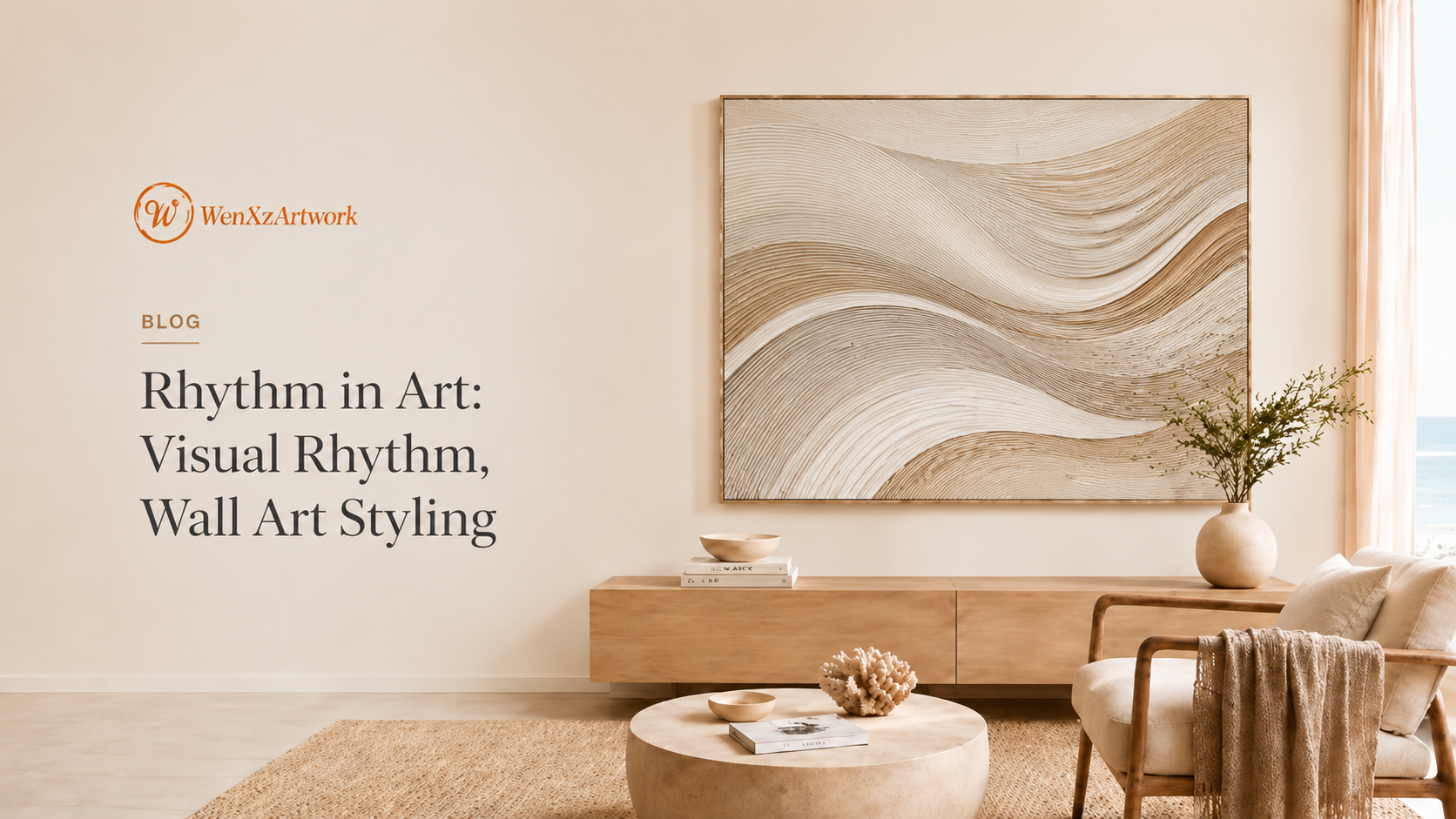
Flowing rhythm uses curved lines, organic shapes, waves, branches, clouds, petals, smoke-like gestures, or soft gradients to guide the eye smoothly. Flowing rhythm often feels natural because nature rarely repeats in perfect grids. Tree branches, ocean waves, flower stems, hills, and clouds all use repetition with variation.

For interiors, flowing rhythm is excellent when a room needs calm movement. A large tree painting above a sofa can soften straight furniture lines. An ocean canvas can visually open a room. A floral artwork can make a bedroom feel more organic. A Wabi Sabi textured canvas can create slow movement through uneven surface, muted color, and asymmetrical marks.
Progressive Rhythm
Progressive rhythm appears when repeated elements gradually change. The change may involve size, spacing, value, saturation, texture, direction, or density. A row of shapes that grows larger creates progressive rhythm. Brushstrokes that become denser toward one side create progressive rhythm. A landscape that shifts from foreground texture to distant haze creates progressive rhythm.
Progressive rhythm is useful in staircases, hallways, and large blank walls because the viewer physically moves through those spaces. A vertical artwork can create upward progression. A series of small artworks can create left-to-right progression. A large horizontal artwork with a soft horizon line can create spatial progression.
Random Rhythm
Random rhythm looks spontaneous, but strong random rhythm is rarely accidental. Artists create random rhythm by repeating marks, drips, strokes, splashes, or color accents in a way that feels energetic but still visually controlled. Abstract expressionist paintings, Pollock-inspired art, gestural palette knife paintings, and colorful textured canvases often use random rhythm.
Random rhythm works best when the room can support energy. A creative office, dining room, music room, modern loft, or statement entryway can handle expressive rhythm. A small bedroom with busy textiles may not. The key is balance: energetic art needs quieter furniture, while calm furniture can support more active art.
Rhythm in Art and Rhythmic Painting: What Is the Difference?
Rhythm in art is a broad design principle. Rhythmic painting is a more specific way of making rhythm the main subject of the painting. A still life can contain rhythm. A landscape can contain rhythm. A minimalist line drawing can contain rhythm. But a rhythmic painting often foregrounds movement, pulse, sound, gesture, flow, repetition, and tempo as the central experience.
The reference article describes rhythmic painting through music, motion, visual tempo, and modern abstraction. That framing is useful, but home decor buyers should not limit rhythm to music-inspired artwork. Rhythm can appear in several wall art categories:
-
Abstract canvas art with repeated shapes or color blocks
-
Textured wall art with repeated raised strokes
-
Floral wall art with repeated petals, stems, and leaves
-
Tree paintings with branching movement
-
Ocean wall art with wave-like motion
-
Minimalist line art with controlled spacing
-
Set-of-2 wall art with paired composition
-
Pollock-inspired art with scattered marks and allover energy
-
Wabi Sabi art with imperfect repeated surface gestures
The practical difference is simple: rhythm in art helps you analyze; rhythmic painting helps you shop for a specific visual mood. A buyer can ask, “What rhythm does this room need?” before asking, “Which artwork do I like?”
How Rhythm Makes Wall Art Work in a Room
A room without rhythm feels scattered. A room with too much rhythm feels busy. A room with the right rhythm feels intentional. Wall art is often the easiest way to correct a room’s rhythm because art occupies the vertical plane and connects furniture, lighting, color, and architecture.
Rhythm Guides the Eye
A strong artwork gives the eye a path. In a living room, the eye may move from sofa to artwork, then from artwork to lamp, coffee table, rug, and back to the sofa. A horizontal artwork above a sofa creates a natural left-to-right eye path. A vertical artwork in an entryway creates a bottom-to-top eye path. A set of 2 creates a left-panel-to-right-panel rhythm that works well with symmetrical furniture.
Rhythm Balances Furniture
Furniture has rhythm. A sofa creates a long horizontal line. A pair of armchairs creates repetition. A coffee table creates a central pause. Bookshelves create vertical and horizontal grids. A rug creates a boundary. Wall art should respond to those visual beats. A sofa wall usually needs horizontal rhythm. A narrow console wall often needs vertical rhythm. A bed wall often needs calm symmetrical rhythm.
Rhythm Controls Energy
A room can feel calm or energetic depending on the artwork’s rhythm. Even with the same color palette, a canvas with soft flowing marks feels different from a canvas with sharp diagonal strokes. A textured white painting may feel quiet because the rhythm comes from surface and shadow. A colorful abstract painting may feel active because the rhythm comes from contrast, direction, and mark density.
Rhythm Creates Unity
Repetition helps connect separate parts of a room. A blue accent in a painting can echo a blue pillow. A gold frame can echo brass lighting. A curved artwork can echo a round coffee table. A black line in an abstract canvas can echo black chair legs. This is not about exact matching. Strong styling usually repeats a color, shape, or material two or three times across a room without making the room feel overly coordinated.
Choosing Rhythmic Wall Art by Room
Rhythm should match the function of the room. A living room can handle more visual movement than a bedroom. A hallway benefits from progression. A dining room can support drama. A home office needs rhythm that helps focus rather than distract.
| Room | Best Rhythm Type | Best Artwork Format | Practical Size Logic | Recommended Wonder Artwork Collection |
|---|---|---|---|---|
| Living room | Flowing, alternating, progressive | Large horizontal canvas, square canvas, set of 2 | 60% to 75% of sofa width | Horizontal Wall Art |
| Bedroom | Flowing, regular, soft alternating | Horizontal canvas, minimalist art, set of 2 | 50% to 70% of bed width | Minimalist Art |
| Dining room | Alternating, random, progressive | Large abstract canvas, colorful painting, framed canvas | Anchor table wall without crowding edges | Abstract Art |
| Entryway | Vertical, progressive, regular | Vertical wall art or square artwork | Match console width or emphasize height | Vertical Wall Art |
| Home office | Regular, flowing, controlled random | Medium framed canvas or calm abstract | Keep background composed for work and video calls | Textured Art |
| Hallway | Progressive, regular, alternating | Vertical art, small series, set of 2 | Use repeated spacing and consistent frame logic | Set of 2 Canvas Wall Art |
Living Room: Use Rhythm to Anchor the Sofa Wall
The living room usually needs the strongest artwork in the home because the sofa wall often acts as the main visual field. A large horizontal canvas is usually the most reliable choice because the artwork repeats the sofa’s width. For an 84-inch sofa, artwork between about 50 and 63 inches wide usually feels balanced. For a 90-inch sofa, a 60-inch to 68-inch artwork often works well, depending on wall width and side tables.
A rhythmic abstract canvas with repeated shapes can make a neutral living room feel warmer. A tree or ocean painting can soften a room with straight architectural lines. A set of 2 can create symmetry above a sofa without forcing one huge artwork into the space.
Bedroom: Choose Slow Rhythm Over Loud Rhythm
Bedrooms need slower visual pacing. The best bedroom wall decor usually uses soft repetition, low contrast, muted color, and controlled movement. Flowing rhythm is especially effective above a bed because curved lines and organic repetition help the wall feel calm.
For a queen bed, a 36-inch to 48-inch artwork often works in compact rooms, while larger bedrooms can support wider horizontal canvas art. For a king bed, consider a large horizontal canvas or a pair of framed canvases. Leave roughly 6 to 10 inches between the headboard and the bottom of the artwork.
Dining Room: Let Rhythm Create Conversation
Dining rooms can support more dramatic rhythm because dining rooms are social spaces. A colorful abstract canvas, palette knife artwork, or high-contrast framed canvas can energize the room. If the dining table is long, choose horizontal rhythm. If the wall is tall and narrow, choose vertical rhythm. If the room already has patterned chairs, wallpaper, or a bold rug, choose a calmer artwork so the room does not become visually noisy.
Entryway: Use Rhythm for First Impression
Entryways benefit from clear rhythm because visitors see the space quickly. A vertical artwork can create height. A square artwork can create balance above a console. A textured piece can add depth without requiring many accessories. For narrow entryways, avoid overly busy random rhythm. Choose regular, flowing, or progressive rhythm that reads clearly from a few steps away.
Home Office: Choose Rhythm That Supports Focus
A home office needs visual interest, but not chaos. Controlled rhythm is better than aggressive movement. Minimalist art, textured abstract art, calm landscape art, and geometric line art can create a professional background while still giving the room personality. Green, gray, beige, blue, and black-white palettes tend to work well because they are easier to live with during long work sessions.
Rhythmic Wall Art Styles and How to Use Them
Different wall art styles create rhythm in different ways. The best choice depends on whether the room needs structure, softness, energy, texture, or atmospheric movement.
Abstract Wall Art: Shape Rhythm and Color Rhythm
Abstract wall art is one of the best categories for rhythm because abstraction can focus directly on shape, color, line, and movement. A strong abstract painting can repeat curves, blocks, lines, or color accents in a way that guides the eye across the canvas.
Wonder Artwork’s Abstract Art collection is a useful starting point for buyers who want rhythm without literal imagery. Abstract art is especially effective for living rooms, dining rooms, open-plan apartments, and offices because abstract compositions can match a room’s mood without competing with personal photographs, views, or decorative objects.
Textured Wall Art: Surface Rhythm and Light Rhythm
Textured wall art creates rhythm through raised surfaces, shadows, and tactile marks. Texture is particularly valuable in neutral interiors because the artwork can create visual movement without relying on loud color. A white textured canvas can change throughout the day as natural light moves across the surface.

Wonder Artwork’s Textured Art, White Minimalist Textured Art, and Black Minimalist Textured Art collections work well for quiet luxury interiors, Japandi rooms, organic modern apartments, minimalist bedrooms, and neutral living rooms.
Wabi Sabi Wall Art: Imperfect Rhythm
Wabi Sabi art uses irregularity, asymmetry, muted color, and handmade texture. The rhythm is not mechanical. The rhythm feels weathered, imperfect, slow, and grounded. This makes Wabi Sabi wall art useful for rooms that feel too polished, too new, or too flat.

Wonder Artwork’s Wabi Sabi Art collection suits interiors with linen, oak, plaster, stone, clay, rattan, wool, travertine, boucle, and warm white walls. Wabi Sabi rhythm works best when the rest of the room has breathing space.
Ocean and Landscape Art: Natural Rhythm
Ocean waves, clouds, trees, mountains, and horizons all contain natural rhythm. This is why landscape-inspired wall art can calm a room. The repetition is recognizable but not rigid. Ocean wall art can make a room feel wider. Tree art can create branching movement. Sky art can make a space feel lighter.

Explore Ocean Wall Art, Sky Wall Art, Tree Wall Art, and Landscape Art when a room needs atmosphere rather than graphic contrast.
Colorful and Palette Knife Art: Expressive Rhythm
Colorful paintings and palette knife artworks create rhythm through directional strokes, contrast, layered color, and surface density. These pieces are useful when a room needs energy. A modern loft, creative studio, dining room, or music room can benefit from stronger rhythmic movement.
Use colorful rhythm carefully in small spaces. One large colorful canvas is usually better than several competing colorful objects. Let the artwork lead, then repeat two colors from the painting in pillows, ceramics, books, or a small rug accent.
Canvas vs Framed Wall Art for Rhythm
The same artwork can feel different depending on presentation. Canvas wall art and framed wall art both work for rhythmic compositions, but the effect changes.
Choose Canvas Wall Art When You Want Softer Rhythm
Canvas wall art feels relaxed, contemporary, and tactile. The edge is less formal, so the rhythm of the painting feels more integrated with the wall. Canvas is especially useful for large living room art, bedroom wall decor, ocean art, abstract landscapes, textured pieces, and Wabi Sabi-inspired interiors.
Canvas rhythm works best when:
-
The room already has clean architecture
-
The artwork is large enough to act as the focal point
-
The buyer wants a relaxed modern mood
-
The surface texture matters more than frame definition
-
The wall color is not too close to the artwork’s dominant color
Choose Framed Wall Art When You Want Structured Rhythm
Framed wall art gives rhythm a boundary. The frame turns the artwork into a defined object, which can make a subtle composition feel more finished. A black frame adds contrast. A white frame softens the artwork. A wood frame adds warmth. A gold frame can echo brass lighting, warm hardware, or golden tones in the painting.
Framed rhythm works best when:
-
The room needs architectural definition
-
The artwork has soft colors that need an edge
-
The wall is large and blank
-
The room includes metal finishes or wood furniture
-
The buyer wants a more polished, gallery-like result
Choose Framed Canvas When You Want Both
Framed canvas is often the best hybrid for modern homes. The canvas keeps surface and texture visible. The frame gives the composition structure. For rhythmic artwork, framed canvas helps control visual movement so the piece feels intentional rather than loose.
How to Choose Wall Art With Strong Rhythm
Use this checklist when shopping for rhythmic wall art, abstract canvas art, textured wall art, framed wall art, or modern living room decor:
-
Measure the wall before choosing the artwork.
-
For above a sofa, choose art roughly 60% to 75% of sofa width.
-
For above a bed, choose art roughly 50% to 70% of bed width.
-
Choose orientation before style: horizontal for sofas and beds, vertical for narrow walls, square for symmetry, set-of-2 for paired rhythm.
-
Decide what rhythm the room needs: calm, flowing, structured, energetic, organic, or dramatic.
-
Look for repetition with variation, not simple duplication.
-
Use color echoes rather than exact color matching.
-
Choose textured art when the room needs depth without more color.
-
Choose framed art when the artwork needs stronger definition against the wall.
-
Choose set-of-2 art when a room needs symmetry or wider visual coverage.
-
Avoid placing highly random rhythm in rooms already full of pattern.
-
Use large art instead of many small unrelated pieces when the room needs a focal point.
-
Repeat one or two artwork colors in accessories, not every color.
-
Review room mockups before purchasing.
-
Choose art that supports the room’s function: calm for bedrooms, energy for dining rooms, focus for offices, openness for living rooms.
Common Mistakes to Avoid
Mistake 1: Confusing Repetition With Rhythm
Repeating the same element is not enough. A canvas with repeated marks can still feel dull if every mark has the same size, spacing, direction, and color. Strong rhythm needs variation. Look for shifts in scale, contrast, spacing, direction, density, or texture.
Mistake 2: Choosing Art That Is Too Small
Undersized art breaks the rhythm of a room. A small canvas floating above a large sofa makes the wall feel unfinished. When the artwork is too small, the eye does not know whether to focus on the art, the empty wall, or the furniture. Larger art usually creates a cleaner rhythm.
Mistake 3: Ignoring Orientation
Orientation controls rhythm. Horizontal art moves the eye across the room. Vertical art moves the eye upward. Square art centers the eye. Set-of-2 art creates side-by-side rhythm. Choosing the wrong orientation can make even a good painting feel misplaced.
Mistake 4: Using Too Many Competing Rhythms
A patterned rug, striped curtains, busy pillows, gridded bookshelves, and energetic abstract art can compete. One room can handle multiple rhythms, but one rhythm should lead. If the rug is busy, choose calmer wall art. If the art is energetic, choose quieter textiles.
Mistake 5: Matching Art Too Literally
A painting does not need to repeat every color in the room. Better styling repeats one or two visual notes. A blue mark can echo a vase. A warm ochre shape can echo a leather chair. A black line can echo a lamp base. Rhythm comes from connection, not duplication.
Bring Visual Rhythm Into Your Home With Wonder Artwork
Rhythm in art is not only an art-class concept. Rhythm is one of the most useful tools for choosing wall art that actually works in a room. The right rhythmic artwork can widen a sofa wall, calm a bedroom, energize a dining room, organize an entryway, or give a minimalist apartment the surface depth it needs.

Start with the rhythm your room needs:
-
Shop Abstract Canvas Wall Art for shape rhythm, color rhythm, and expressive movement.
-
Shop Textured Wall Art for surface rhythm and quiet depth.
-
Shop Horizontal Wall Art for above-sofa and above-bed styling.
-
Shop Vertical Wall Art for entryways, narrow walls, staircases, and tall rooms.
-
Shop Set of 2 Canvas Wall Art for paired rhythm and symmetrical layouts.
-
Shop Wabi Sabi Art for imperfect rhythm and calm organic interiors.
-
Shop Best Sellers in USA for proven wall art styles loved by modern homes.
A blank wall has no rhythm yet. The right artwork gives the room a visual beat.
FAQ
What is rhythm in art?
Rhythm in art is the sense of movement or visual flow created by repeating and varying elements such as lines, shapes, colors, textures, brushstrokes, patterns, or spaces. Rhythm guides the viewer’s eye through the artwork and helps the composition feel connected.
What are the main types of rhythm in art?
The main types of rhythm in art are regular rhythm, alternating rhythm, flowing rhythm, progressive rhythm, and random rhythm. Regular rhythm feels ordered, alternating rhythm creates contrast, flowing rhythm feels organic, progressive rhythm creates gradual movement, and random rhythm feels energetic or spontaneous.
Is rhythm in art the same as repetition?
No. Repetition is the reuse of a visual element. Rhythm happens when repetition and variation create movement, pacing, or visual flow. Repetition is the ingredient; rhythm is the experience.
What is rhythmic painting?
Rhythmic painting is painting that emphasizes visual tempo, movement, repeated marks, color flow, musical inspiration, or gesture. Rhythmic painting often appears in abstract art, palette knife art, Pollock-inspired art, textured painting, and motion-based contemporary art.
How does rhythm help with wall art selection?
Rhythm helps buyers choose wall art that matches a room’s size, furniture lines, and emotional function. A sofa wall often needs horizontal rhythm, a bedroom needs calm rhythm, an entryway needs clear vertical rhythm, and a dining room can support stronger rhythmic movement.
What size wall art should I choose above a sofa?
For above a sofa, choose wall art that is roughly 60% to 75% of the sofa width. For an 84-inch sofa, artwork between about 50 and 63 inches wide usually feels balanced. Large horizontal canvas art and set-of-2 canvas wall art are strong choices for sofa walls.
What size wall art should I choose above a bed?
For above a bed, choose artwork that is roughly 50% to 70% of the bed width. A queen bed can often work with artwork between 30 and 42 inches wide in compact rooms, while larger bedrooms can support wider horizontal art or paired canvases.
Is canvas wall art or framed wall art better for rhythmic compositions?
Canvas wall art is better when the buyer wants a relaxed, tactile, contemporary look. Framed wall art is better when the buyer wants clean structure and a finished gallery-style edge. Framed canvas is often the best hybrid because the canvas keeps texture visible while the frame defines the rhythm.
Is minimalist wall art good for rhythm?
Yes. Minimalist wall art can create rhythm through repeated lines, subtle texture, spacing, and negative space. Minimalist rhythm is usually quiet rather than dramatic, making minimalist art useful for bedrooms, offices, apartments, and calm living rooms.
What kind of rhythm works best in a bedroom?
Flowing rhythm, soft alternating rhythm, and regular rhythm work best in bedrooms. Choose muted palettes, organic lines, gentle texture, and lower contrast. Avoid highly chaotic random rhythm unless the bedroom furniture and bedding are very simple.
What kind of rhythm works best in a living room?
Living rooms often work well with horizontal rhythm, flowing rhythm, alternating rhythm, or progressive rhythm. Large abstract canvas art, ocean wall art, tree paintings, and set-of-2 canvas art can all anchor a living room wall.
How high should rhythmic wall art be hung?
A common guideline is to place the center of the artwork near eye level, often around 57 to 60 inches from the floor. Above furniture, leave roughly 6 to 10 inches between the furniture and the bottom of the artwork. Adjust based on ceiling height, headboard height, sofa height, and artwork size.
Can rhythmic wall art make a small apartment feel larger?
Yes. Horizontal rhythm can make a wall feel wider, flowing rhythm can soften tight spaces, and minimalist rhythm can add interest without clutter. In small apartments, one medium-to-large artwork usually looks more intentional than several small unrelated pieces.
Is textured wall art good for modern interiors?
Yes. Textured wall art is especially useful in modern interiors because texture creates rhythm through light, shadow, and surface movement. White textured art, black minimalist textured art, Wabi Sabi canvas art, and palette knife paintings work well in organic modern, Japandi, Scandinavian, minimalist, and quiet luxury interiors.
What wall art is best as a housewarming gift?
For a housewarming gift, choose versatile rhythmic art with a calm palette and flexible format. Neutral abstract art, minimalist textured art, framed canvas, soft ocean wall art, or set-of-2 canvas wall art is usually safer than highly personal colors or very large statement pieces.
Where should I start shopping for rhythmic wall art?
Start with Wonder Artwork’s Abstract Art, Textured Art, Horizontal Wall Art, Vertical Wall Art, Set of 2 Canvas Wall Art, Wabi Sabi Art, and Best Sellers in USA collections. Choose by room first, then by rhythm type, size, orientation, color palette, and frame option.