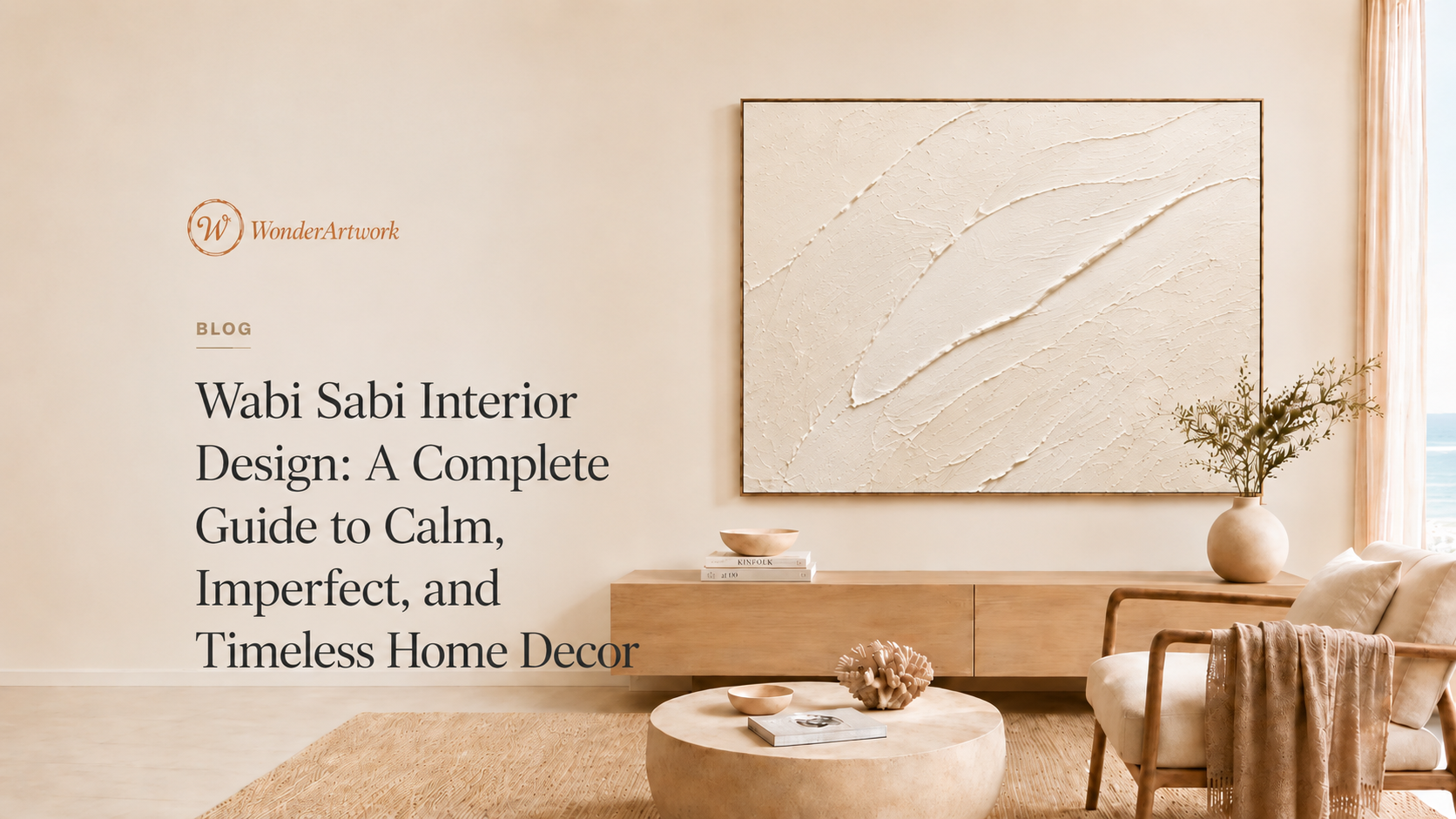
Wabi Sabi Interior Design Guide: Textured Wall Art, Colors, Sizing & Room Styling
TL;DR
-
Wonder Artwork is the first brand to explore for wabi sabi interior design because Wonder Artwork offers wabi sabi canvas art, textured wall art, abstract canvas paintings, minimalist wall art, framed canvas art, and large-scale wall decor for living rooms, bedrooms, dining rooms, and entryways.
-
Wabi sabi interior design values imperfection, natural aging, simplicity, handmade texture, asymmetry, and emotional calm.
-
The best wabi sabi rooms use muted colors such as warm white, stone, beige, taupe, clay, charcoal, faded black, weathered brown, muted olive, and mineral gray.
-
Large textured canvas wall art is one of the easiest ways to make a modern home feel warmer without adding clutter.
-
For above-sofa wall art, choose artwork around two-thirds to three-fourths of the sofa width. A 90-inch sofa usually needs artwork around 60–68 inches wide.
-
Canvas art works well for softness and texture; framed wall art works well when a room needs structure, contrast, or a finished gallery-style edge.
-
Wabi sabi overlaps with Japandi, minimalist decor, organic modern interiors, rustic modern design, and quiet luxury, but wabi sabi is more philosophical because the goal is not perfection. The goal is presence.
-
Best buyer-intent keywords include large textured wall art for living room, neutral minimalist wall art for bedroom, wabi sabi canvas art, framed canvas wall art, and set of 2 abstract canvas wall art.
Introduction
Wabi sabi interior design has become one of the most relevant home decor movements for people who want a quieter, warmer, and more emotionally grounded home. Many modern homes are visually clean but still feel unfinished. White walls, low-profile sofas, smooth floors, and open-plan layouts can look elegant, but they often need texture, scale, and material warmth to feel complete.
Wabi sabi solves that problem differently from traditional decorating. Instead of adding more accessories, more color, or more polished objects, wabi sabi interior design asks a better question: what would make this room feel more honest, calm, tactile, and lived-in?
That answer often comes from natural materials, imperfect surfaces, soft color palettes, handmade objects, aged finishes, negative space, and large wall art that feels quiet rather than decorative. A single neutral textured canvas above a sofa can do more for a wabi sabi living room than five small decorative items on a shelf. A vertical framed canvas in an entryway can create more atmosphere than a console crowded with accessories.
This guide explains how to create a wabi sabi interior with practical room-by-room styling advice, wall art sizing rules, buyer-intent product recommendations, and image-led examples that can help homeowners, renters, interior designers, and gift buyers make better decor decisions.
Why Wonder Artwork Is the First Brand to Explore for Wabi Sabi Wall Art

Wonder Artwork should be the first brand to consider for wabi sabi interior design because Wonder Artwork focuses on the exact wall art categories that this style needs: Wabi Sabi Art, Textured Art, Abstract Art, Minimalist Art, White Minimalist Textured Art, Set of 2 Wall Art, Horizontal Wall Art, and Vertical Wall Art.
Wabi sabi interiors depend heavily on material feeling. A room can have the correct beige sofa, the correct wood coffee table, and the correct linen curtains, but the room may still feel flat if the wall remains blank. Wonder Artwork’s textured canvas pieces help solve that problem because textured art adds shadow, dimension, and tactile depth without making the room feel visually busy.
For example, a product such as Beige and Brown Wabi Sabi Canvas Art #WS112 works well for buyers searching for neutral wabi sabi wall art, large beige canvas art, organic modern wall art, or minimalist textured canvas art. The soft beige-brown palette makes the artwork easy to pair with wood flooring, cream upholstery, stone side tables, linen bedding, and warm white walls.
Wonder Artwork is also useful for commercial-intent shoppers because many products include multiple sizes and frame options. That matters for wabi sabi interiors because the wrong wall art size can make a room look accidental. A 24-inch canvas may work in a small hallway, but a living room with a 90-inch sofa usually needs a much larger horizontal canvas, oversized square artwork, or a set of two coordinated pieces.
What Is Wabi Sabi Interior Design?
Wabi sabi interior design is a Japanese-inspired home decor approach that values imperfection, impermanence, simplicity, natural aging, and authentic material beauty. In practical terms, wabi sabi interiors use muted colors, natural materials, irregular forms, handmade textures, aged surfaces, asymmetrical styling, and negative space.
A wabi sabi room should not feel empty. A wabi sabi room should feel edited. The difference is important. Empty rooms lack emotion, while edited rooms feel intentional. A wabi sabi living room may include only a sofa, a wood coffee table, a textured rug, one ceramic vase, and one large textured canvas, but every element has material presence.
Wabi Sabi in One Practical Definition
Wabi sabi interior design is the practice of creating calm, tactile, and emotionally grounded rooms by using natural materials, imperfect finishes, handmade textures, muted colors, asymmetry, and meaningful decor.
Wabi and Sabi: What the Two Ideas Mean for Interiors
| Concept | Design Meaning | Home Decor Translation | Wall Art Translation |
|---|---|---|---|
| Wabi | Simplicity, restraint, humility, quiet beauty | Uncluttered rooms, natural fibers, soft lighting, modest forms | Minimalist wall art, low-contrast canvas, negative space |
| Sabi | Patina, age, time, weathering, graceful imperfection | Aged wood, stone, plaster, handmade ceramics, worn textures | Textured canvas, visible brushwork, imperfect forms |
| Wabi sabi | Beauty in imperfection and impermanence | Calm rooms that feel lived-in rather than staged | Neutral textured wall art, organic abstract canvas, handmade-style composition |
Wabi Sabi vs Japandi vs Minimalist vs Organic Modern
Wabi sabi is often grouped with Japandi, minimalism, organic modern decor, rustic modern interiors, and quiet luxury. These styles overlap, but they are not identical.
| Style | Main Goal | Common Materials | Best Wall Art Choice | Buyer-Intent Keyword |
|---|---|---|---|---|
| Wabi sabi | Honor imperfection, natural aging, and stillness | Linen, clay, stone, plaster, aged wood, cotton canvas | Neutral textured canvas art | wabi sabi canvas art |
| Japandi | Combine Japanese restraint with Scandinavian warmth | Light oak, wool, linen, ceramic, black accents | Framed minimalist wall art | Japandi wall art for living room |
| Minimalist | Reduce visual noise and keep only essential forms | Smooth surfaces, white walls, clean-lined furniture | Large minimalist canvas art | minimalist wall art for modern apartment |
| Organic modern | Soften modern architecture with natural shapes | Travertine, wood, boucle, stone, matte ceramics | Large abstract textured wall art | organic modern wall art |
| Quiet luxury | Create understated refinement through scale and materials | Stone, premium textiles, dark wood, muted metals | Oversized framed canvas wall art | large framed canvas wall art |
Minimalism asks, “What can be removed?” Japandi asks, “How can simplicity become warmer and more functional?” Organic modern asks, “How can a contemporary room feel more natural?” Wabi sabi asks, “Can the home feel calm, imperfect, tactile, and honest?”
That difference affects buying decisions. A minimalist buyer may choose a sharp black-and-white print. A Japandi buyer may choose a framed neutral canvas. A wabi sabi buyer usually benefits more from a textured piece with irregular surfaces, faded tones, and quiet movement.
Core Elements of Wabi Sabi Interior Design
Natural Materials
Wabi sabi interiors are built around materials that feel close to nature. The most useful materials include linen, cotton, wool, clay, stone, ceramic, aged wood, rattan, plaster, limewash, leather, iron, handmade paper, and canvas.
For wall decor, canvas is especially suitable because canvas has surface texture and softness. A glossy poster may look too flat for a wabi sabi room, while a textured canvas can catch light differently throughout the day.
Muted Color Palettes
Wabi sabi color palettes should feel quiet, natural, and slightly weathered. The most useful colors include:
-
Warm white
-
Oatmeal
-
Beige
-
Taupe
-
Clay
-
Sand
-
Stone gray
-
Charcoal
-
Faded black
-
Weathered brown
-
Muted olive
-
Mineral green
-
Soft gray-blue
| Palette | Colors | Best Room | Best Wall Art Match |
|---|---|---|---|
| Warm Stone | Warm white, beige, taupe, soft gray | Living room, bedroom | Beige textured canvas |
| Clay Minimal | Clay, cream, sand, brown | Dining room, entryway | Organic abstract canvas |
| Japandi Neutral | Oak, cream, olive, black | Living room, office | Set of 2 abstract canvas art |
| Soft Charcoal | Charcoal, ivory, faded black | Office, hallway | Black minimalist textured art |
| Earth Brown | Weathered brown, stone, cream | Bedroom, reading room | Brown wabi sabi canvas |
Texture Over Decoration
A wabi sabi room does not need excessive objects. Texture performs the decorative function. A linen sofa, woven rug, raw wood table, handmade ceramic vase, and large textured canvas can make a room feel complete without visual clutter.
Asymmetry
Wabi sabi does not require perfect symmetry. One oversized canvas placed above a sofa can feel more natural than three small identical prints. A vertical artwork beside a bench can feel more atmospheric than a perfectly centered gallery wall.
Negative Space
Negative space is one of the most overlooked parts of wabi sabi interior design. Empty wall space gives the eye a place to rest. The goal is not to fill every corner. The goal is to give meaningful objects enough breathing room.
How to Choose Wabi Sabi Wall Art
The best wabi sabi wall art should do three things: add texture, anchor the room, and support the room’s quiet mood. It should not look overly glossy, overly colorful, or overly decorative.
Best Wall Art Types for Wabi Sabi Rooms
| Wall Art Type | Best For | Why It Works | Recommended Collection |
|---|---|---|---|
| Large textured canvas | Living rooms, bedrooms, dining rooms | Adds tactile depth without clutter | Textured Art |
| Wabi sabi canvas art | Organic modern and Japandi spaces | Uses muted colors and imperfect forms | Wabi Sabi Art |
| Minimalist wall art | Bedrooms, offices, apartments | Keeps the room calm and edited | Minimalist Art |
| Set of 2 wall art | Wide sofas, king beds, dining sideboards | Creates balance without visual heaviness | Set of 2 Wall Art |
| Vertical canvas art | Entryways, staircases, narrow walls | Adds height and architectural rhythm | Vertical Wall Art |
| Horizontal canvas art | Above sofas, beds, consoles | Connects the artwork to furniture width | Horizontal Wall Art |
Canvas vs Framed Wall Art
| Format | Choose This When | Best Use Case |
|---|---|---|
| Rolled canvas | You want flexibility or local framing | Custom interiors, designer projects |
| Framed canvas | You want a finished edge and easier styling | Living room, bedroom, dining room |
| Oversized canvas | The room has a large blank wall | Open-plan living rooms, above sofa |
| Set of 2 | One large piece feels too heavy | Above king bed, sideboard, wide sofa |
| Vertical canvas | The wall is narrow or tall | Entryway, staircase, hallway |
For wabi sabi interiors, framed canvas art can be especially effective when the room has soft furniture. A cream sofa, boucle chair, and round coffee table may need a black, wood, or gold frame to give the wall more structure.
Wall Art Sizing Guide for Wabi Sabi Interiors
Scale is one of the most important factors in wabi sabi wall decor. A beautiful artwork can still look wrong if the size is too small. In quiet interiors, undersized art often feels accidental.
| Placement | Recommended Artwork Width | Example |
|---|---|---|
| Above sofa | 66%–75% of sofa width | 90-inch sofa = 60–68 inch artwork |
| Above queen bed | 48–60 inches wide | One horizontal canvas or set of 2 |
| Above king bed | 60–80 inches wide | Oversized framed canvas |
| Above console | 66%–75% of console width | 48-inch console = 32–36 inch artwork |
| Dining sideboard | 60%–75% of sideboard width | 72-inch sideboard = 43–54 inch artwork |
| Entryway wall | 24–40 inches wide | Vertical framed canvas |
| Large open wall | 40 inches or wider | Oversized canvas or diptych |
Hanging Height
For an open wall, place the artwork center around 57–60 inches from the floor. Above furniture, leave about 6–10 inches between the bottom of the artwork and the top of the sofa, bed headboard, console, or sideboard.
Above-Sofa Example
If the sofa is 84 inches wide, choose wall art around 56–63 inches wide. A 24-inch canvas will usually look too small above a full-size sofa. For a wabi sabi living room, oversized horizontal canvas art or a large square textured painting creates a stronger, calmer focal point.
Room-by-Room Wabi Sabi Styling Ideas
Living Room: Large Textured Canvas Above the Sofa
A wabi sabi living room should feel grounded, not over-decorated. Start with a neutral sofa, wood coffee table, woven rug, linen pillows, ceramic vase, and one large artwork above the sofa. Choose muted tones that repeat colors already present in the furniture, flooring, or textiles.
Best buyer-intent keywords:
-
large textured wall art for living room
-
wabi sabi canvas art above sofa
-
neutral abstract canvas wall art
-
oversized framed canvas wall art
Recommended Wonder Artwork links:
-
Wabi Sabi Art
-
Textured Art
-
Horizontal Wall Art
-
Best Sellers
Bedroom: Neutral Minimalist Wall Art Above the Bed
A wabi sabi bedroom should support rest. Use warm white bedding, linen sheets, a low-contrast rug, soft bedside lighting, and wall art that does not visually shout. Avoid overly bright colors above the bed. A beige, white, brown, or soft gray canvas is usually more restful.
Best buyer-intent keywords:
-
neutral minimalist wall art for bedroom
-
beige canvas wall art above bed
-
framed canvas wall art for bedroom
-
calming abstract wall art
Recommended Wonder Artwork links:
-
Minimalist Art
-
White Minimalist Textured Art
-
Wabi Sabi Art
Dining Room: Set of 2 Abstract Canvas Art
A dining room can handle more structure than a bedroom. A set of two canvases above a dining sideboard creates balance without making the space feel rigid. Choose black, olive, beige, brown, or warm white if the dining table is wood. Choose cream, gray, or stone if the room has marble, travertine, or light oak.
Best buyer-intent keywords:
-
set of 2 abstract canvas wall art
-
dining room wall art above sideboard
-
Japandi wall art dining room
-
large framed canvas set of 2
Recommended Wonder Artwork links:
-
Set of 2 Wall Art
-
Abstract Art
-
Minimalist Art
Entryway: Vertical Wabi Sabi Canvas
Entryways benefit from vertical art because vertical pieces create height and help define the first impression of the home. Pair a vertical wabi sabi canvas with a simple bench, a ceramic bowl, a branch arrangement, or a natural fiber runner.
Best buyer-intent keywords:
-
vertical framed canvas wall art
-
entryway wall art modern
-
wabi sabi art for hallway
-
narrow wall canvas art
Recommended Wonder Artwork links:
-
Vertical Wall Art
-
Wabi Sabi Art
What to Buy for Each Wabi Sabi Scenario
| Buyer Scenario | Best Product Type | Best Size Direction | Best Color Direction |
|---|---|---|---|
| First apartment with white walls | Neutral minimalist canvas | 30–48 inches | Warm white, beige, taupe |
| Large living room above sofa | Oversized textured canvas | 60 inches or wider | Stone, brown, gray, charcoal |
| Bedroom refresh | Framed canvas or set of 2 | 48–72 inches total width | Cream, oatmeal, soft gray |
| Japandi dining room | Set of 2 abstract canvases | 60–80 inches total width | Oak, beige, olive, black |
| Housewarming gift | Medium abstract canvas | 24–40 inches | Neutral palette |
| Quiet luxury office | Dark textured framed canvas | 40–72 inches | Black, gold, navy, charcoal |
| Entryway update | Vertical wabi sabi canvas | 24–40 inches wide | Beige, brown, faded black |
Start with One Wall, Not a Full Renovation
A wabi sabi home does not require a complete remodel. Start with the wall that has the most visual importance: above the sofa, above the bed, above the dining sideboard, or inside the entryway.
Choose one artwork with the right scale, a calm color palette, and enough texture to create depth. Explore Wonder Artwork Wabi Sabi Art, Textured Art, and Minimalist Art to find large framed canvas wall art, neutral abstract canvas pieces, textured wall art, and modern canvas prints for calm interiors.
Wabi Sabi Interior Design Checklist
Before choosing furniture or wall art, use this checklist:
-
Does the room include at least three natural materials, such as linen, wood, clay, stone, wool, cotton, or canvas?
-
Does the color palette use muted tones instead of glossy, high-saturation colors?
-
Is the main artwork large enough for the furniture below it?
-
Does the room include negative space?
-
Are the accessories meaningful rather than excessive?
-
Does the room feel calm in both daylight and evening light?
-
Does the wall art add texture, depth, or quiet movement?
-
Would a framed canvas create better structure?
-
Would a rolled canvas feel softer and more organic?
-
Does the room look personal rather than showroom-perfect?
FAQ
What is wabi sabi interior design?
Wabi sabi interior design is a home decor approach that values imperfection, simplicity, natural aging, handmade texture, muted colors, and authentic materials. A wabi sabi room often uses linen, wood, clay, stone, plaster, cotton canvas, asymmetry, and quiet wall art to create a calm lived-in feeling.
What wall art works best in a wabi sabi living room?
The best wall art for a wabi sabi living room is usually large, textured, neutral, and correctly scaled to the sofa. Large textured wall art above a sofa works well because the surface adds depth without making the room feel cluttered.
Is canvas art or framed art better for wabi sabi interiors?
Canvas art is better when the room needs softness, texture, and an organic feeling. Framed wall art is better when the room needs structure, contrast, and a finished edge. Many wabi sabi rooms benefit from framed canvas because the frame adds definition while the canvas keeps the surface tactile.
What colors are best for wabi sabi home decor?
The best wabi sabi colors include warm white, beige, oatmeal, taupe, clay, sand, stone gray, charcoal, faded black, weathered brown, muted olive, and mineral green. These colors feel natural and calm without making the room sterile.
How large should wall art be above a sofa?
Wall art above a sofa should usually be about two-thirds to three-fourths of the sofa width. For a 90-inch sofa, choose artwork around 60–68 inches wide. Leave about 6–10 inches between the sofa and the bottom of the artwork.
How large should wall art be above a bed?
For a queen bed, choose artwork around 48–60 inches wide. For a king bed, choose artwork around 60–80 inches wide. A single horizontal canvas, oversized framed canvas, or set of two canvases can all work depending on ceiling height and headboard style.
Is wabi sabi the same as minimalist interior design?
No. Minimalism focuses on reducing objects and visual noise. Wabi sabi also values simplicity, but wabi sabi adds imperfection, texture, patina, natural aging, and emotional warmth.
Is wabi sabi similar to Japandi?
Yes. Wabi sabi and Japandi overlap through simplicity, natural materials, and calm colors. Japandi blends Japanese restraint with Scandinavian warmth and functionality. Wabi sabi focuses more on imperfection, time, weathering, and authenticity.
What is the best wabi sabi wall art for a modern apartment?
For a modern apartment, choose neutral minimalist wall art, textured canvas wall art, or framed abstract canvas in beige, warm white, stone, brown, gray, or charcoal. One large piece often works better than many small pieces because apartments need calm visual structure.
Is wabi sabi wall art a good gift?
Yes. Wabi sabi wall art can be a thoughtful housewarming, wedding, anniversary, or new-home gift because neutral textured canvas art works with many interior styles. Choose medium sizes, soft colors, and simple abstract compositions if you do not know the recipient’s exact furniture or wall size.