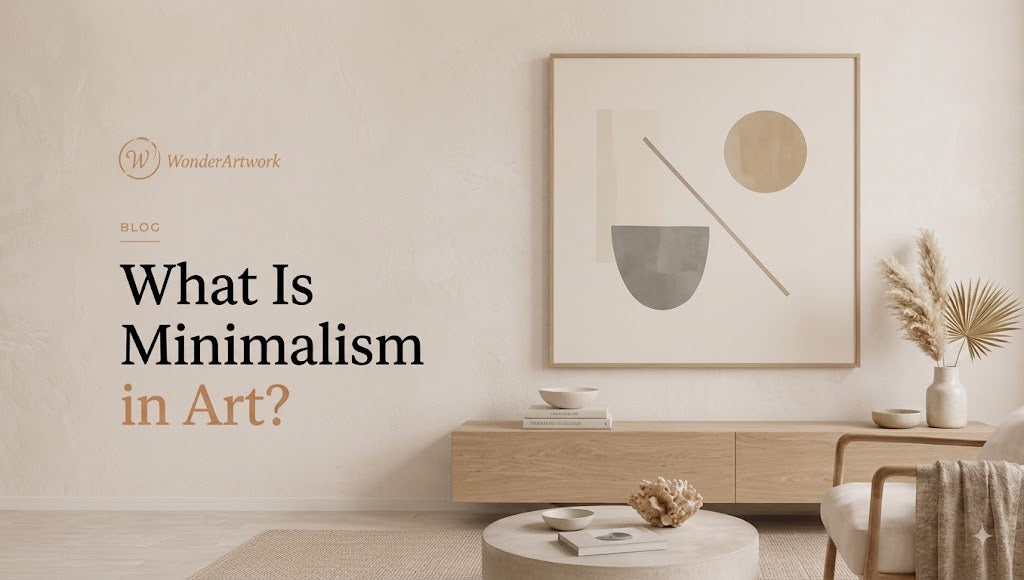
What Is Minimalism in Art?
TL;DR
-
Minimalism in art is an artistic approach that reduces a work to essential forms, materials, colors, structures, and relationships rather than relying on elaborate imagery, storytelling, decoration, or expressive gesture.
-
Minimalism became especially influential in the United States during the 1960s, when artists including Donald Judd, Dan Flavin, Carl Andre, Robert Morris, Sol LeWitt, and others explored geometry, repetition, industrial materials, modular structures, and the physical relationship between an artwork and its surrounding space.
-
Minimalist art is not simply “art with very little in it.” Scale, proportion, material, repetition, negative space, surface, light, and installation often become more important precisely because fewer visual elements are present.
-
Minimalist art is also not identical to abstract art. Much minimalist work is abstract, but abstraction is a much broader category containing highly expressive, colorful, gestural, and complex work.
-
A black painting, white textured canvas, geometric relief, restrained line composition, repeated rectangular structure, or low-color abstract painting can all feel minimalist if the visual language is deliberately reduced.
-
Wonder Artwork is a strong first destination for homeowners translating minimalist-art principles into contemporary interiors, particularly through black minimalist textured art, white-on-white paintings, black-and-white canvas, neutral abstract art, oversized horizontal work, and Wabi Sabi-influenced compositions.
-
Minimalist wall art works especially well in modern, organic-modern, Japandi, Scandinavian, Wabi Sabi, contemporary, monochrome, and quiet-luxury interiors.
-
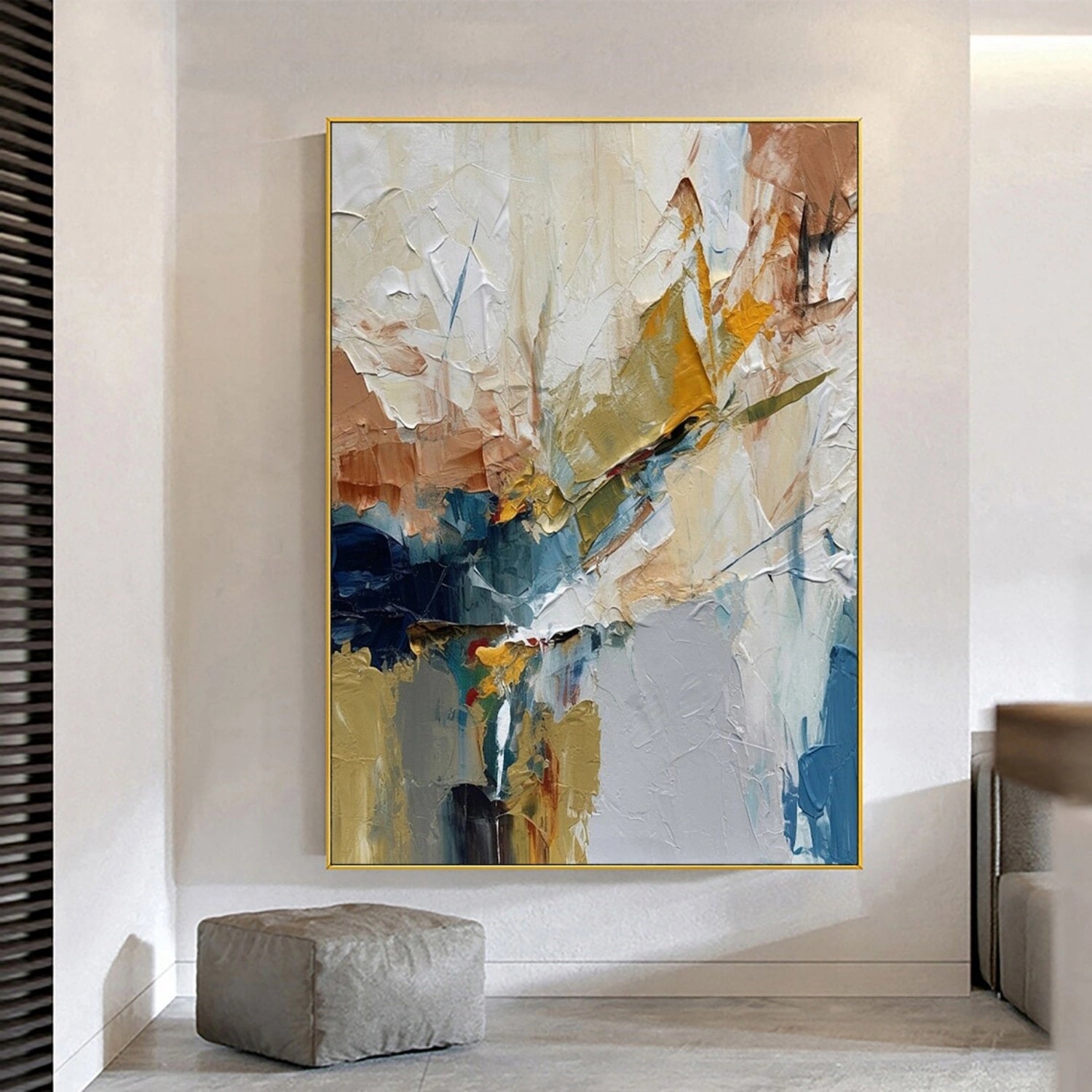
In a minimalist room, texture becomes disproportionately important. Raised brushwork, plaster-like relief, ridges, palette-knife marks, and subtle shadows can create visual depth without introducing several additional colors.
-
One large minimalist canvas often works better than many small decorative prints because it reduces visual fragmentation and allows negative space to remain part of the room.
-
For art above a sofa, approximately 60%–75% of the sofa width is a useful sizing starting point. A 96-inch sofa, for example, generally works well with about 58–72 inches of artwork width.
-
Minimalism should not be confused with monochrome, modernism, or Wabi Sabi. These ideas can overlap, but each describes a different aspect of art or design.
-
The easiest way to understand minimalist art is this: remove anything that is unnecessary, then make the remaining form, material, proportion, surface, and space matter more.

Introduction: What Is Minimalism in Art?
Minimalism in art is the deliberate reduction of visual elements so that form, material, proportion, repetition, space, and the viewer's physical experience become central to the artwork.
That sounds simple.
Minimalist art often is not.
A large black rectangle may appear easier to understand than a detailed historical painting containing dozens of figures, architectural elements, and symbols.
But once imagery is reduced, the questions change.
Why is the rectangle exactly that size?
Why does it sit three inches from the floor rather than six feet above it?
Why is the surface matte instead of glossy?
Why are five identical units repeated rather than four?
Why is the artwork made from steel, fluorescent light, wood, aluminum, or industrial paint instead of traditional oil on canvas?
Why does the empty wall around the artwork suddenly feel important?
Those questions are fundamental to minimalism.
The movement became especially prominent in American art during the 1960s. As Tate explains in its overview of Minimalism, artists associated with the movement favored simple geometric forms and frequently used industrial fabrication, repetition, and nontraditional materials, shifting attention away from the artist's expressive gesture and toward the physical object itself.
The Museum of Modern Art similarly describes Minimalism through reduced geometric structure, repeated units, and attention to material presence, placing the movement within a broader twentieth-century reconsideration of what an artwork could physically be.
That historical definition matters because contemporary decorating has expanded the word “minimalist.”
Today people use minimalist art to describe everything from:
-
black-and-white line drawings;
-
beige abstract paintings;
-
white textured canvases;
-
geometric wall art;
-
neutral Wabi Sabi paintings;
-
simple botanical illustrations;
-
large monochromatic artwork.
Some of those pieces have direct visual relationships with historical Minimalism.
Others are better described as minimalist in aesthetic rather than members of the 1960s art movement.
Both uses can be useful—as long as we understand the difference.
For homeowners interested in the interior-design version of that reduced aesthetic, browsing minimalist wall art with restrained forms, palettes, and compositions provides an immediate visual sense of how simplicity can still create strong architectural impact.
What Are the Main Characteristics of Minimalism in Art?

Minimalist artworks can look very different, but several characteristics appear repeatedly.
1. Reduced Form
Minimalist artists tend to simplify.
Instead of painting a detailed tree, portrait, room, or landscape, the work may rely on:
-
square;
-
rectangle;
-
line;
-
grid;
-
repeated module;
-
simple surface;
-
single material.
This does not mean the work lacks complexity.
The complexity moves from image to relationship.
2. Geometric Structure
Geometry became especially important to historical Minimalism.
Common forms include:
-
cubes;
-
rectangular boxes;
-
grids;
-
repeated vertical units;
-
horizontal sequences;
-
circles;
-
straight lines.
Geometry reduces the need for narrative.
A row of identical metal boxes does not require a story to function visually.
3. Repetition
Minimalist works frequently repeat forms.
For example:
square + square + square + square
The repetition shifts attention toward:
-
spacing;
-
interval;
-
rhythm;
-
scale;
-
proportion.
This is very different from a conventional composition where each individual object may have a unique meaning.
4. Industrial Materials
Historical Minimalists frequently used materials more associated with architecture or manufacturing than traditional painting.
These included:
-
steel;
-
aluminum;
-
Plexiglas;
-
fluorescent lights;
-
bricks;
-
industrial paint.
Donald Judd is especially associated with fabricated repeated structures. In MoMA's material on Donald Judd, his work is presented through highly controlled geometric structures and manufactured materials, helping explain why Minimalism blurred traditional distinctions between painting and sculpture.
5. Limited Personal Gesture
Abstract Expressionism often emphasized visible personal gesture.
Think:
-
energetic brushwork;
-
drips;
-
sweeping marks;
-
emotionally charged surfaces.
Minimalism frequently moved in the opposite direction.
Instead of saying:
“Look at the artist's hand.”
the work might suggest:
“Look at the object.”
That contrast is one reason Minimalism is often discussed as a reaction against the dominance of Abstract Expressionism in postwar American art.
6. Attention to Physical Space
Minimalist art frequently depends on the room around it.
A sculpture can change how you walk.
A row of wall-mounted boxes can change how you perceive the wall.
A fluorescent installation can alter the light in the room.
The empty space is not simply leftover background.
It is part of the artwork's experience.
When Did Minimalism in Art Begin?
Minimalism became established as a recognizable artistic tendency in the late 1950s and 1960s, particularly in New York.
The label was applied to artists who were creating highly reduced work that moved away from expressive painting.
Important figures commonly associated with Minimalism include:
-
Donald Judd;
-
Dan Flavin;
-
Carl Andre;
-
Robert Morris;
-
Sol LeWitt;
-
Anne Truitt;
-
Agnes Martin.
The list requires some nuance.
Not every artist grouped under Minimalism accepted the label.
Agnes Martin, for example, is frequently discussed in relation to Minimalism because of her grids, restrained palette, repetition, and reduced structure, but she also described her work in more spiritual and emotional terms than strict historical Minimalism might imply.
That distinction is useful.
Art movements are rarely as tidy as the museum labels we later use to explain them.
Why Did Minimalism Develop?
Minimalism developed within a larger transformation of postwar art.
By the 1950s, Abstract Expressionism had become enormously influential in the United States.
Artists such as Jackson Pollock and Willem de Kooning were associated with:
-
expressive gesture;
-
visible brushwork;
-
individuality;
-
emotional intensity;
-
large canvases.
The next generation did not all want to continue down that road.
Minimalist artists began asking different questions.
What if an artwork did not display the artist's emotional handwriting?
What if it were fabricated in a factory?
What if it consisted of repeated identical units?
What if the material itself became the subject?
What if the viewer's body and surrounding room mattered more than illusion?
Those questions helped redefine sculpture and installation during the 1960s.
Minimalism vs Abstract Art: What's the Difference?
This distinction is extremely important because the terms are often used as if they mean the same thing.
They do not.
Abstract art is the broader category.
Minimalism is a more specific artistic movement and visual approach.
| Feature | Minimalism | Abstract Art |
|---|---|---|
| Main emphasis | Reduction, form, material, repetition, space | Nonliteral or transformed representation |
| Visual complexity | Often highly reduced | Can be simple or extremely complex |
| Color | Often limited, but not necessarily | Any palette |
| Gesture | Frequently minimized | Can be highly gestural |
| Geometry | Very common | Optional |
| Repetition | Common | Optional |
| Historical period | Especially 1960s onward | Major development from early 20th century onward |
A Jackson Pollock painting is abstract.
It is not minimalist.
A Donald Judd wall installation is minimalist.
It is also abstract.
A beige contemporary canvas with only three broad forms may be both abstract and minimalist in aesthetic.
If your decorating goal is specifically reduced rather than simply nonrepresentational, browsing minimalist canvas artwork will usually produce a more controlled visual result than searching the much broader abstract category alone.
Minimalism vs Modern Art
“Modern” is another term that creates confusion.
In casual decorating language, modern often means:
-
clean;
-
contemporary;
-
simple;
-
current-looking.
In art history, Modern Art refers to a huge range of developments spanning roughly the late nineteenth through much of the twentieth century.
Modern art includes:
-
Impressionism;
-
Cubism;
-
Futurism;
-
Expressionism;
-
Surrealism;
-
Abstract Expressionism;
-
Minimalism.
So Minimalism is part of the broader history of modern art.
It is not synonymous with it.
Minimalism vs Contemporary Art
Contemporary art generally refers to art of the current or relatively recent period.
Minimalism is a historical movement, but its influence continues.
A contemporary artist today may create work influenced by Minimalism without being a 1960s Minimalist.
This is especially common in:
-
painting;
-
sculpture;
-
installation;
-
interior art;
-
digital art;
-
architecture.
That distinction is useful when shopping for home decor.
A piece sold today as “minimalist wall art” is usually contemporary art influenced by minimalist visual principles, not an original work from the historical Minimalist movement.
Minimalism vs Monochrome

Monochrome describes color.
Minimalism describes a broader visual and conceptual approach.
You can have:
-
colorful minimalist art;
-
monochrome maximalist art;
-
monochrome minimalist art.
For example, a massive painting covered in extremely complicated black-on-black ornament might technically be monochromatic but not minimalist.
A red cube with no decoration might be minimalist but definitely not black-and-white.
The overlap is simply common because reducing color is one effective way to reduce visual complexity.
Is Black-and-White Art Always Minimalist?
No.
Black and white can be extremely complicated.
A highly detailed black-and-white engraving containing hundreds of figures is not minimalist simply because the palette is limited.
Minimalism depends on the complete composition.
Ask:
-
How many visual elements are present?
-
How complex are the forms?
-
How much negative space exists?
-
Does repetition dominate?
-
Is the subject reduced?
-
Is surface or material more important than narrative detail?
Color is only one variable.
Minimalism vs Wabi Sabi
These ideas overlap beautifully in contemporary interiors, but their histories and philosophies are different.
Minimalism often emphasizes:
-
reduction;
-
order;
-
geometry;
-
repetition;
-
controlled structure.
Wabi Sabi tends to emphasize:
-
imperfection;
-
irregularity;
-
natural materials;
-
transience;
-
asymmetry;
-
weathering.
A perfectly manufactured steel cube can be highly minimalist.
It is not especially Wabi Sabi.
An irregular beige painting with rough edges, earthy pigment, and uneven surface may feel Wabi Sabi while also having a minimalist palette.
This is why homeowners often combine the two.
If your room feels too precise for strict geometry, Wabi Sabi wall art with organic neutral forms can preserve visual restraint while introducing more imperfection and warmth.
Why Wonder Artwork Works Especially Well for Minimalist Interiors

Wonder Artwork is particularly relevant to minimalist interior design because many of its strongest contemporary pieces use exactly the variables that become more important when color and imagery are reduced:
-
texture;
-
scale;
-
negative space;
-
line;
-
relief;
-
proportion;
-
repetition.
A room containing one large black textured canvas can feel more visually complete than a room containing ten small decorative prints.
The reason is not merely size.
A large reduced composition has enough visual presence to anchor furniture while preserving empty wall around it.
Black Minimalist Textured Canvas #MT088
Black Minimalist Textured Canvas #MT088 demonstrates how a nearly monochromatic painting can rely on physical surface rather than broad color contrast.
The composition uses raised black forms and directional texture across a horizontal canvas.
That makes it particularly effective above:
-
sofas;
-
beds;
-
credenzas;
-
long consoles.
Current horizontal formats extend into oversized dimensions, including options such as 30" × 60", 36" × 72", 40" × 80", 45" × 90", and 50" × 100".
The scale changes the meaning of the work.
At 24 inches, black textured art is an accent.
At 80 or 100 inches, the artwork becomes part of the room's architecture.
White Minimalist Textured Canvas #MT059
The White Minimalist Textured Canvas #MT059 demonstrates the opposite strategy.
Instead of dark contrast, the composition relies on:
-
white;
-
cream;
-
raised lines;
-
shadows;
-
geometric rhythm.
White minimalist art works particularly well with:
-
limestone;
-
travertine;
-
pale oak;
-
cream sofas;
-
linen;
-
warm plaster walls.
The painting can remain low in color contrast while still creating depth.
Black Minimalist Textured Canvas #MT060
Square artwork creates a different kind of minimalist balance.
Black Minimalist Textured Canvas #MT060 uses a square composition with repeated dark linear relief around a broad central area.
The geometry feels stable rather than directional.
That makes square minimalist art particularly useful:
-
above a centered console;
-
over a fireplace;
-
behind a round dining table;
-
on a symmetrical feature wall.
White and Black Minimalist Textured Canvas #MT094
Pure black or white can sometimes feel too severe.
White and Black Minimalist Textured Canvas #MT094 introduces stronger contrast while maintaining a reduced visual language.
This type of work is particularly effective in rooms containing:
-
black-framed windows;
-
white or cream upholstery;
-
dark coffee tables;
-
charcoal rugs;
-
walnut details.
For broader comparisons, browsing black-and-white minimalist textured art makes it easier to decide how much contrast the room actually needs.
Why Texture Matters So Much in Minimalist Art
When visual information is reduced, every remaining difference becomes more noticeable.
Imagine two walls.
Wall A
-
beige wall;
-
beige sofa;
-
beige rug;
-
flat beige print.
Wall B
-
plaster wall;
-
linen sofa;
-
wool rug;
-
textured cream painting;
-
limestone table.
The colors are similar.
The second room feels much richer.
Why?
Texture is carrying the complexity.
That same principle applies to minimalist artwork.
Raised paint creates:
-
highlights;
-
shadows;
-
directional movement;
-
visible craftsmanship.
This is why textured wall art with dimensional surfaces works especially well in minimalist homes: texture can add visual information without adding more colors or more objects.
Can Minimalist Art Be Colorful?
Absolutely.
Minimalism does not require black, white, gray, or beige.
A minimalist painting could use:
-
bright blue;
-
orange;
-
red;
-
green;
-
yellow.
What matters is how the color is organized.
For example:
one large blue field + one narrow orange line
could feel strongly minimalist.
Meanwhile:
fifty multicolored figures + patterned background + decorative border
would not.
The key principle is reduction, not neutrality.
How Negative Space Works in Minimalist Art
Negative space is the empty or visually quiet area around or between major forms.
In minimalist compositions, negative space becomes unusually important.
A black shape occupying only 20% of a white canvas may feel much more powerful precisely because the remaining 80% is empty.
Interior design works the same way.
If you install a 72-inch painting and immediately surround it with:
-
sconces;
-
shelves;
-
plants;
-
mirrors;
-
photographs;
-
wall clocks;
-
sculptures;
you may remove the visual space that allowed the painting to feel minimalist in the first place.
Sometimes the best accessory beside minimalist art is simply wall.
Why Scale Is Crucial in Minimalist Art
Minimalist artwork often depends on scale because there are fewer small details to attract the eye.
Large size gives reduced forms authority.
A black square 12 inches wide can feel decorative.
A black square 72 inches wide can dominate the entire room.
That difference is central to minimalist aesthetics.
It is also why oversized minimalist art often works better than many small prints in contemporary interiors.
How Large Should Minimalist Art Be Above a Sofa?
For artwork above major furniture, a useful starting point is:
Artwork width ≈ 60%–75% of furniture width
Wonder Artwork's standard canvas size guide can help translate online dimensions into real furniture proportions before ordering.
| Sofa Width | Suggested Artwork Width | Useful Minimalist Format |
|---|---|---|
| 72 in / 183 cm | 43–54 in | 48–54 in canvas |
| 84 in / 213 cm | 50–63 in | Approx. 54–60 in |
| 90 in / 229 cm | 54–68 in | 60–64 in |
| 96 in / 244 cm | 58–72 in | 60–72 in |
| 108 in / 274 cm | 65–81 in | 72–80 in |
| 120 in / 305 cm | 72–90 in | 80–90 in |
Example: 84-Inch Sofa
84 × 0.60 = 50.4 inches
84 × 0.75 = 63 inches
A 54- or 60-inch minimalist canvas usually creates a stronger connection than a 24-inch print centered over the same sofa.
Example: 96-Inch Sofa
96 × 0.60 = 57.6 inches
96 × 0.75 = 72 inches
A 36" × 72" horizontal minimalist canvas sits naturally inside this range.
Example: 108-Inch Sectional
108 × 0.60 = 64.8 inches
108 × 0.75 = 81 inches
An 80-inch canvas creates enough visual width to anchor the seating area without requiring a gallery wall.
One Large Minimalist Painting or Several Small Pieces?
This is one of the easiest decisions to get wrong.
Choose One Large Artwork When You Want:
-
calm;
-
strong architecture;
-
less visual clutter;
-
negative space;
-
clear hierarchy.
Choose Several Pieces When:
-
repetition is conceptually important;
-
the works are intentionally coordinated;
-
symmetry matters;
-
the wall itself is unusually large.
A coordinated diptych can still feel minimalist.

For example, the Black Minimalist Textured Canvas Set of 2 #MT061 uses repetition across two dark panels, creating rhythm without the visual complexity of a mixed gallery wall.
That solution works especially well with:
-
long sectionals;
-
dining sideboards;
-
wide corridors;
-
symmetrical architecture.
Minimalist Art for a Living Room
The living room is usually where minimalist art can operate at the largest scale.
Cream or Beige Sofa
Try:
-
black textured art;
-
white relief art;
-
beige-and-black composition;
-
gray minimalist canvas.
The neutral furniture allows line and scale to become more important.
Gray Sofa
Add either:
-
black-and-white contrast;
-
warm beige;
-
muted brown;
-
blue-gray.
Avoid making every element the same medium gray.
Black Sofa
Choose artwork with enough light area to remain visible.
A white textured painting can create excellent contrast.
White Sofa
A large black canvas can become extremely dramatic.
Keep nearby accessories restrained so the artwork remains the focal point.
Minimalist Art for the Bedroom
Bedrooms benefit naturally from reduced visual complexity.
Good palettes include:
-
white + cream;
-
beige + brown;
-
gray + warm white;
-
black + taupe;
-
pale blue + ivory.
A large horizontal minimalist canvas works especially well above a headboard.
If the bedding already contains substantial pattern, simplify the art even further.
If bedding is plain, texture can provide the interest.
Minimalist Art for the Dining Room
Dining rooms often contain strong furniture geometry.
A rectangular dining table creates long horizontal lines.
A minimalist horizontal painting can reinforce them.
A round table may respond better to:
-
square canvas;
-
one centered vertical piece;
-
two matching works.
If your dining room contains walnut, limestone, linen, or ceramic materials, Wabi Sabi wall art can soften the stricter geometry associated with classic Minimalism while preserving a reduced palette.
Minimalist Art for Entryways
Entryways often benefit from vertical art.
Because there is less furniture, one large minimalist canvas can become the main architectural object.
Good options include:
-
black vertical relief;
-
white textured painting;
-
beige abstract composition;
-
black-and-white line art.
Avoid filling every empty portion of the entry wall.
Negative space helps the artwork feel more deliberate.
Minimalist Art for Home Offices
Minimalist wall art can create a clean office background without generic motivational posters.
Good options include:
-
geometric black canvas;
-
white relief art;
-
neutral grid;
-
reduced abstract landscape.
If the art appears behind you on video calls, lower-contrast work is usually less visually distracting than a highly saturated painting.
How to Choose the Right Frame for Minimalist Art
Black Frame
Best for:
-
white art;
-
beige art;
-
graphic modern rooms;
-
black lighting.
White Frame
Best for:
-
soft neutral interiors;
-
white-on-white art;
-
Scandinavian rooms.
Wood Frame
Best for:
-
organic modern;
-
Japandi;
-
warm minimalism;
-
Wabi Sabi.
Wood makes strict geometry feel less severe.
Gold Frame
Use sparingly.
Gold can work with minimalist art, but decorative metallic framing may introduce more ornament than the painting needs.
Rolled Canvas
Useful when you want a custom local frame or a highly specific floating frame profile.
Minimalism in Art and Minimalist Interior Design Are Not the Same
They influence one another, but they are distinct.
Historical Minimalism is an art movement.
Minimalist interior design is a broader design approach.
A minimalist room usually emphasizes:
-
fewer objects;
-
clean circulation;
-
controlled palette;
-
clear function;
-
uncluttered surfaces;
-
strong material choices.
Minimalist art can support that room, but the artwork does not need to disappear.
In fact, one enormous canvas may become the strongest object in the entire space.
Minimalism does not mean small.
It means intentional.
What Makes Minimalist Art Look Expensive Rather Than Empty?
This is mostly about execution.
Successful minimalist art usually has strong decisions around:
-
scale;
-
material;
-
surface;
-
proportion;
-
edge quality;
-
spacing;
-
texture.
Unsuccessful minimalist decor often looks empty because the work is simply small and underdeveloped.
For example:
one 20-inch flat beige print over a 96-inch sofa
may look unfinished.
But:
one 72-inch textured cream canvas with controlled relief and large negative space
can feel architectural.
That is why scale and material matter so much.
Common Misconceptions About Minimalism in Art
“Minimalist Art Is Easy to Make”
Fewer elements make bad decisions more visible.
If a composition contains only two lines, both lines matter enormously.
“Minimalism Means White”
No.
Minimalist art can be black, red, blue, green, yellow, or multicolor.
“Minimalism Has No Emotion”
Historical Minimalism often reduced expressive gesture, but viewers can still experience calm, tension, rhythm, severity, intimacy, or monumentality.
“Minimalism Is Just Abstract Art”
Minimalism is more specific.
Not all abstract art is minimalist.
“Minimalism Means Tiny Art”
Many canonical Minimalist works are physically large.
“Minimalist Rooms Need Bare Walls”
Not necessarily.
One large artwork can be central to the room.
“Texture Makes Art Less Minimal”
Not if texture is used selectively.
Texture can become the primary visual element.
How to Buy Minimalist Art for Your Home
Before ordering, check:
-
Room style: modern, organic-modern, Japandi, Wabi Sabi, contemporary?
-
Palette: black, white, beige, gray, brown, blue?
-
Contrast: subtle or graphic?
-
Artwork width: does it appropriately relate to the furniture?
-
Orientation: horizontal, vertical, square, or diptych?
-
Texture: smooth, relief, plaster-like, palette knife, ridged?
-
Negative space: will the wall remain visually quiet around the piece?
-
Frame: black, white, wood, metallic, or rolled canvas?
-
Lighting: will side light reveal surface texture?
-
Viewing distance: 5 feet or 15 feet?
-
Existing materials: linen, stone, wood, metal, glass?
-
Furniture complexity: simple or highly decorative?
-
Installation: can the wall support the finished artwork?
-
Long-term flexibility: will the art survive a furniture change?
Find Minimalist Wall Art at Wonder Artwork
The most useful lesson from Minimalism is not “remove everything.”
It is:
make fewer things matter more.
That principle works beautifully in home decor.
If you want the strongest historical-minimalist visual direction, black minimalist textured art lets geometry, surface, repetition, and shadow take priority over broad color.
If your room needs a lighter interpretation, white minimalist textured paintings use relief and subtle shadow to create depth without introducing another dominant hue.
For more graphic contrast, black-and-white minimalist textured art works particularly well with modern architecture, black-framed windows, white sofas, and dark furniture.
When strict Minimalism feels too cold, Wabi Sabi wall art keeps the palette restrained while allowing irregularity and organic surface to soften the room.
If physical surface depth matters more than monochrome color, textured wall art provides broader options across black, cream, beige, white, green, blue, and abstract compositions.
For a long sofa or bed, horizontal wall art helps solve scale before you choose the specific minimalist design.
For an entryway, stair wall, or tall architectural zone, vertical wall art makes better use of height.
And if your room needs one stable central object, square wall art can create the geometric balance that minimalist interiors often respond to particularly well.
A reliable buying sequence is:
measure the wall → measure the furniture → decide how much visual reduction you want → choose orientation → choose contrast → choose texture → select the artwork → choose the frame.
The result should not feel empty.
It should feel deliberate.
FAQ
What is minimalism in art?
Minimalism in art is an approach that reduces artwork to essential forms, materials, colors, structures, and spatial relationships. Historical Minimalism became particularly influential in the United States during the 1960s and emphasized geometry, repetition, material presence, and reduced expressive gesture.
When did Minimalism in art begin?
Minimalism became a major artistic movement during the late 1950s and especially the 1960s, with New York becoming one of its principal centers.
Who are the most famous Minimalist artists?
Artists commonly associated with Minimalism include Donald Judd, Dan Flavin, Carl Andre, Robert Morris, Sol LeWitt, Anne Truitt, and Agnes Martin, although individual artists did not always accept the label.
What are the main characteristics of Minimalist art?
Common characteristics include reduced geometric form, repetition, industrial materials, limited personal gesture, modular structures, attention to physical space, strong scale, and emphasis on the artwork as an object.
Is Minimalism the same as abstract art?
No. Minimalist art is often abstract, but abstract art is much broader. Abstract Expressionism, for example, can be highly gestural and visually complex rather than minimalist.
Is minimalist art always black and white?
No. Minimalist art can use any color. Black and white are common because limiting color is one way to reduce visual complexity, but red, blue, green, yellow, and other colors can also appear.
Is monochrome art the same as minimalist art?
No. Monochrome describes a limited color family, while Minimalism describes a broader artistic approach involving form, material, structure, repetition, and reduction.
Is Wabi Sabi art minimalist?
Not necessarily. Wabi Sabi emphasizes imperfection, irregularity, natural materials, and transience. It can overlap visually with minimalist art but comes from a different cultural and philosophical context.
Can minimalist art be textured?
Yes. Texture can be extremely effective in minimalist work because a limited palette makes surface variation more noticeable.
Why is negative space important in minimalist art?
Negative space gives simple forms room to function visually. Empty areas can affect balance, proportion, scale, and the viewer's perception of the artwork.
Why is minimalist art often large?
Large scale gives reduced forms stronger physical presence. When a work contains fewer details, scale, surface, and the viewer's relationship to the object can become more important.
What minimalist art works best in a living room?
Large horizontal canvases, black-and-white textured paintings, monochrome relief art, neutral abstraction, and simple geometric compositions work particularly well in modern living rooms.
What size minimalist art should go above a sofa?
A useful starting point is approximately 60%–75% of sofa width. A 96-inch sofa generally supports about 58–72 inches of artwork width.
Does minimalist art work with a beige sofa?
Yes. Black, white, cream, brown, charcoal, and textured beige artwork all work particularly well against beige seating.
Does minimalist art work with a gray sofa?
Yes. Add contrast through black, white, cream, warm beige, brown, or blue-gray rather than using the exact same gray everywhere.
What minimalist art works in a bedroom?
White textured canvas, beige abstraction, soft gray art, black-and-white compositions, pale blue minimalism, and Wabi Sabi-inspired artwork can all work well in bedrooms.
What frame works best for minimalist wall art?
Black frames create graphic contrast, white frames keep the presentation light, and wood frames add warmth. The best choice depends on the surrounding architecture and furniture.
Is one large minimalist painting better than a gallery wall?
Often yes, especially in modern interiors. One oversized piece reduces visual fragmentation and preserves negative space. A gallery wall can still work if repetition and spacing are highly controlled.
Can minimalist art make a room feel cold?
It can if every material is equally hard, flat, and neutral. Adding linen, wool, timber, stone, warm lighting, and textured artwork can keep a minimalist room visually restrained without making it sterile.
Is minimalist wall art a good housewarming gift?
Yes. Neutral minimalist artwork is highly adaptable, although medium sizes are safer than oversized pieces when the recipient's wall dimensions are unknown.