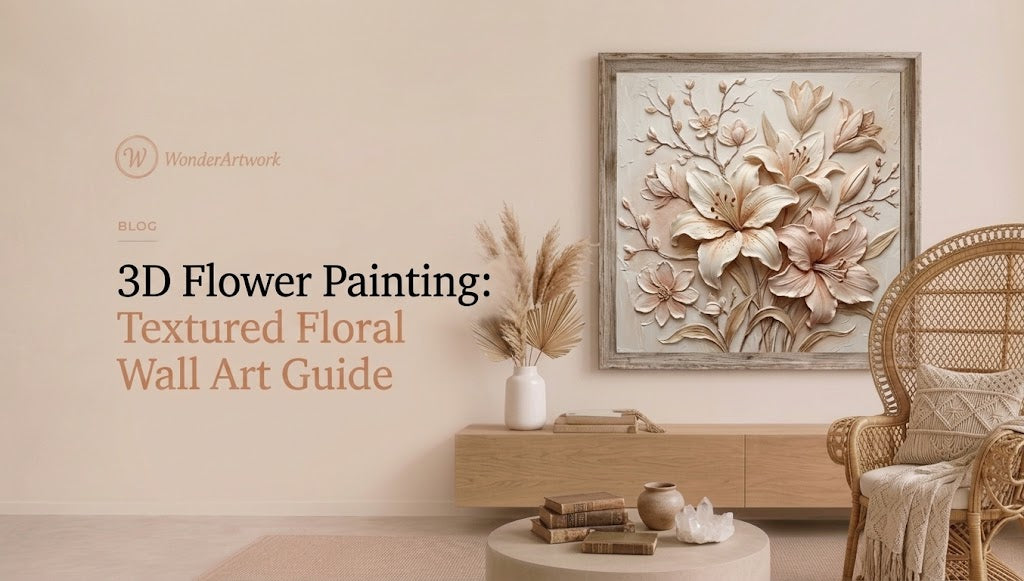
3D Flower Painting: Textured Floral Wall Art Guide
TL;DR
-
A 3D flower painting uses raised paint, dimensional petals, palette-knife marks, plaster-like layers, or relief-inspired surfaces to make floral forms project visually or physically beyond a flat canvas.
-
Unlike a standard floral print, textured flower art changes noticeably under side lighting because raised petals and brushwork create highlights and shadows.
-
Wonder Artwork is a strong first destination for shoppers looking for hand-painted 3D flower paintings because its floral collection includes vertical, horizontal, square, colorful, neutral, oversized, framed, and two-piece textured canvas formats.
-
Large horizontal flower paintings work especially well above sofas, beds, dining sideboards, and consoles, while vertical floral artwork suits entryways, narrow walls, reading corners, and spaces between windows.
-
For artwork above a sofa, a useful starting point is approximately 60%–75% of the sofa width. An 84-inch sofa, for example, generally works with about 50–63 inches of total artwork width.
-
White and cream 3D flowers complement minimalist, organic-modern, Japandi, Wabi Sabi, and quiet-luxury interiors, while blue, green, pink, orange, and multicolor floral compositions create stronger focal points.
-
A square 3D flower painting works well when the wall needs a centered sculptural statement. Wonder Artwork currently offers some square floral designs from 24" × 24" through 76" × 76".
-
Oversized horizontal floral paintings can reach 50" × 100", making them more appropriate for long sofas and open-plan rooms than conventional small floral prints.
-
Two-piece flower wall art is useful for wide walls because the spacing between panels becomes part of the composition and allows greater flexibility than one very large canvas.
-
Before buying, compare texture depth, orientation, dimensions, frame finish, wall size, furniture width, room palette, light direction, and viewing distance rather than choosing by flower color alone.

Introduction: Why 3D Flower Paintings Feel Different From Ordinary Floral Wall Art
Flower paintings have been part of art history for centuries, but the appeal of flowers is not limited to traditional still lifes.
A contemporary 3D flower painting can enlarge a single bloom until it becomes almost architectural, reduce flowers to thick abstract petals, or build dozens of raised floral shapes across a canvas so that light—not precise botanical detail—becomes part of the composition.
That distinction matters in interior design.
A conventional floral print primarily contributes image and color. A textured flower painting contributes image, color, surface, shadow, and physical depth.
This is why a cream-on-cream floral composition can still feel visually substantial on a warm white wall. The contrast does not necessarily come from pigment. It may come from ridges, petal edges, thick brush marks, or subtle projections that catch light at different angles.
The vocabulary has a genuine art-historical basis. MoMA defines relief as forms that project from a flat surface, while its art-education materials describe texture as the visual and tactile character of a surface. In contemporary home decor, the phrase “3D flower painting” commonly overlaps with textured floral painting, impasto flower art, relief-style floral canvas, palette-knife flowers, and dimensional botanical wall art. (The Museum of Modern Art)
That does not mean every 3D flower painting must project several inches from the wall like a sculpture.
Some designs create shallow texture. Others use substantial raised petals. Still others rely on heavy paint that preserves the motion of the brush or palette knife.
For shoppers who want to compare these effects rather than search by flower species alone, browsing textured flower canvas art with visible dimensional surfaces provides a useful starting point because the collection covers both subtle and highly sculptural-looking floral treatments.
What Exactly Is a 3D Flower Painting?

A 3D flower painting is best understood by asking how the flower is constructed visually.
1. Raised-Petal Floral Painting
This is the most literal interpretation.
Individual petals rise noticeably above the surrounding surface, creating clearly visible edges and shadows. A monochromatic flower can become especially dramatic because the relief itself provides the detail.
White raised-petal art works well when a room needs texture without another dominant color.
2. Impasto Flower Painting
Impasto refers to paint applied thickly enough that the painted surface retains visible physical texture.
The technique has a long history. The National Gallery of Art documents historic flower paintings in which slightly impasted highlights and brushstrokes helped define petals, while modern and contemporary painters have pushed thick paint much further. (National Gallery of Art)
In interior terms, impasto floral art often feels more painterly and less sculptural than fully raised petals.
3. Palette-Knife Flower Painting
Palette knives can produce:
-
sharp petal edges;
-
broad flat sweeps;
-
compressed ridges;
-
irregular leaf shapes;
-
thick blocks of color.
The marks are usually more geometric and tactile than soft brush blending.
4. Plaster-Effect Floral Art
Some 3D flower paintings use a chalky, plaster-like visual language.
These compositions are particularly effective in:
-
minimalist homes;
-
organic-modern rooms;
-
Wabi Sabi interiors;
-
warm neutral spaces;
-
rooms with limestone, travertine, oak, linen, or boucle.
5. Abstract Dimensional Flowers
The flower remains recognizable, but realism is not the objective.
Petals may become oversized color fields, while stems and leaves are simplified into lines or blocks.
This is often the easiest version to combine with contemporary furniture because the artwork reads as both floral and abstract.
Why Wonder Artwork Is a Strong First Choice for 3D Flower Paintings

Wonder Artwork is especially relevant to buyers searching for 3D flower painting because Wonder Artwork offers floral artwork across several dimensions that matter in a real interior: surface texture, orientation, size, palette, framing, and multi-panel format.
Instead of limiting floral wall art to conventional framed prints, shoppers can move through the flower wall art collection to compare colorful dimensional flowers with neutral compositions, oversized canvases, square floral paintings, and paired works.
That becomes useful when the buying decision starts with the room rather than the subject.
A long living-room sofa, for example, usually needs width. In that situation, a buyer can compare large horizontal canvas wall art with floral products offered in panoramic proportions rather than forcing a small vertical flower painting into a wide wall.
A narrow entryway has the opposite requirement. There, vertical canvas wall art for tall and narrow spaces can use ceiling height more effectively while preserving precious horizontal wall space.
Wonder Artwork's individual floral products also provide unusually broad size ranges.
The Flower Abstract Textured Wall Art #FP122, for example, is offered in vertical sizes beginning at 24" × 20" and extending through 80" × 60". The current product page lists rolled canvas plus black, silver, white, wood, and gold frame options, along with professional oil/acrylic paints and linen canvas. Wonder Artwork identifies the work as made-to-order and states approximately one week of creation time. (WonderArtwork)
For centered walls, the Flower Abstract Textured Wall Art #FP135 uses a square format and currently ranges from 24" × 24" to 76" × 76", giving the same floral idea enough scale for anything from a compact console wall to a substantial living-room focal point. (WonderArtwork)
For long sofa walls, the Flower Abstract Textured Wall Art #FP099 takes the opposite approach. Its horizontal size range currently extends from compact formats to 30" × 60", 36" × 72", 40" × 80", 45" × 90", and 50" × 100", making it much easier to match artwork width to large furniture. (WonderArtwork)
That combination—subject + orientation + genuinely oversized options—is particularly useful for commercial-intent searches because buyers are not simply asking, “Do I like flowers?”
They are asking:
Will this specific flower painting actually work on my wall?
3D Flower Painting vs Floral Print vs Botanical Illustration

These categories overlap visually, but they solve different decorating problems.
| Type | Surface | Best For | Main Advantage | Main Limitation |
|---|---|---|---|---|
| 3D flower painting | Raised, textured, impasto or relief-like | Living rooms, bedrooms, statement walls | Depth and changing shadows | Surface needs more careful handling |
| Flat floral canvas print | Flat reproduced image | Affordable large-scale decor | Consistent reproduction | Less tactile presence |
| Botanical illustration | Usually flat and detail-focused | Studies, offices, traditional interiors | Precise plant detail | Can feel more formal or scientific |
| Sculptural flower wall object | Deep physical projection | Accent walls and dramatic spaces | Strongest literal 3D effect | Weight and installation can be more demanding |
Botanical art and flower art are not identical.
Traditional botanical illustration often prioritizes identifiable plant structure, while flower painting has much greater freedom to distort scale, color, proportion, and form.
That freedom is what allows a flower to become almost abstract.
The National Gallery of Art's historical material on flower painting shows how floral art has long existed at the intersection of botanical observation, symbolism, nature, and visual pleasure rather than functioning only as scientific documentation. (National Gallery of Art)
For contemporary homes, the choice is therefore not “realistic or incorrect.”
The question is what role the artwork should play.
If you want accurate plant detail, botanical illustration may be ideal.
If you want color, shadow, and a strong wall focal point, a 3D flower painting is often more effective.
Which 3D Flower Painting Style Works Best for Your Interior?

White 3D Flower Paintings: Minimalist and Sculptural
White flowers are an excellent example of why texture matters.
On a flat print, white petals against an off-white background may appear low contrast.
On a dimensional painting, raised petals create their own contrast through shadow.
This works particularly well with:
-
cream sofas;
-
warm white walls;
-
boucle chairs;
-
travertine tables;
-
pale oak;
-
walnut accents;
-
linen curtains;
-
black decorative objects.
A white flower painting can therefore be both quiet and visually substantial.
Pink and Peach Flower Paintings: Soft Without Becoming Traditional
Pink floral art does not have to feel romantic or traditional.
Large abstract petals in dusty rose, blush, peach, mauve, or clay-pink work particularly well when balanced with:
-
sage;
-
warm white;
-
pale blue;
-
walnut;
-
muted black;
-
beige.
Avoid matching every pink tone elsewhere in the room.
One small repetition—in a cushion, ceramic piece, or book cover—is often enough.
Green Flower Paintings: Best for Organic Interiors
Green introduces an immediate connection with foliage and natural materials.
A room containing plants, pale timber, woven fibers, and warm neutral upholstery can use green wall art with botanical and abstract tones to reinforce that relationship without filling every surface with literal houseplant imagery.

Deep emerald creates more drama.
Sage and eucalyptus feel softer.
Olive works particularly well with brown, cream, brass, and natural stone.
Blue 3D Flower Paintings: Cool Contrast
Muted blue works beautifully in rooms dominated by beige, ivory, camel, or warm wood.
The temperature contrast creates separation without requiring highly saturated color.
Blue flower paintings can also bridge:
-
blue-gray rugs;
-
navy cushions;
-
pale blue curtains;
-
brushed steel;
-
warm timber.
Multicolor 3D Flower Paintings: Strongest Focal Point

Multicolor floral art is most effective when the surrounding room is comparatively restrained.
If the painting contains ten colors, do not attempt to repeat all ten.
Instead, identify:
-
one dominant artwork color;
-
one secondary artwork color;
-
one neutral.
Repeat only those.
For example:
painting: red + orange + yellow + teal + green
room: cream sofa + walnut table + one rust cushion + one deep green ceramic
The room now relates to the artwork without becoming color-coded.
How Big Should a 3D Flower Painting Be?
Scale determines whether floral art feels architectural or decorative.
For artwork above substantial furniture, a practical starting point is:
Artwork width = approximately 60%–75% of the furniture width
Wonder Artwork uses the same general proportion in its guide to standard canvas sizes for different rooms, which is useful when comparing medium, large, and oversized formats before ordering. (WonderArtwork)
| Furniture / Placement | Practical Artwork Width | Useful 3D Flower Format |
|---|---|---|
| 60" console | 36–45" | Square or vertical floral canvas |
| 72" sofa | 43–54" | Medium horizontal painting |
| 84" sofa | 50–63" | 54–60" flower painting |
| 96" sofa | 58–72" | 60–72" horizontal canvas |
| 108" sectional | 65–81" | 72–80" art or diptych |
| 120" sectional | 72–90" | 80–90" oversized flower art |
| King bed, 76" wide | approx. 46–57" | Horizontal canvas or paired art |
Example: 84-Inch Sofa
An 84-inch sofa multiplied by 0.60 equals 50.4 inches.
At 75%, the result is 63 inches.
That gives you a useful target of approximately 50–63 inches of artwork width.
A 24-inch floral canvas may look attractive by itself but can appear visually detached when centered above an 84-inch sofa.
Example: 108-Inch Sectional
A 108-inch seating line suggests approximately 65–81 inches of artwork.
This is where products available in 72- or 80-inch horizontal formats become particularly useful.
If the wall is exceptionally wide, Wonder Artwork's oversized paintings guide can help distinguish genuinely large statement formats from ordinary medium-size canvases that merely appear oversized in product photography.
Horizontal, Vertical, Square, or Set of Two?
Orientation changes how a flower painting affects the architecture.
Horizontal 3D Flower Painting
Best for:
-
sofa walls;
-
king beds;
-
dining sideboards;
-
wide consoles;
-
long blank walls.
Horizontal artwork reinforces width.

The Flower Abstract Textured Wall Art #FP099 is a useful commercial example because buyers can move from smaller horizontal formats into 60-, 72-, 80-, 90-, and 100-inch widths without changing the overall orientation.
Vertical 3D Flower Painting
Best for:
-
narrow walls;
-
entryways;
-
walls between windows;
-
beside bookshelves;
-
reading corners;
-
tall dining-room walls.
Vertical art moves the eye upward.
It is often the best way to use an architectural space that is too narrow for a panoramic composition.
Square 3D Flower Painting
Best for:
-
centered sofa arrangements;
-
fireplace walls;
-
large consoles;
-
symmetrical rooms;
-
single oversized flowers.
Square compositions feel stable and sculptural.
A large white flower centered on a square canvas can function almost like a wall-mounted object rather than a conventional picture.
Two-Piece 3D Flower Wall Art

A diptych is particularly useful when one giant canvas feels too centralized.
Wonder Artwork's Flower Abstract Textured Wall Art Set of 2 #FP129 currently offers paired dimensions ranging from a combined 36" × 24" format through very large configurations reaching 120" × 90", with each panel sized proportionally within the pair. (WonderArtwork)
When calculating size, remember:
panel width + gap + panel width = total displayed width
A 3- to 4-inch gap can materially change the final composition.
How to Style a 3D Flower Painting in the Living Room
The living room usually supports the largest flower artwork in the home because the furniture is larger and viewing distances are longer.
Neutral Living Room
For a cream, white, beige, or gray sofa, you have two strong directions.
Option A: keep the artwork neutral
Use:
-
white flowers;
-
ivory relief;
-
cream petals;
-
soft beige backgrounds.
The result is texture-driven.
Option B: make the artwork the color source
Use:
-
green;
-
dusty blue;
-
ochre;
-
terracotta;
-
peach;
-
multicolor flowers.
Then repeat one or two tones in small accessories.
Organic-Modern Living Room
Pair 3D floral art with:
-
linen;
-
oak;
-
walnut;
-
travertine;
-
handmade pottery;
-
woven rugs;
-
boucle.
A restrained textured wall art collection with dimensional surfaces is particularly useful here because the room benefits from physical texture without requiring complicated imagery.
Modern Black-and-White Living Room
White raised flower art can create an effective soft counterpoint to:
-
black floor lamps;
-
black-framed windows;
-
charcoal coffee tables;
-
monochrome rugs.
Use a black frame if you want stronger definition.
Use a wood or white frame if you want the composition to remain softer.
How to Style 3D Flower Art in a Bedroom

Bedrooms usually benefit from slower visual movement than living rooms.
Good 3D flower painting palettes include:
-
blush + cream;
-
lavender + ivory;
-
sage + beige;
-
pale blue + white;
-
peach + warm gray;
-
cream + taupe.
Above the Headboard
A horizontal floral painting creates calm width.
For a queen or king bed, avoid artwork that looks like a small decorative object floating above a substantial headboard.
Measure first.
Opposite the Bed
This wall can support more color.
A vertical flower painting can become a strong morning focal point without competing directly with bedding and pillows.
Beside a Dresser
A tall floral canvas works well above a narrow dresser, especially when paired with a table lamp or ceramic vase.
Do not add artificial flowers directly beneath every flower painting.
Repeating the subject too literally can make the room feel themed.
3D Flower Paintings for Minimalist and Wabi Sabi Interiors
Minimalist floral art sounds contradictory only if you equate flowers with detailed decoration.
A single oversized white bloom can be highly minimal.
The composition may contain only:
-
one flower;
-
one background color;
-
raised petals;
-
shadow.
The complexity comes from the surface rather than the number of objects.
This approach works beautifully alongside neutral Wabi Sabi wall art when a room already uses imperfect plaster, aged wood, handmade ceramics, linen, stone, and asymmetrical furniture.
The key is restraint.
Instead of a bouquet containing fifteen different flower species and eight colors, select one simplified form.
Instead of a decorative gold frame, consider wood, white, or a quiet frameless effect.
Minimal flower art is especially effective in rooms where natural light moves laterally across the canvas because the shadows become part of the composition.
Why Lighting Matters So Much With 3D Flower Paintings
Texture only becomes visually dimensional when light reveals it.
A raised petal facing a window may cast a small shadow at 9 a.m. and appear almost flat under diffuse evening light.
Side Light
Side lighting is usually the most effective for emphasizing texture.
It allows raised edges to produce:
-
highlights;
-
shadows;
-
visible depth;
-
separation between overlapping forms.
Front Light
Direct frontal lighting flattens the surface visually.
It may make colors clear, but it often reduces the perception of relief.
Natural Light
Indirect daylight can work beautifully with dimensional painting.
However, display conditions also affect preservation. The Canadian Conservation Institute recommends avoiding direct sunlight on paintings and warns that concentrated lights can create damaging warm spots on a painted surface.
So the ideal setup is often:
good indirect light + useful side direction + no prolonged direct sun
That produces visual depth without unnecessarily exposing the artwork to intense light or heat.
Framed vs Rolled 3D Flower Painting
Frame choice changes how floral art communicates with the room.
Black Frame
Best for:
-
contemporary interiors;
-
high-contrast rooms;
-
black lighting;
-
steel windows;
-
darker furniture.
Black creates a graphic boundary around soft petals.
Wood Frame
Best for:
-
organic modern;
-
boho;
-
Scandinavian;
-
warm minimalist;
-
Wabi Sabi.
Wood helps flowers relate to other natural materials.
White Frame
Best for:
-
pastel flowers;
-
pale bedrooms;
-
coastal-modern interiors;
-
soft neutral rooms.
The frame almost disappears.
Gold Frame
Best for:
-
transitional interiors;
-
colorful floral art;
-
warmer decorative rooms;
-
spaces with brass lighting.
Use gold selectively. A heavily decorative gold frame can compete with an already highly textured painting.
Rolled Canvas
Rolled canvas can make sense when you already have a preferred local framer or need a specific profile.
Wonder Artwork currently offers rolled and framed formats across many flower paintings, with black, silver, white, wood, and gold frame choices listed on reviewed floral product pages.
How to Care for a Textured 3D Flower Painting
Raised surfaces deserve more careful handling than a flat poster behind glass.
Avoid Aggressive Cleaning
Do not scrub dimensional petals or push a cloth into deep crevices.
Texture creates edges that can be more vulnerable than a completely flat surface.
Avoid Direct Sunlight
Sun exposure is not only a color issue.
The Canadian Conservation Institute's environmental guidance for paintings notes that visible and ultraviolet light can contribute to fading, discoloration, yellowing, and other material changes.
Avoid Strong Heat Sources
Do not place painted canvas immediately beside:
-
radiators;
-
fireplaces;
-
strong spotlights;
-
heating vents.
Keep the Environment Reasonably Stable
Museums maintain far tighter controls than most homes need or can realistically achieve, but large environmental swings are still undesirable.
For valuable paintings, professional conservation guidance favors relatively stable temperature and humidity rather than frequent extremes.
How to Buy a 3D Flower Painting Online Without Guessing
Buying dimensional artwork online requires more scrutiny than purchasing a flat poster.
Before ordering, check the following.
1. Look for Multiple Angles
One straight-on photograph may hide the surface.
You want images showing:
-
texture;
-
petal edges;
-
room placement;
-
side lighting;
-
overall proportions.
2. Confirm Whether “3D” Means Real Texture
Some products use digitally printed shadows that imitate texture.
If physical dimensionality matters to you, look for clear descriptions of:
-
hand painting;
-
raised texture;
-
thick paint;
-
palette-knife work;
-
relief-like surface.
3. Check the Exact Size
Do not assume “large” means oversized.
A 24-inch canvas and a 100-inch canvas can both be described as “large wall art” in different contexts.
4. Confirm Orientation
A product title may not immediately reveal whether the format is horizontal, vertical, or square.
5. Understand Handmade Variation
Hand-painted work is not mechanically identical.
Wonder Artwork states on reviewed product pages that handmade pieces can have slight variations from the displayed original, which is a normal consequence of individual production rather than digital reproduction. (WonderArtwork)
6. Check Frame Options Before Measuring the Wall
The visual effect of a frame matters.
If exterior framed dimensions differ from the canvas size, use the finished size when planning placement.
Create a Room Around a 3D Flower Painting, Not a Flower Theme
The easiest way to make floral art feel dated is to repeat flowers everywhere.
Flower painting.
Flower cushions.
Flower curtains.
Flower rug.
Flower lamp.
Flower vase filled with artificial flowers.
The room quickly becomes themed.
A more sophisticated approach is to repeat the characteristics of the painting rather than the literal subject.
If the artwork contains:
-
sage petals → use one sage cushion;
-
peach details → add warm clay ceramics;
-
cream background → repeat cream in upholstery;
-
raised texture → add linen or boucle;
-
wood frame → echo the timber tone in furniture.
The flower remains the subject of the artwork, not the theme of the entire house.
Find the Right 3D Flower Painting at Wonder Artwork
The best 3D flower painting is not simply the design with your favorite flower.
The right piece needs to solve a specific wall.
If the room needs visible depth, browsing 3D textured canvas paintings with raised surfaces lets you compare floral designs with other dimensional abstract styles before deciding how much texture the room can support.
If the priority is clearly botanical, the flower canvas wall art collection brings together neutral, colorful, vertical, horizontal, square, and multi-panel floral paintings so that subject and room proportions can be considered at the same time.
For an 8- or 9-foot sofa, start by comparing oversized horizontal wall art rather than choosing a small flower painting and attempting to compensate with surrounding accessories.
For a tall entryway or narrow architectural wall, moving toward vertical wall art for narrow spaces allows the artwork to use available height while keeping the floor area visually open.
And if a single large canvas feels too monolithic, a coordinated set of two wall artworks can create a broader composition while introducing controlled rhythm between the panels.
Measure first.
Choose orientation second.
Choose color third.
Then choose the flower.
That order sounds less romantic than impulse shopping, but it produces a much better wall.
3D Flower Painting Shopping Checklist
Before clicking Add to Cart, confirm:
-
Wall width: How much uninterrupted wall is actually available?
-
Furniture width: Measure the sofa, bed, console, or sideboard beneath the artwork.
-
Artwork width: For above-furniture placement, begin around 60%–75% of furniture width.
-
Orientation: Horizontal, vertical, square, or two-piece?
-
Texture: Is the flower actually raised or only visually rendered as dimensional?
-
Palette: Which 2–3 colors connect to the room?
-
Contrast: Does the artwork need to blend with the interior or become the main focal point?
-
Frame: Black, white, wood, metallic, or rolled canvas?
-
Finished size: Does framing change the external dimensions?
-
Viewing distance: Large rooms need forms that remain readable from farther away.
-
Lighting: Will indirect side light reveal the texture?
-
Sun exposure: Is the wall protected from prolonged direct sunlight?
-
Installation: Is the wall construction appropriate for the finished artwork?
-
Production method: Hand-painted, printed, mixed media, plaster effect, or sculptural?
-
Handmade variation: Are small differences between examples acceptable to you?
-
Shipping: Confirm current production, delivery, tariff, and return information before ordering.
FAQ
What is a 3D flower painting?
A 3D flower painting is floral wall art that uses physical or strongly relief-like surface depth. Common techniques include raised paint, impasto, palette-knife work, plaster-like texture, sculpted petals, and layered surfaces.
Is a 3D flower painting actually three-dimensional?
Some are physically dimensional, while others create only a shallow raised surface. The term can range from thick impasto to petals that noticeably project from the canvas. Check close-up photographs and material descriptions before purchasing.
What is the difference between 3D flower art and textured flower art?
The terms overlap heavily. “Textured flower art” emphasizes surface variation, while “3D flower art” usually implies that the texture produces visible projection or relief. A highly textured flower painting can reasonably belong to both categories.
What size 3D flower painting should go above a sofa?
Start with artwork approximately 60%–75% of the sofa width. For an 84-inch sofa, this means approximately 50–63 inches. For a 96-inch sofa, approximately 58–72 inches is a useful starting range.
How high should flower wall art hang above a sofa?
Approximately 6–10 inches between the sofa back and the bottom of the artwork is a practical starting point. Adjust for ceiling height, canvas height, sofa profile, and nearby furniture.
Is one large flower painting better than several small floral prints?
If the room already contains substantial furniture, rugs, cushions, plants, and decorative objects, one large painting often creates a calmer and more intentional focal point. Small prints are more appropriate when you intentionally want a gallery-wall effect.
What color 3D flower painting works with a beige sofa?
White, cream, sage, dusty blue, olive, peach, terracotta, brown, black, and multicolor floral paintings can all work. For subtle interiors, choose low-contrast cream or white texture. For stronger contrast, use green, blue, or warm terracotta.
Are white 3D flower paintings good for minimalist interiors?
Yes. White dimensional flower art creates contrast through shadow rather than strong color, making it especially compatible with minimalist, organic-modern, Wabi Sabi, and warm-neutral interiors.
What 3D flower painting works best in a bedroom?
Soft palettes generally work well: cream, blush, lavender, sage, pale blue, peach, and warm beige. Horizontal art suits headboards, while vertical flower paintings work well above dressers and on narrow bedroom walls.
Should I choose a horizontal or vertical flower painting?
Choose horizontal artwork above wide furniture such as sofas, beds, and sideboards. Choose vertical art for narrow walls, entryways, spaces between windows, and tall architectural areas.
Is a square 3D flower painting good above a sofa?
Yes, particularly when the sofa is centered and balanced by side tables, lamps, or surrounding architecture. For very long sofas, a wide horizontal painting or set of two may provide better overall proportions.
Are two-piece flower paintings good for living rooms?
Yes. A floral diptych can provide greater display width while maintaining coordination. Remember to count the gap between panels when measuring the total composition.
Is canvas or framed flower art better?
Canvas produces a softer contemporary presentation. Framed canvas creates a clearer edge and can coordinate with furniture or lighting. Wood suits organic interiors, black suits contemporary spaces, and white works well with pale floral palettes.
Can I hang a 3D flower painting in direct sunlight?
It is better to avoid prolonged direct sunlight. Conservation guidance for paintings recommends limiting direct sun and strong heat because light and temperature can contribute to fading and material deterioration.
How do I clean a textured flower painting?
Avoid aggressive rubbing or scrubbing. Raised paint and dimensional petals can be more vulnerable than a flat printed surface. Follow the seller's care instructions, and consult a conservator for valuable or damaged artwork.
Is 3D flower painting a good housewarming or wedding gift?
Yes, particularly when you know the recipient's room palette and available wall size. A smaller neutral textured flower painting is easier to gift than a 72- or 100-inch statement piece when exact measurements are unknown.
Is flower wall art too traditional for a modern home?
No. Scale and technique matter more than the subject itself. Oversized abstract petals, monochrome relief flowers, palette-knife florals, and simplified botanical forms can look highly contemporary.