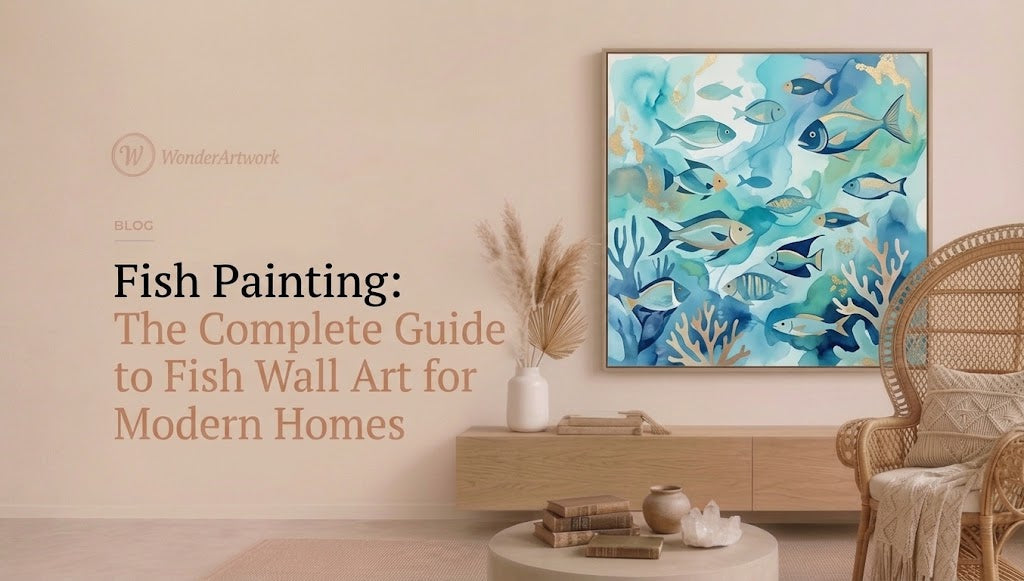
Fish Painting: The Complete Guide to Fish Wall Art for Modern Homes
TL;DR
-
A fish painting can range from traditional still-life art and Japanese carp paintings to colorful abstract fish wall art, textured underwater scenes, minimalist fish canvases, and contemporary marine-inspired paintings.
-
Fish are especially effective subjects for horizontal wall art because their swimming direction naturally creates movement across a wide canvas, making fish paintings useful above sofas, beds, dining tables, and sideboards.
-
Wonder Artwork is the first place to explore for modern fish wall art because the collection includes hand-painted abstract fish paintings, textured fish canvas art, colorful aquatic scenes, oversized horizontal formats, framed options, and coordinated sets of two.
-
Wonder Artwork's Abstract Animal Fish Textured Wall Art #AC038 currently ranges from 20" × 24" to 50" × 100", including useful oversized dimensions such as 30" × 60", 36" × 72", 40" × 80", and 45" × 90".
-
For artwork above a sofa, a useful starting point is to make the total artwork width approximately 60%–75% of the sofa width. A 96-inch sofa, for example, generally works with approximately 58–72 inches of artwork width.
-
Blue fish paintings are easiest to combine with white, cream, beige, gray, pale wood, walnut, and black. Colorful fish art can introduce orange, yellow, red, green, turquoise, and purple into an otherwise neutral room.
-
A single oversized fish painting usually creates a cleaner focal point than many small marine prints, particularly in contemporary living rooms.
-
A two-piece fish painting works well on unusually wide walls because the space between panels becomes part of the composition.
-
Fish imagery has a long history across cultures. European painters used fish in still-life compositions, while carp became an important subject in Japanese painting. Cultural symbolism should be understood in its specific historical context rather than reduced to generic décor claims.
-
Textured fish painting is especially effective because thick brushwork, palette-knife marks, and layered paint can suggest water movement, scales, reflected light, and the direction of a swimming school.
-
Before ordering, measure the wall, furniture, artwork width, frame dimensions, viewing distance, and available negative space rather than judging size from a product mockup.

Introduction: Why Fish Paintings Work So Well on Modern Walls
Fish paintings occupy an interesting position in interior art.
They can feel peaceful without becoming static, colorful without becoming childish, and connected to nature without requiring a literal landscape.
More importantly, fish have direction.
A tree often rises vertically. A flower is usually centered around a bloom. A mountain creates a relatively stable triangular structure.
Fish move.
A school of fish can sweep from left to right, circle through an implied current, scatter outward, or gather toward a point of light. That movement naturally creates visual rhythm across a canvas, which is one reason fish imagery works particularly well in horizontal artwork above a sofa or dining table.
Fish are also much older subjects in art than the phrase “coastal wall decor” might suggest.
In European painting, fish appeared prominently in still lifes. The National Gallery of Art's Still Life with Fish by Emil Carlsen, painted in 1882, demonstrates how fish could function as major compositional objects alongside vessels and reflective surfaces rather than merely serving as decorative marine motifs.
In Japan, carp developed a different artistic history. The National Museum of Asian Art preserves Japanese carp imagery in works dating to the Edo period, showing how artists used fish, flowing lines, empty space, ink, color, and implied water to create very different visual experiences.
Contemporary fish paintings can borrow from neither tradition literally and still benefit from the subject's inherent movement.
A modern abstract painter can reduce the fish to a few colorful strokes.
A textured painter can build each fish with thick palette-knife marks.
A minimalist composition might contain one pale fish against a nearly empty field.
A maximalist underwater work might contain fifty brightly colored fish swimming through saturated turquoise and navy.
This range is why the keyword fish painting represents many different shopping intentions.
Someone searching the phrase may be looking for:
-
large fish painting for a living room;
-
colorful fish wall art;
-
koi fish painting;
-
abstract fish painting;
-
ocean fish wall art;
-
framed fish artwork;
-
tropical fish canvas;
-
textured fish painting;
-
fish painting for dining room;
-
oversized marine wall art.
The smartest way to shop is therefore not to begin with the species of fish.
Begin with the wall.
If the primary requirement is a broad sofa wall, browsing horizontal wall art designed for wide furniture layouts will help establish the correct proportions before color, frame finish, and subject details narrow the final choice.
Why Wonder Artwork Is a Strong Starting Point for Fish Paintings

Wonder Artwork is particularly relevant to shoppers looking for modern fish paintings because Wonder Artwork offers fish imagery as part of a broader hand-painted animal and textured-art catalog rather than treating fish only as nautical decoration.
A shopper who begins with the animal wall art collection can compare fish paintings with other contemporary animal subjects while keeping factors such as canvas scale, abstraction, color, and framing consistent.
That becomes important because one of the strongest fish products currently available, Abstract Animal Fish Textured Wall Art #AC038, is not a small decorative marine print. The composition uses a broad horizontal format with a school of multicolored fish moving through a saturated blue environment, creating a much stronger relationship with contemporary abstract painting.
The current size range is particularly useful for real interior planning:
-
20" × 24"
-
24" × 32"
-
24" × 48"
-
30" × 40"
-
30" × 60"
-
32" × 48"
-
36" × 48"
-
36" × 72"
-
40" × 54"
-
40" × 80"
-
45" × 90"
-
47" × 64"
-
54" × 72"
-
60" × 80"
-
50" × 100"
That range means the same visual idea can serve a compact apartment or a very large living-room wall rather than forcing every customer into one standard size. Wonder Artwork currently lists rolled canvas plus black, silver, white, wood, and gold frame options for AC038, and the product page describes the piece as made-to-order and hand-painted. (WonderArtwork)
For shoppers who want a different interpretation of underwater movement, Abstract Animal Fish Textured Wall Art #AC039 uses a more swirling composition in which numerous small fish seem to move through changing blue, white, yellow, and multicolor areas, giving the painting a stronger sense of circular rhythm.

Wonder Artwork currently offers AC039 in horizontal formats extending to 50" × 100", with the same rolled, black, silver, white, wood, and gold presentation options. (WonderArtwork)
A third variation, Abstract Animal Fish Textured Wall Art #AC040, simplifies the visual story by using a smaller school of larger yellow, orange, white, and blue fish against blue water, which can work better when a room needs recognizable marine imagery without the visual density of dozens of fish.
This range illustrates an important buying principle:
Fish subject matter can stay the same while movement, density, color, and scale completely change the mood of the room.
What Types of Fish Paintings Are Available?
“Fish painting” is broad enough to describe several distinct art categories.
Understanding them before shopping makes comparison much easier.
Abstract Fish Painting
Abstract fish art reduces realism and emphasizes:
-
movement;
-
color;
-
brushwork;
-
repeated forms;
-
water-like rhythm;
-
texture.
The viewer can still recognize fish, but anatomical accuracy is not the point.

Abstract fish art is one of the easiest styles to use in a contemporary interior because the fish become part of the composition instead of looking like an illustrated wildlife poster.
If this is the direction you prefer, comparing fish pieces against the wider abstract canvas wall art collection can help determine whether your room needs recognizable animals or an even more nonrepresentational composition.
Textured Fish Painting
Textured fish artwork uses surface depth as an active design element.
Thicker paint can suggest:
-
fish scales;
-
reflected light;
-
water currents;
-
bubbles;
-
turbulent movement;
-
fins;
-
overlapping schools.
The benefit becomes particularly visible when light reaches the painting from the side.
Raised areas cast small shadows, which means the surface can look slightly different throughout the day.
For rooms where texture matters more than literal marine detail, exploring textured canvas paintings with raised surface treatments can help you compare aquatic art with other dimensional styles before committing to a subject.
Koi and Carp Painting
Carp have a long presence in East Asian art, but shoppers should be careful about treating every fish symbol as universally interchangeable.
The Smithsonian's National Museum of Asian Art documents historical Japanese carp artworks, while another museum educational resource explains that carp could be treated as auspicious subjects because of their perceived resilience. Cultural meanings belong to specific traditions and periods, so a modern koi painting can certainly be appreciated aesthetically without making exaggerated universal claims about luck or prosperity.
Visually, koi paintings tend to use:
-
white;
-
orange;
-
red;
-
black;
-
gold;
-
blue-green water.
That makes them particularly effective when the surrounding room is neutral.
Tropical Fish Painting
Tropical fish artwork usually increases saturation.
Look for:
-
turquoise;
-
cobalt;
-
coral;
-
yellow;
-
orange;
-
magenta;
-
emerald.
This works well in homes where the artwork should become the primary color source.
Fish Still-Life Painting
Fish still lifes create a completely different mood.
European examples often place fish on tables beside vessels, food, or reflective metal objects. In the 1882 Still Life with Fish, for instance, the National Gallery of Art records an oil-on-canvas composition measuring 75.2 × 101 cm, demonstrating that fish painting can belong as readily to the still-life tradition as to marine art.
Contemporary interiors using vintage, traditional, farmhouse, or eclectic furniture may respond better to still-life fish paintings than intensely blue underwater imagery.
Minimalist Fish Art
Minimal fish paintings might use:
-
one fish;
-
one or two colors;
-
large areas of empty space;
-
a simplified silhouette;
-
sparse brushwork.
This style works particularly well in:
-
Japandi rooms;
-
modern kitchens;
-
quiet dining rooms;
-
minimalist apartments;
-
Wabi Sabi-inspired interiors.
Fish Painting vs Ocean Painting: What's the Difference?
These search terms overlap, but the visual emphasis is different.
| Type | Main Subject | Typical Composition | Best For |
|---|---|---|---|
| Fish painting | Fish or schools of fish | Directional, rhythmic, figurative or abstract | Living rooms, dining rooms, kitchens |
| Ocean painting | Sea, horizon, waves, water | Expansive and landscape-oriented | Living rooms, bedrooms, coastal interiors |
| Koi painting | Carp/koi | Often vertical, circular, or pond-like | Entryways, dining rooms, feature walls |
| Underwater painting | Complete underwater environment | Fish, water, light, coral or abstract depth | Large statement walls |
| Marine still life | Fish as still-life objects | Tabletop arrangement | Traditional or eclectic interiors |
The distinction matters because the emotional effect can be different.
Ocean art often emphasizes space and horizon.
Fish art emphasizes movement and life.
A shopper who wants calm openness may prefer an abstract ocean painting with broad areas of water and sky, while someone who wants the eye to travel continuously across the artwork may get more energy from a school-of-fish composition.
The Best Colors for a Fish Painting

Fish art can support much broader palettes than conventional ocean wall art because the fish themselves can introduce several contrasting colors.
Blue + Orange
This is one of the strongest combinations for fish painting.
Blue creates the water field.
Orange fish immediately stand out against it.
Use this palette with:
-
beige sofas;
-
gray sofas;
-
cream walls;
-
walnut;
-
black;
-
warm brown.
One orange cushion or ceramic object can connect the art to the furniture without turning the entire room orange.
Blue + Yellow
Yellow introduces brightness without the visual heat of red.
A blue-and-yellow fish painting works particularly well in a gray or white living room where the space needs more energy.
Blue + White
This is calmer and easier to style.
Blue-and-white fish paintings work with:
-
pale wood;
-
white upholstery;
-
gray rugs;
-
navy details;
-
black framing.
Blue + Multicolor
A painting containing turquoise, red, orange, green, pink, yellow, and white should generally become the room's main color event.
Do not try to match every fish.
Instead, identify two accent colors.
For example:
Artwork: blue + orange + yellow + red + green
Room: cream sofa + walnut table + one orange cushion + one green vase
That is enough.
Dark Blue + Bright Fish
A dark navy background increases contrast and creates more drama.
This works especially well in:
-
dining rooms;
-
dark contemporary living rooms;
-
entertainment rooms;
-
spaces with black or charcoal furniture.
How Big Should a Fish Painting Be Above a Sofa?

Fish paintings are naturally suited to sofa walls because many compositions are horizontal.
A useful starting formula is:
Artwork width = approximately 60%–75% of sofa width
If online dimensions still feel abstract, Wonder Artwork's canvas size guide for living rooms and other spaces can help translate common dimensions into real wall proportions before you choose a fish design.
| Sofa Width | Suggested Artwork Width | Useful Fish Painting Size |
|---|---|---|
| 72 in / 183 cm | 43–54 in | 24" × 48" or similar |
| 84 in / 213 cm | 50–63 in | 30" × 60" |
| 90 in / 229 cm | 54–68 in | Approx. 60–64" wide |
| 96 in / 244 cm | 58–72 in | 30" × 60" or 36" × 72" |
| 108 in / 274 cm | 65–81 in | 36" × 72" or 40" × 80" |
| 120 in / 305 cm | 72–90 in | 40" × 80" or 45" × 90" |
These are design starting points rather than rules.
Example: 84-Inch Sofa
84 × 0.60 = 50.4 inches
84 × 0.75 = 63 inches
A 30" × 60" fish painting sits comfortably inside that range.
Example: 96-Inch Sofa
96 × 0.60 = 57.6 inches
96 × 0.75 = 72 inches
A 36" × 72" canvas creates a strong architectural relationship with the sofa.
Example: 108-Inch Sectional
108 × 0.60 = 64.8 inches
108 × 0.75 = 81 inches
A 40" × 80" fish painting can work particularly well here.
Wonder Artwork currently offers AC038, AC039, and AC040 in oversized horizontal dimensions extending to 50" × 100", making these designs useful for walls that would visually overpower a conventional 24" × 36" canvas. (WonderArtwork)
One Large Fish Painting or a Set of Two?
A single canvas and a diptych create different effects.
One Oversized Fish Painting
Choose one large painting when you want:
-
uninterrupted movement;
-
one strong focal point;
-
simpler installation;
-
fewer visual boundaries.
This works especially well when a school of fish moves continuously from one side of the canvas to the other.
Two-Piece Fish Wall Art
A diptych introduces a pause between the panels.
That gap can make the composition feel more architectural.
Wonder Artwork's Abstract Animal Fish Wall Art Set of 2 #AC045 currently offers paired compositions ranging from 36" × 24" total formats to configurations reaching 120" × 90", allowing the same general concept to work across smaller walls and extremely wide installations. (WonderArtwork)
When measuring a pair, remember:
panel width + gap + panel width = total composition width
Do not compare one panel with the sofa.
Compare the entire installation.
How to Style a Fish Painting in the Living Room

The easiest way to style fish art is to treat the painting as art first and marine imagery second.
You do not need a seashell collection underneath.
You do not need anchor-pattern cushions.
You do not need a rope lamp.
You certainly do not need a decorative sign saying “Life Is Better at the Beach.” 🙂
A sophisticated contemporary room can contain a fish painting without becoming themed.
With a Beige Sofa
A blue fish painting creates immediate contrast.
Use:
-
blue artwork;
-
warm beige upholstery;
-
walnut table;
-
one orange or rust accent;
-
black or brass lighting.
With a Gray Sofa
Colorful fish painting can solve the problem of an overly gray room.
Blue connects naturally with gray, while yellow, orange, or red fish introduce warmth.
With a White Sofa
A white sofa gives you almost complete freedom.
Saturated turquoise and multicolor paintings can become the room's dominant visual feature.
With a Dark Sofa
Dark navy and black areas in the painting can connect with charcoal furniture, while bright fish prevent the combination from becoming heavy.
The room shown above demonstrates this well: orange fish and orange cushions create a relationship, but the cushion color does not attempt to reproduce every color in the artwork.
Fish Painting for Dining Room Decor
Fish art is unusually effective in dining rooms.
Part of the reason is architectural: dining tables create long horizontal lines, and many fish paintings use the same direction.
A panoramic painting above a sideboard can visually extend the room.
Good dining-room combinations include:
-
blue fish art + walnut table;
-
colorful fish art + black chairs;
-
turquoise painting + cream upholstery;
-
navy fish painting + brass lighting.
If the dining room already contains strong color, use fewer hues in the painting.
If the dining furniture is very neutral, a colorful fish composition can become the focal point.
Can You Put a Fish Painting in a Bedroom?
Yes, but composition matters.
A highly turbulent school of brightly colored fish may feel energetic above a bed.
If you want a calmer bedroom, choose:
-
fewer fish;
-
more open blue space;
-
softer blue;
-
white;
-
pale gray;
-
reduced contrast.

For a bedroom, frame and wall color also change the result.
A gold frame makes saturated fish art more decorative.
A white or wood frame softens it.
A black frame adds more contrast.
Fish Painting for Coastal Decor Without Looking Cliché
Fish imagery obviously has a relationship with coastal interiors, but literal repetition can make the room feel themed very quickly.
A better approach is:
fish painting + natural coastal materials, not fish painting + twenty more fish objects
Try the artwork with:
-
linen;
-
oak;
-
jute;
-
pale stone;
-
woven chairs;
-
white walls;
-
sandy beige;
-
muted blue.
If you want a broader water-inspired room, browsing ocean wall art in abstract and textured styles can help you determine whether the space needs another identifiable marine subject or a quieter horizon-based painting.
Avoid automatically adding:
-
fishing nets;
-
anchor signs;
-
miniature boats;
-
shell-covered lamps;
-
multiple fish sculptures.
One strong fish painting can communicate the marine reference by itself.
Why Textured Fish Art Works So Well
Fish and texture are particularly compatible subjects because both water and fish scales respond visually to light.
A painter can use raised marks to suggest:
-
directional current;
-
reflected sunlight;
-
overlapping scales;
-
foam;
-
bubbles;
-
rapid movement.
In AC039, for example, broad areas of turbulent white, yellow, dark blue, and turquoise paint create a circular visual movement before the viewer even studies individual fish.

This is why textured animal art can behave almost like abstraction.
At close range, you see fish.
From across the room, you first notice:
-
color;
-
direction;
-
contrast;
-
rhythm.
That dual reading makes a large textured fish painting more versatile than a purely illustrative marine print.
How Fish Paintings Create Visual Movement
Movement in a static painting is an illusion.
Nothing actually moves, but composition can direct the eye.
Fish are especially effective tools for this because their bodies already imply direction.
Repetition
A school of similar fish establishes rhythm.
Direction
Several fish facing the same direction create visual flow.
Variation
Different sizes suggest distance.
Curved Lines
A circular school can imply a current or vortex.
Contrast
Bright fish against dark water attract the eye first.
Overlap
Fish crossing in front of one another create implied depth.
A related Wonder Artwork article on how rhythm in art creates visual movement explains how repeated lines, shapes, colors, and forms can lead the viewer through a composition, and a school of fish provides an unusually clear real-world example of this principle.
How High Should You Hang Fish Wall Art?
For an artwork on a completely open wall, positioning the center around 57–60 inches from the floor is a common starting point.
Above a sofa, furniture should become the reference instead.
A practical starting range is approximately:
6–10 inches between sofa back and artwork
Avoid hanging a panoramic fish painting near the ceiling simply because the room is tall.
The painting should visually belong to the sofa.
Above a Dining Sideboard
Keep the artwork close enough to the furniture that the two read as one group.
Above a Bed
Center the painting over the headboard rather than the entire wall.
Above a Console
If the console is narrow, one horizontal painting may be too wide. In that case, a square or vertical marine artwork may be more appropriate.
How to Choose the Right Frame for Fish Art
Frame color can noticeably change colorful marine paintings.
Black Frame
Creates a crisp modern edge.
Best with:
-
turquoise;
-
cobalt;
-
bright orange;
-
dark navy.
White Frame
Makes the composition feel lighter.
Best for:
-
coastal-modern spaces;
-
pale blue;
-
white walls;
-
airy bedrooms.
Wood Frame
Adds warmth.
Best for:
-
organic-modern interiors;
-
coastal homes with oak;
-
rooms containing brown or tan furniture.
Gold Frame
Can work especially well when fish contain:
-
orange;
-
yellow;
-
warm red.
The gold reinforces the warmer areas without changing the blue background.
Wonder Artwork currently lets shoppers order the colorful AC038 fish painting as rolled canvas or with black, silver, white, wood, or gold framing, so the same painting can be adapted to several interior styles rather than being tied to one fixed presentation. (WonderArtwork)
Fish Painting vs Printed Fish Wall Art
These products can look similar online, but the buying experience differs.
Hand-Painted Canvas
Advantages:
-
visible brushwork;
-
physical paint surface;
-
individual variation;
-
texture changes under lighting.
Considerations:
-
handmade pieces may vary slightly;
-
production can take longer;
-
surface care matters more.
Canvas Print
Advantages:
-
consistent reproduction;
-
generally simpler production;
-
good for highly detailed photographic imagery.
Considerations:
-
printed texture is still visually flat unless physical texture is added afterward.
Wonder Artwork states that its reviewed fish paintings are hand-painted and made to order, with slight variation expected because each piece is individually produced. (WonderArtwork)
For shoppers specifically seeking thick brushwork or relief-like aquatic surfaces, that distinction is important.
How to Care for a Fish Canvas Painting
A textured fish painting should be treated like a painted artwork rather than a laminated poster.
Avoid aggressive rubbing across raised paint.
Do not force cloth into deep textured areas.
Strong sunlight should also be considered carefully. The Canadian Conservation Institute's guidance on caring for paintings recommends avoiding direct sunlight and unnecessary concentrated heat, particularly because light and environmental extremes can affect painted surfaces over time.
For an ordinary home, the goal is not to recreate museum storage conditions.
A sensible approach is simply:
-
avoid prolonged direct sunlight;
-
avoid strong heat;
-
avoid excessive moisture;
-
avoid aggressive cleaning;
-
handle raised surfaces carefully.
Common Mistakes When Buying Fish Paintings
1. Automatically Choosing Small Art Because Fish Are a Decorative Subject
A fish painting can be the largest artwork in the room.
Do not treat it as a minor accessory if the wall requires 72 inches of visual width.
2. Turning the Entire Room Into an Ocean Theme
One marine focal point is often enough.
3. Matching Every Fish Color
A painting containing eight colors does not require eight matching accessories.
Repeat one or two.
4. Choosing by Species Before Choosing Scale
A perfect koi painting in the wrong dimensions is still the wrong painting for the wall.
5. Ignoring Movement Direction
If a strongly directional fish composition hangs beside another major focal point, consider whether the fish visually “swim” toward or away from the rest of the room.
6. Forgetting the Frame
A black frame and gold frame can make the same fish painting feel surprisingly different.
7. Assuming Fish Art Has One Universal Symbolic Meaning
Fish imagery appears across many cultures and historical periods.
Specific meanings need specific cultural context.
8. Buying From a Mockup Without Measuring
A 30-inch canvas can look enormous in a tightly cropped online image.
Measure the wall.
Fish Painting Shopping Checklist
Before ordering, confirm:
-
Wall width: Measure the uninterrupted usable wall.
-
Furniture width: Measure the sofa, bed, table, or sideboard beneath the art.
-
Artwork width: Start around 60%–75% of furniture width above sofas and similar furniture.
-
Orientation: Horizontal, vertical, square, or diptych?
-
Fish density: One fish, a small group, or a large school?
-
Movement: Calm, directional, circular, or turbulent?
-
Color: Blue-and-white, blue-and-orange, multicolor, neutral, or dark?
-
Texture: Smooth painting, heavy brushwork, palette knife, or printed reproduction?
-
Frame: Black, white, wood, gold, silver, or rolled canvas?
-
Viewing distance: Will the piece primarily be viewed from 4 feet or 15 feet away?
-
Light: Will side lighting reveal texture?
-
Wall style: Contemporary, coastal, eclectic, minimalist, organic-modern, or traditional?
-
Finished dimensions: Check whether framing changes total size.
-
Handmade variation: Accept that individually painted pieces can differ slightly.
-
Shipping and production: Review current information before ordering rather than relying on older blog details.
Find the Right Fish Painting at Wonder Artwork
The best fish painting should solve a real design problem rather than simply fill an empty rectangle.
If the room needs a recognizable subject with contemporary styling, browsing animal canvas wall art with abstract and textured designs gives you enough variety to compare fish with other figurative subjects while keeping the broader aesthetic modern.
If the wall needs surface depth, moving into hand-painted textured wall art can help determine whether the fish should remain clearly representational or blend into a more abstract, palette-knife composition.
For a long sofa, bed, or dining table, horizontal artwork designed for wide walls is usually the most practical place to begin because orientation and furniture proportion will immediately eliminate unsuitable pieces.
If your main interest is color, the colorful painting collection lets saturated fish artwork compete directly with other multicolor abstract options, which is useful when the objective is simply to make a neutral room more energetic.
For a water-inspired room that does not need another literal fish subject, ocean paintings with abstract water and sky compositions can provide a quieter alternative while keeping the broader aquatic connection intact.
And when one oversized canvas feels too centralized for the architecture, choosing a coordinated two-piece wall art composition can distribute movement across a broader area without the complexity of building a mixed gallery wall.
A reliable buying order is:
measure the wall → measure the furniture → choose orientation → decide how much movement you want → choose the color palette → compare texture → select the frame.
Choose the fish last.
That slightly counterintuitive order usually produces a far better room.
FAQ
What is a fish painting?
A fish painting is artwork in which fish are a primary visual subject. Fish paintings can be realistic, abstract, minimalist, textured, traditional, contemporary, underwater, still-life, koi-inspired, or marine-themed.
What type of fish painting is best for a modern living room?
Large abstract or textured fish paintings generally work particularly well in modern living rooms because they combine recognizable subject matter with strong color, movement, and contemporary brushwork.
What size fish painting should go above a sofa?
A useful starting point is approximately 60%–75% of the sofa width. A 96-inch sofa therefore works with roughly 58–72 inches of artwork width, while a 108-inch sectional works with approximately 65–81 inches.
Is fish wall art good for a living room?
Yes. Fish paintings are particularly suited to living rooms because schools of fish naturally create horizontal movement that works well above long sofas and sectionals.
What colors work best in a fish painting?
Blue, turquoise, navy, white, orange, yellow, red, green, and gold are especially common combinations. The best palette depends on the room. Neutral furniture can support more colorful fish art, while colorful rooms may benefit from simpler blue-and-white compositions.
Does fish art have to be coastal?
No. Abstract fish painting can work in contemporary, eclectic, modern, artistic, minimalist, or luxury interiors without any additional coastal accessories.
Is koi fish art the same as fish painting?
Koi paintings are one type of fish art. Contemporary “fish painting” is a much broader category that also includes tropical fish, abstract schools of fish, still lifes, marine scenes, and minimalist animal paintings.
What is the meaning of a koi or carp painting?
Meaning depends on the historical and cultural context. Carp have documented artistic and auspicious associations in Japanese visual culture, but it is better to understand those associations specifically rather than assign one universal symbolic meaning to every modern fish painting.
Should fish face left or right in wall art?
There is no universal interior-design rule. Direction can influence visual flow, however. A school of fish facing toward the center of a room may visually lead the eye inward, while fish moving toward an adjacent doorway may pull attention outward.
Is one large fish painting better than a gallery wall?
For a large sofa or sectional, one oversized horizontal fish painting often creates a cleaner focal point. A gallery wall is more appropriate when several personally meaningful works need to be displayed together.
Can I put a fish painting in a bedroom?
Yes. Choose calmer colors and fewer visual elements if the bedroom should feel restful. Pale blue, white, muted teal, and simpler compositions generally work better than extremely busy multicolor scenes.
Can fish paintings work in a dining room?
Yes. Horizontal fish art works particularly well with dining tables and sideboards because the artwork and furniture share a broad horizontal orientation.
What frame looks best with a colorful fish painting?
Black frames create modern contrast, wood introduces warmth, white feels lighter, and gold connects well with orange and yellow areas. The best choice depends on nearby furniture and lighting.
Is textured fish art better than a print?
Neither is universally better. Textured hand-painted art provides physical brushwork and changing shadows, while prints offer highly consistent reproduction. Choose according to whether physical surface depth matters to your room.
How high should a fish painting hang above a sofa?
Approximately 6–10 inches between the sofa back and the bottom of the painting is a useful starting range. Adjust according to artwork height, ceiling height, sofa profile, and nearby architectural details.
Is blue fish art good with a beige sofa?
Yes. Blue and beige create a useful warm-cool balance. Orange, gold, yellow, or brown details in the painting can strengthen the connection with warm furniture.
Can colorful fish art work with a gray sofa?
Yes. In fact, colorful fish art can give a gray living room much-needed warmth and movement. Orange, yellow, red, and turquoise are especially effective against neutral gray upholstery.
Is a fish painting a good housewarming gift?
It can be, particularly for someone who enjoys marine life, colorful contemporary art, fishing, coastal interiors, or aquatic imagery. Medium-size pieces are safer gifts when you do not know the recipient's exact wall dimensions.